
The best commercial office cleaning company for your building is the one that can show you its scope, its supervision, and its results before you sign. This guide gives property managers ten specific things to look for, a weighted scorecard to rate every bidder, and a plan for catching service drift before your tenants do.
Citi Cleaning Services has cleaned Central Florida office properties since 2004. In that time we have seen what tenants notice first, and we have seen why a vendor that shines in month one can slip by month six.
You will learn how to read a scope of work, which metrics predict tenant satisfaction, and how to test a bidder’s inspection system. First, a quick look at the ten items on the list.
Key Takeaways
- Insist on an office-specific scope written as areas, tasks, and frequencies.
- Ask about multi-tenant experience. Common areas and tenant suites need different access and rhythms.
- Look for a named supervisor and a written inspection cadence, not a promise to “stay on top of it.”
- Plan for month six. Crew turnover and fading attention cause most quality drift.
- Track tenant-facing metrics: complaint rate, response time, inspection scores, and tenant retention.
- Score every bidder on the same weighted scorecard so price does not decide alone.
A good commercial office cleaning company hands you a scope that lists every area, every task, and how often each happens. A generic “we clean everything” proposal is a warning sign.
Offices have a distinct rhythm. Restrooms, break rooms, lobbies, elevators, and conference rooms get daily attention, while private offices and storage rooms may need only a lighter pass.
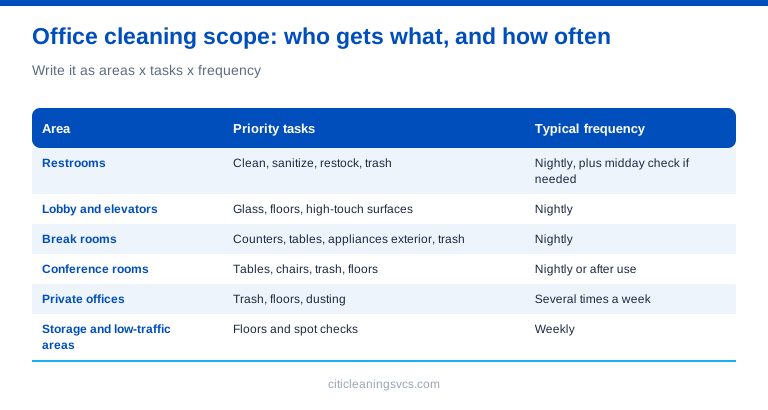
Ask to see the scope as a table. If a task is not written down, you cannot inspect it, and you cannot hold anyone to it.
Our post on how to read a cleaning proposal shows what a complete scope looks like, line by line.
Red flag: a proposal that says “all areas” without naming restrooms, lobbies, or conference rooms leaves the crew to decide what counts.
What good looks like: the vendor walks the building with you, marks the plan on a floor map, and measures each area. That walkthrough turns guesses about square footage into a scope both sides can inspect.
Choose a vendor that already cleans buildings like yours. Multi-tenant offices add complications that single-tenant sites do not have.
Common areas belong to the property, while suites belong to tenants who may have their own preferences, alarms, and access rules. A vendor who understands that split avoids the avoidable mistakes, such as a locked suite left uncleaned or an alarm tripped at midnight.
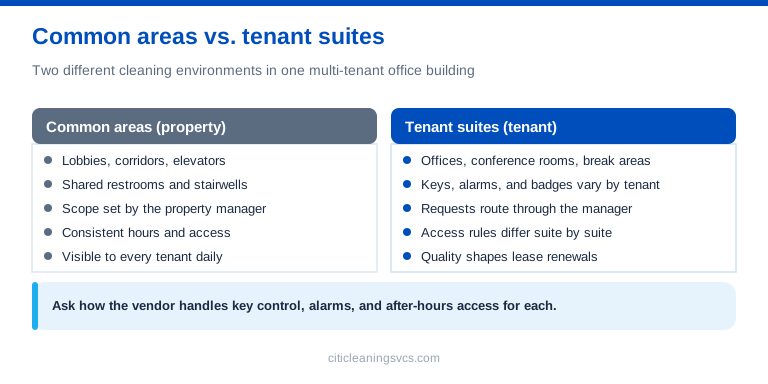
Ask how the vendor handles key control, after-hours entry, and tenant requests that arrive through the property manager. The answers reveal whether the process is built or improvised.
Our office building cleaning page describes how we approach those properties.
Red flag: a vendor whose references are all single-tenant warehouses or retail stores may not understand lobby traffic, tenant move-ins, or shared restrooms.
What good looks like: references from managed office buildings, plus a clear process for tenant requests. Ask for two property managers you can call.
Look for a vendor that names the person responsible for your building and shows you how often that person inspects. Supervision is what turns a scope on paper into clean floors at 7 a.m.
Ask for the inspection form. A useful one lists areas, scores each one, records deficiencies, and states who fixes them by when.
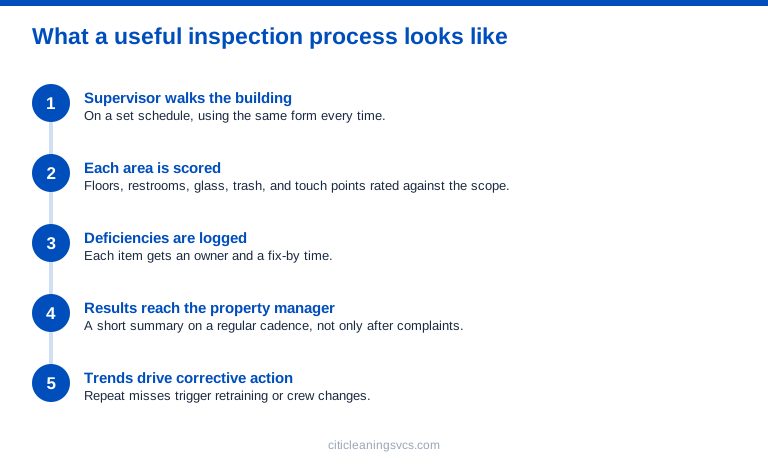
Then ask who sees the results. The strongest arrangement shares inspection scores with the property manager on a set schedule, so you never learn about a problem from a tenant first.
Supervision also protects your crew assignments. A supervisor who knows the building notices when a new cleaner misses the third-floor restrooms.
Red flag: a supervisor who covers so many buildings that visits happen only after a complaint.
What good looks like: a visit schedule you can verify, a log of findings, and a supervisor whose phone number the property manager actually has.
Every bidder looks good in month one. The right question is what keeps quality steady in month six, when the proposal team has moved on and the first crew has turned over.
Drift usually comes from three causes: crew turnover, supervisors stretched across too many sites, and supply shortages that nobody reports. A strong vendor can explain how it prevents each one.
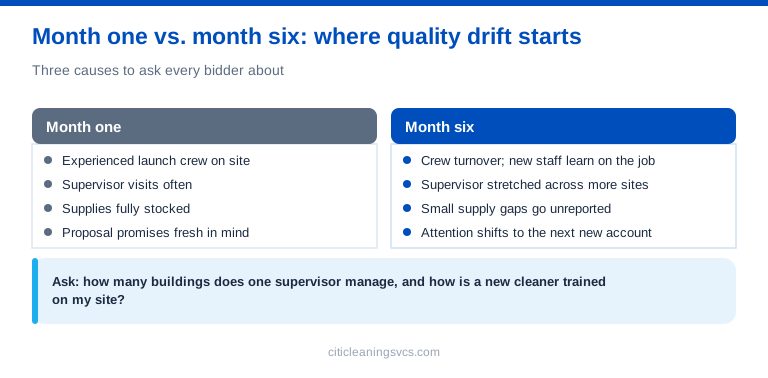
Ask for specifics. How many buildings does one supervisor manage, how is a new cleaner trained on your site, and how are supplies tracked?
Red flag: a vendor that cannot explain how it trains a replacement cleaner. That gap shows up as missed tasks within weeks of a staffing change.
If the answers are vague, plan to run a 90-day check-in yourself. Our guide on how to know you have hired the wrong commercial cleaning service lists the early warning signs.
Stable crews clean better, because people who know a building catch problems that new people miss. Ask how long the average crew member has worked for the company and how long they have been on your type of building.
Then ask about screening. Background checks, reference checks, and a documented onboarding process matter in an office where cleaners work among laptops, files, and badges.
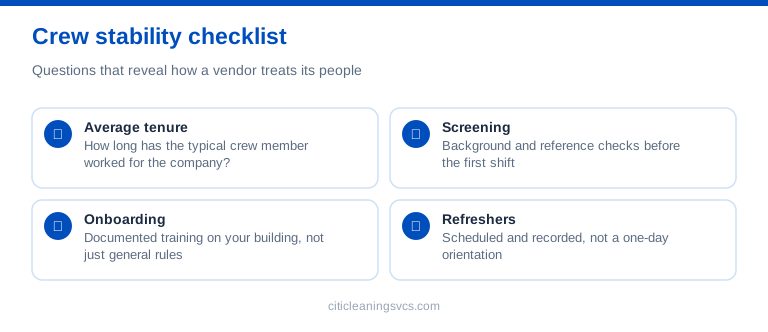
At Citi, we maintain a team of more than 70 trained professionals, and our client relationships average more than ten years. That retention exists because stable crews produce steady results.
Training should be ongoing, not a one-day orientation. Ask how often refreshers happen and whether they are documented.
Training should be ongoing, not a one-day orientation. Ask how often refreshers happen and whether they are documented.
Red flag: heavy reliance on temporary labor for a site that needs consistency, especially where cleaners work near files, laptops, and badge-controlled areas.
What good looks like: a core team assigned to your building, a trained backup for every route, and a supervisor who introduces new people to the property manager.
A reliable vendor follows federal chemical-safety rules and can prove it. OSHA’s Hazard Communication standard requires employers with hazardous chemicals to provide labels and safety data sheets and to train exposed workers to handle them.
Ask to see the training log and the data sheet binder. Both should exist for every product used in your building.
On sanitizing, the Centers for Disease Control and Prevention advises cleaning high-touch surfaces regularly, and cleaning surfaces before sanitizing or disinfecting them. The CDC’s page on when and how to clean and disinfect a facility lists examples such as door handles, elevator buttons, and desks.
Red flag: unlabeled spray bottles, no data sheet binder, or a cleaner who cannot say which product goes on which surface.
What good looks like: labeled products, a posted data sheet binder, and a short training record for each crew member.
Those two sources set the baseline for a safe program. A Green Seal-aligned approach, like ours, builds the same habits into daily routines.
Ask for the certificate of insurance and read the coverage limits yourself. Then read the contract for how either side can end the arrangement.
Long lock-ins and automatic renewals protect the vendor more than the building. A clean exit clause protects you if quality slips.
Many property managers prefer arrangements without long-term commitments. We work contract-free, and our post on the benefits of contract-free commercial cleaning explains how that changes vendor behavior.
Red flag: automatic renewals, steep termination fees, or a clause that makes you pay for a full term after a documented failure.
For a full list of clauses to check, see what should be in a cleaning contract.
What tenants notice is simple: clean restrooms, tidy lobbies, and fast answers when something goes wrong. Your vendor should measure all three.
Ask which metrics the vendor reports. Four predict tenant satisfaction better than any sales claim.
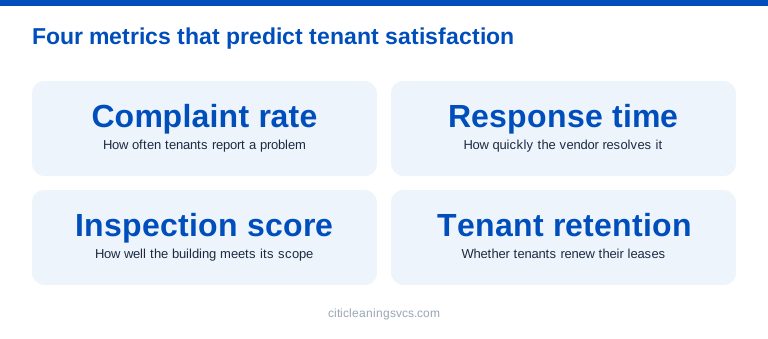
Complaint rate shows how often problems occur. Response time shows how quickly the vendor fixes them.
Inspection scores show whether the building meets the scope. Tenant retention shows whether the whole system keeps people happy enough to renew.
Agree on the reporting format before you start. A one-page monthly summary is usually enough.
Agree on the reporting format before you start. A one-page monthly summary is usually enough.
Red flag: a vendor with no way to log complaints, so problems live in email threads and nobody sees the pattern.
What good looks like: a single point of contact, a response-time target, and a monthly summary that shows trends instead of anecdotes.
Pricing is transparent when two bids with the same scope can be compared line by line. If one bid lists tasks and another lists only a total, you are comparing a plan to a guess.
Commercial office cleaning is typically quoted per square foot, per hour, or as a flat monthly fee. Square footage, restroom count, visit frequency, and service hours drive the final number.
Red flag: a bid that is far below the others without a clear reason. Ask what is missing from the scope, the supervision, or the supplies.
Resist picking the lowest bid by default. A lower number often means fewer tasks, fewer supervisor hours, or less training.
Our guides on how to compare commercial cleaning bids and how much commercial cleaning costs walk through the drivers without making up a rate.
The best cleaning schedule fits your building, not the other way around. Hours, access rules, and security protocols should shape the plan.
Some offices need nightly cleaning after the last tenant leaves. Others benefit from a daytime presence for restrooms and lobbies.
If you are weighing options, read our comparison of day porter vs. night porter services. A day porter can handle restroom checks and spill response while the main crew works overnight.
Finally, confirm availability. We serve facilities around the clock, which matters when a tenant event or a weather disruption changes the schedule.
Finally, confirm availability. We serve facilities around the clock, which matters when a tenant event or a weather disruption changes the schedule.
Red flag: a vendor that cannot explain how it handles keys, alarm codes, and badge access after hours.
What good looks like: written access procedures, a check-in and check-out log, and a plan for the first night in a new building. Our janitorial services page outlines how we structure those routines.
Tenants notice restrooms, lobbies, and trash within seconds. They rarely mention a perfectly vacuumed corner, but they always remember a restroom that ran out of soap.
That means your scorecard should weight visible, high-frequency items heavily. A missed detail under a desk matters less than a dirty sink in a shared restroom.
Tenants also notice how problems get handled. A same-day response to a spill or a missed refill often builds more goodwill than a flawless week.
Property managers can use this to their advantage. Share the top five tenant-visible items with your vendor and ask for a simple daily confirmation.
The first 90 days set the pattern for the whole relationship. A short, scheduled review at 30, 60, and 90 days catches drift while it is still easy to fix.
At 30 days, compare inspection scores to the scope and confirm that supply stocking and access procedures are working. At 60 days, review complaint rate and response time with the supervisor.
At 90 days, walk the building with the supervisor and the lead cleaner. Ask what slowed them down, what the building needs, and what they would change.
Document each review in a single page. That record becomes your evidence if quality changes later, and it signals that you expect a managed service.
A weighted scorecard keeps the decision about the building instead of the lowest number. Assign weights before bids arrive, then score every vendor the same way.
The sample below is a starting point. Adjust the weights to match your building’s priorities.
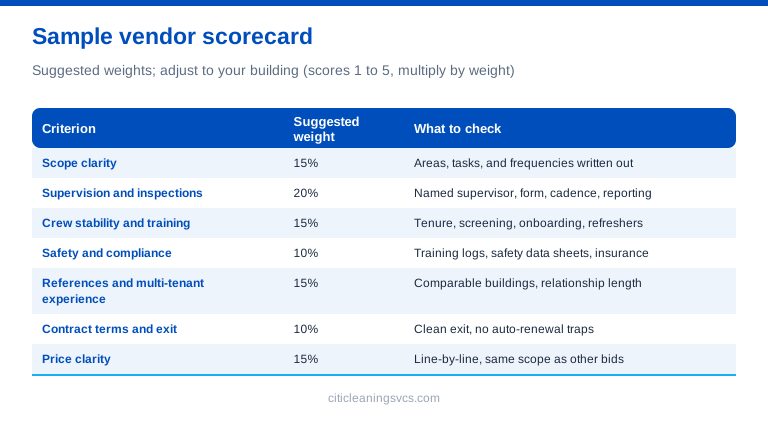
Run the scorecard with two people if you can. Independent scores expose blind spots and make the final conversation shorter.
For more on structuring that comparison, see our guide to selecting a janitorial service provider, or browse our property manager’s guide to vendor selection.
Cost depends on square footage, restroom count, visit frequency, and service hours. Providers quote per square foot, per hour, or as a flat monthly fee, so compare bids that share the same scope.
Most occupied offices are cleaned nightly or several times a week. Restrooms, break rooms, and lobbies need the most frequent attention.
Standard service covers trash removal, restroom cleaning, break room care, floor maintenance, and surface cleaning. Periodic work such as floor refinishing is added by agreement.
It should include the scope, frequencies, insurance requirements, inspection process, and a clear way for either side to end the arrangement. Our contract guide lists the clauses to check.
Watch for rising tenant complaints, slower response times, falling inspection scores, and more supply shortages. A scheduled 90-day review catches these trends early.
Yes. Request the certificate of insurance and confirm the limits fit your lease and tenant requirements.
Night cleaning avoids disrupting tenants, while a day porter handles restroom checks and spills during business hours. Many buildings use both.
The right commercial office cleaning company shows its scope, its supervision, and its results before you sign. It measures what tenants notice and it explains how quality survives past the first month.
Use the ten items above as your filter and the scorecard as your tiebreaker. That combination keeps the decision about performance.
