
Contract-free commercial cleaning means your janitorial vendor earns your business every single month — no 3-year lock-in, no auto-renewal traps, no early-termination penalties. In an industry built on long paper contracts, a small group of Central Florida providers has chosen to compete on service quality instead of signature ink. This post breaks down five specific benefits, when they matter most, and the questions to ask before you switch.
You will learn why 3-year contracts protect the vendor more than the facility, how month-to-month arrangements actually deliver higher retention than locked-in ones, what happens to pricing when the vendor cannot rely on a contract, the flexibility payoff for seasonal or fluctuating businesses, and the exact clauses to watch for when a vendor claims to be “contract-free” but is not.
By the end you will know whether contract-free is right for your facility, which situations still warrant a longer paper agreement, and the exact language to request in the service level agreement that replaces the traditional multi-year contract.
Key Takeaways
- Contract-free cleaning means 30-day cancellation on either side — no lock-ins, no early-termination fees.
- Locked-in contracts protect the vendor’s cash flow; they rarely protect the customer’s quality.
- Month-to-month arrangements actually generate longer client relationships when quality holds — retention is earned, not contracted.
- Pricing is competitive — contract-free vendors do not charge a “flexibility premium” when they operate efficiently.
- Seasonal businesses benefit most: scale up for peak, scale down without penalty during slow months.
- Read the fine print — some “contract-free” vendors bury multi-month cancellation windows or renewal auto-locks.
The single biggest complaint from facility managers about locked-in cleaning contracts is being unable to leave a vendor whose quality has slipped. Signatures on a 3-year agreement give the vendor 36 months of guaranteed revenue whether they perform or not.
Contract-free arrangements flip this dynamic. Your vendor knows every month is an audition. If quality slips, you leave with 30 days notice. The vendor’s incentive structure is aligned with your outcomes — perform every night, keep the account.
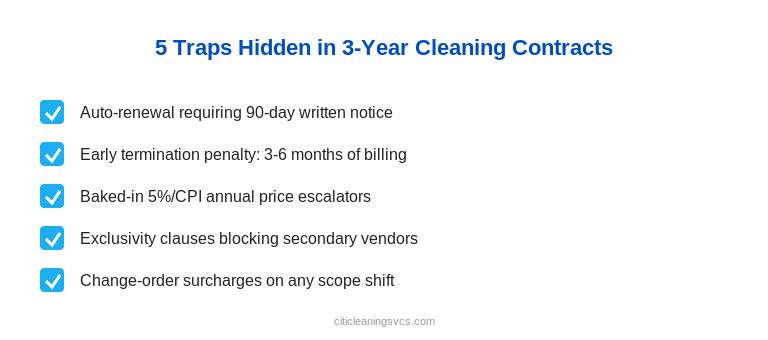
None of these clauses appear in a true contract-free service agreement. The service level agreement stands on its own — quality expectations, response times, coverage hours, insurance — without a term binding you to keep paying if the vendor stops delivering. For a full breakdown, see our guide on what should be in a cleaning contract.
Vendors with 3-year locked contracts routinely staff their B and C-tier accounts with newer or less-experienced crews once the ink is dry — because there is nothing you can do about it for 34 more months. Contract-free arrangements eliminate that dynamic.
Every night is a fresh evaluation. Every complaint is a real risk to the account. The crews assigned to contract-free clients tend to be the vendor’s most experienced, because the vendor cannot afford to lose the account through mediocre service. This is one of the least-understood benefits of month-to-month cleaning — the crew quality is often higher, not lower.

Track three metrics monthly. Any contract-free vendor should welcome this scoreboard.
For inspection frameworks, our red flags guide covers what to watch for, and our how to read a cleaning proposal guide shows how quality expectations should be written into the SLA.
A common myth about contract-free cleaning is that vendors charge a “flexibility premium.” In practice, contract-free rates in Central Florida run identical to or slightly below traditional multi-year contract pricing. The reason is structural: vendors who operate efficiently and staff W-2 employees do not need long contracts to protect cash flow. They earn retention through consistent service.
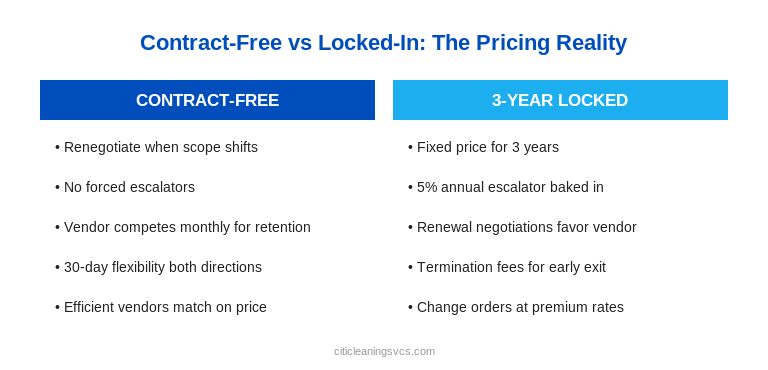
Month-to-month arrangements let you renegotiate when scope shifts — good for the vendor when you add square footage, good for you when you close a wing. Neither side is trapped. See our companion piece on why we go contract-free for the operational rationale.
Retail, hospitality, event venues, seasonal manufacturing, and businesses in growth or contraction phases benefit the most from contract-free cleaning. Traditional multi-year contracts assume a stable facility — a bad assumption for many Central Florida operations.
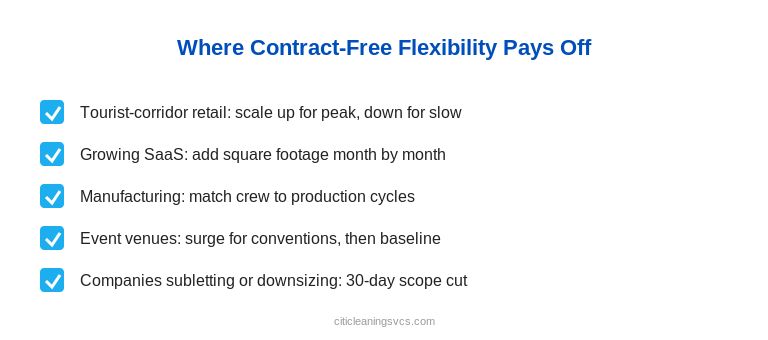
Locked-in vendors handle scope changes with change-order paperwork and premium rates. Contract-free vendors handle them with a phone call and a revised SLA. The ISSA industry data shows facilities with variable demand save 8–15% annually by avoiding capacity they do not need. For facilities that also compare bids across vendors, our how to compare commercial cleaning bids guide covers the SLA vs. contract-length tradeoff line by line.
The counterintuitive part: contract-free vendors typically post longer average client retention than locked-in vendors. The reason is simple — when the client is not forced to stay, the ones who stay are choosing to. That signals a working relationship.
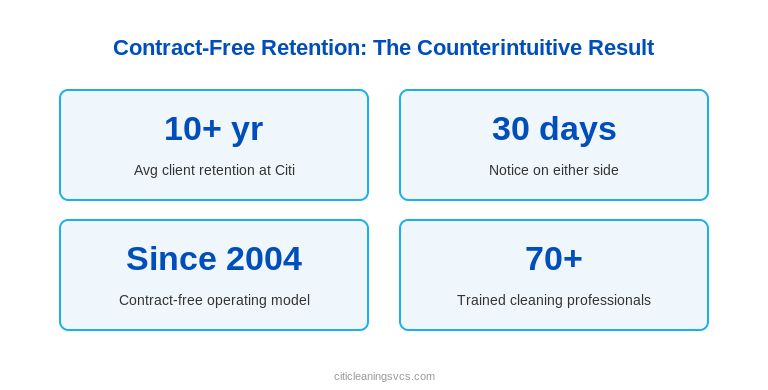
Citi Cleaning Services has operated contract-free since founding in 2004 and posts a 10+ year average client retention across the book — well above industry averages that tend to churn at 3-year contract end points. When a locked-in client’s term ends, they often shop. When a contract-free client is happy, they simply stay.
Retention that comes from choice is a stronger signal of vendor quality than retention that comes from contract lock-in. Facility managers who understand this pattern often prefer contract-free precisely because it filters for vendors confident enough to compete monthly. Related reading: what property owners need from a janitorial partner.
Contract-free is not universally better. A small number of situations call for a longer agreement. Being honest about them is part of a real evaluation.
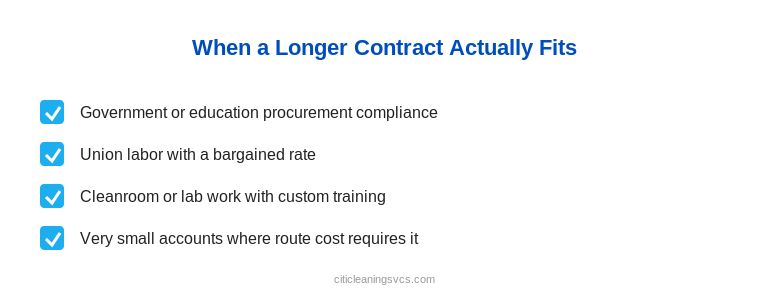
For most commercial offices, warehouses, retail plazas, medical offices, and hospitality properties in Central Florida — contract-free is the better structural fit.
Citi Cleaning Services is a family-owned, minority/women-owned (M/WBE) Central Florida provider that has operated contract-free since 2004, with 70+ trained pros and 10+ year average client retention. All crews are OSHA-certified and Green Seal-aligned. Coverage runs 24/7 across Orange, Seminole, Lake, and Osceola counties. Phone: (407) 540-1850. See our homepage and our commercial janitorial services guide for the full picture.
“Contract-free” does not mean “no paperwork.” A real month-to-month arrangement replaces a term commitment with a strong service level agreement that defines quality, response, and coverage — without binding you to a term.
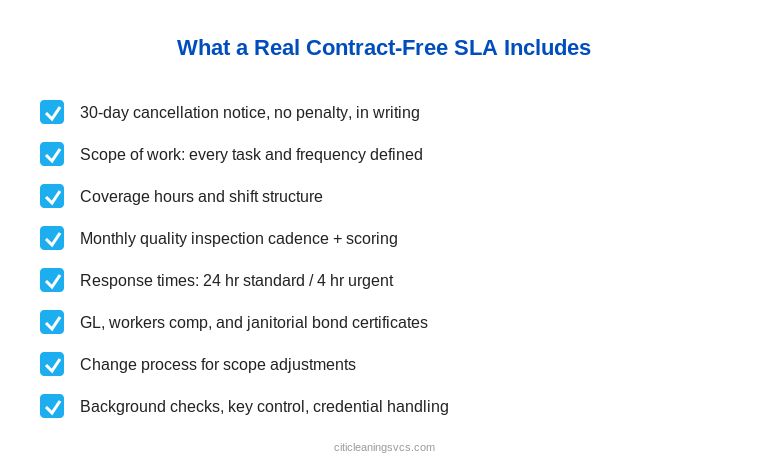
Nothing in the list above requires a multi-year term commitment. The Occupational Safety and Health Administration compliance responsibilities and standard commercial cleaning best practices all live inside the SLA regardless of contract length.
It means either party can cancel with 30 days notice — no lock-in, no early-termination penalty, no auto-renewal. A written service level agreement still defines quality, scope, and insurance requirements.
No. Central Florida contract-free rates run identical to or slightly below traditional multi-year pricing. Efficient vendors do not need long contracts to price competitively.
Locked-in contracts protect the vendor’s cash flow and make it harder for clients to switch. They are structurally better for the cleaner, not the customer.
Seasonal retail, hospitality, event venues, growing companies adding office space, and any facility with variable demand. Also facilities that have been burned by unresponsive vendors under long contracts.
By earning retention through quality. A well-run vendor’s average client stays 5–10+ years by choice, not contract — which is longer than most 3-year lock-ins get renewed.
Yes — some vendors call themselves contract-free but bury 60 or 90 day cancellation windows or auto-renewals in the fine print. Ask for a plain-English 30-day cancellation clause in writing.
Most Central Florida transitions run 14–30 days. If you are inside a locked contract, review the termination clause carefully — some allow exit for non-performance.
Yes. Contract-free arrangements scale to multi-location portfolios and 100,000+ sq ft single sites. The SLA and pricing structure carry the relationship regardless of size.
