
Your commercial cleaning company was supposed to make your building look sharp, keep tenants happy, and take work off your plate. If any of those three promises are slipping, you already know something is wrong. The question is whether you should coach the vendor through it or start the switching process today.
We have watched this pattern play out for more than 20 years serving Central Florida facility managers, and the warning signs are almost always the same. Below are 10 red flags that a commercial cleaning company is failing you, paired with a switching timeline you can run in under 30 days without disrupting operations.
The tenth red flag alone justifies a vendor change, and most facilities we audit are dealing with at least four of them at once.
Key Takeaways
- Restroom appearance is the single fastest tenant-complaint driver and the earliest signal a cleaning program is breaking down.
- Recurring complaints, missing supervisors, and silent turnover usually mean the vendor is under-staffing your building to protect margin.
- Missing insurance certificates or lapsed COIs shift risk onto your property owner and are grounds for immediate termination in most contracts.
- Four or more red flags together means switching is the right move, and a clean transition can be completed in 21 to 30 days.
The fastest way to tell a cleaning program is failing is to walk your busiest restroom at 4:30 PM. If the floor near the urinals is streaked, the dispensers are half empty, or the mirrors show water spots, the crew is either skipping the mid-day touch-up or the scope was written without a day-porter component.
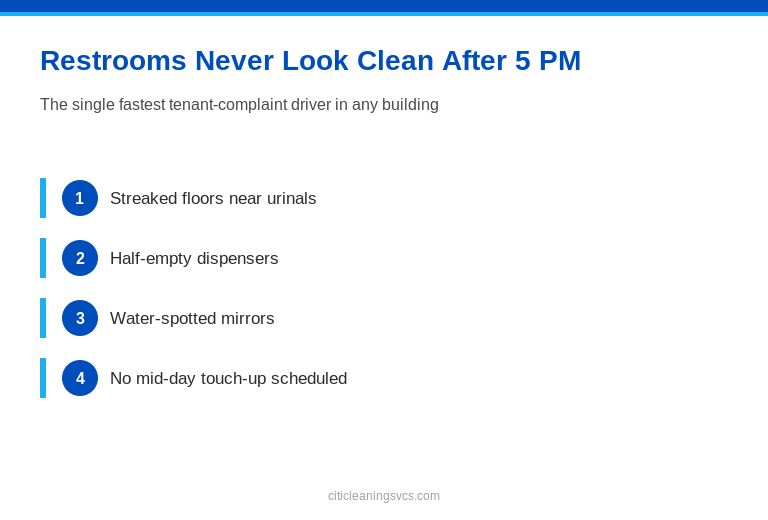
Restrooms are where tenants form 80% of their opinion about a building. A single dirty restroom generates more complaints than an entire floor of dusty desks. This is not a small oversight — it is the leading indicator that scope, staffing, or supervision has broken down.
If two of the three are failing, the vendor is under-scoping the job. Fix the scope in writing or begin your switching evaluation.
Every cleaning program has a bad night. What separates a good vendor from a failing one is whether the same complaint appears twice. A trash can that is missed once is human error. A trash can that is missed three Fridays in a row is a systems failure.
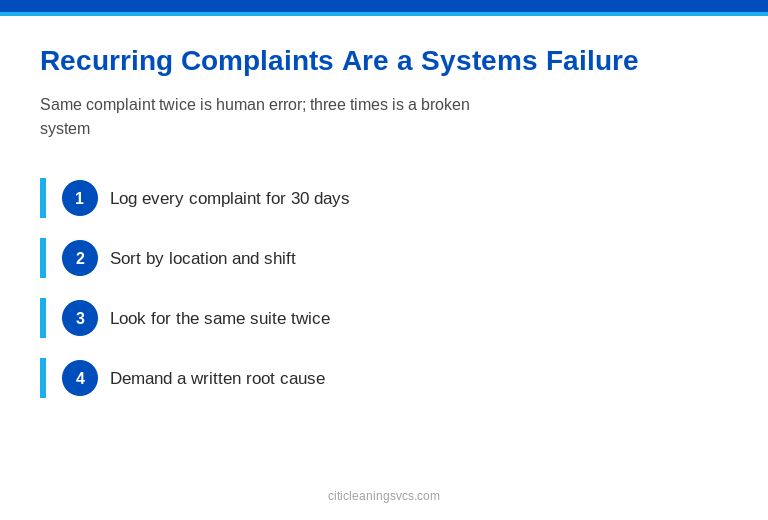
Log every complaint for 30 days and sort them by location and shift. If the same suite, the same restroom, or the same conference room appears more than twice, the vendor has a training or supervision gap they are not closing. This is the second-highest predictor of a vendor breakup, right after restroom failures.
Track complaints in a shared spreadsheet with these five columns: date, location, complaint, cleaner assigned, resolution. Share it with the vendor at day 15. If the vendor cannot map a root cause and a corrective action by day 30, you have your answer.
Facility managers using this method reduce repeat complaints by roughly 60% within one quarter — either with the current vendor or the next one.
A cleaning crew without a supervisor is a crew without accountability. When a vendor bids a job at a low price, the first line item they cut is on-site supervision. Instead of a working supervisor walking your building three or four nights a week, you get a district manager who visits once a month with a clipboard.
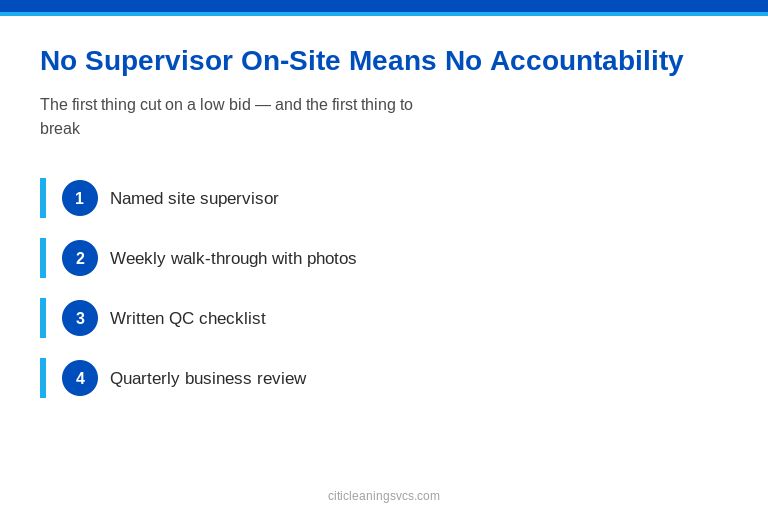
Ask when the last supervisor walk-through happened, and ask to see the punch list. If the answer is vague or the punch list does not exist, the supervision layer is missing. That gap is what allows problems 1 and 2 to persist.
Citi Cleaning Services builds every account around a working supervisor plus a dedicated account manager, because the math on quality assurance falls apart without both. We are a family-owned, M/WBE-certified operation with 20+ years of experience and 70+ trained professionals — supervision is the layer that makes the rest of the program run.
You should not have to re-explain your building to a new cleaner every 30 days. When crew turnover is that high, the vendor is losing the tribal knowledge that keeps your program running — which door codes work, which suite has a sensitive server room, which tenant hates the smell of citrus cleaner.
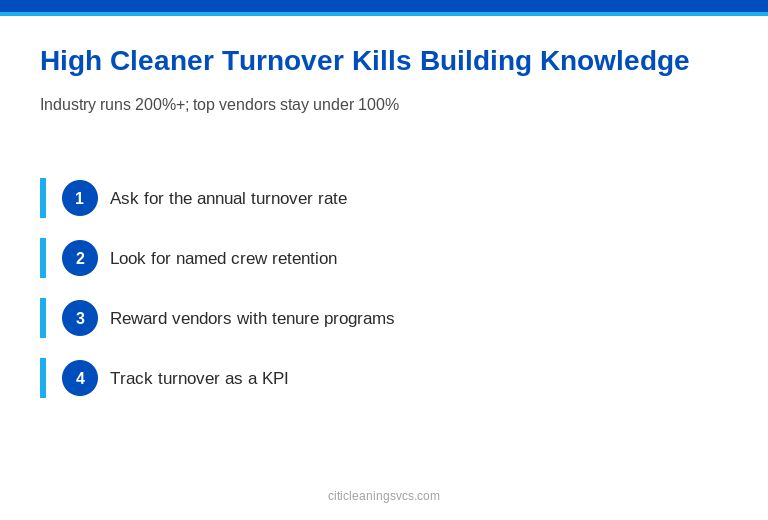
Industry-wide turnover in commercial cleaning runs above 200% annually, according to ISSA. Vendors who pay competitively and offer real supervision run closer to 50%. Ask your current vendor what their annual turnover rate is. If they will not answer, that is the answer.
A 10-person crew that has been in your building for three years will outperform a 15-person crew that turns over twice a year. Citi maintains a 10+ year average client retention rate because we invest in the crew before we invest in the sales pipeline.
If your only proof that cleaning happened last night is that the trash is gone, you have no program — you have a hope. Modern commercial cleaning vendors run digital sign-in, task-completion logs, and photo-based quality control that you can pull up in a portal.
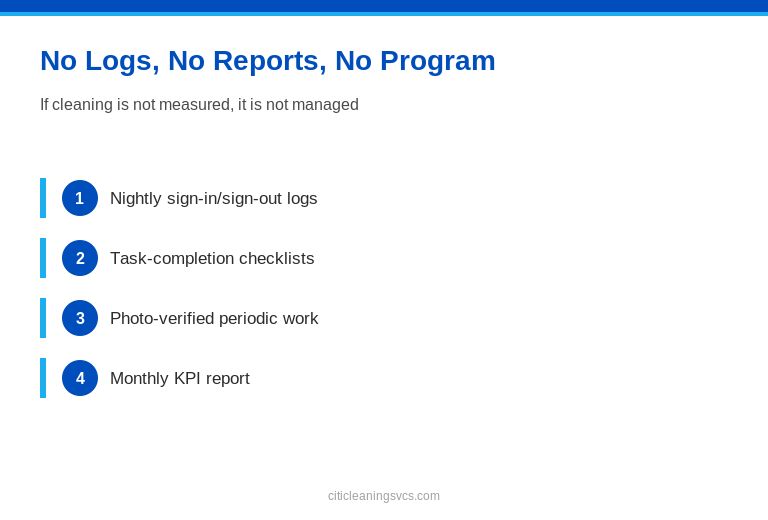
When a vendor cannot show you last week’s task log, they are not tracking what their own crew is doing. That means they cannot coach a struggling cleaner, cannot prove SLA compliance, and cannot defend the contract if you dispute an invoice. It is a red flag on operations and on billing at the same time.
Empty paper towel dispensers, missing hand soap, no toilet paper on a Monday morning — these are the calls that erode tenant trust the fastest. A functioning vendor tracks supply usage as a leading indicator and reorders on a par level, not on a “when we notice” basis.
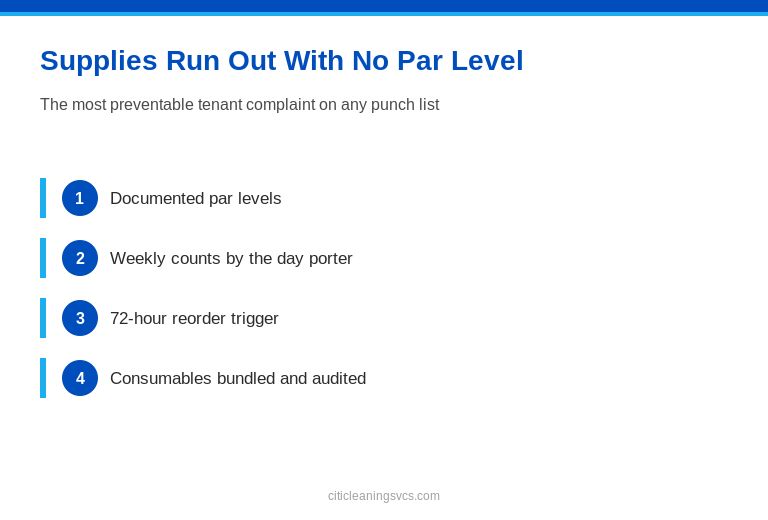
When you catch a “we ran out” three times in a quarter, ask to see the vendor’s par-level chart. If one does not exist, the vendor is running your consumables program on guesswork. That is a hidden cost of the current relationship: staff time spent chasing supply issues that a proper inventory model would prevent.
Documented par levels per fixture, weekly counts logged by the day porter or lead cleaner, and a 72-hour reorder window on any item that drops below the trigger. Vendors who bundle consumables into the monthly rate should be able to prove they are not skimming — the log is the proof.
Every commercial cleaning vendor should be able to email you a current Certificate of Insurance and OSHA compliance summary the same day you ask. If yours cannot, you are carrying risk that belongs on the vendor’s books, not yours.
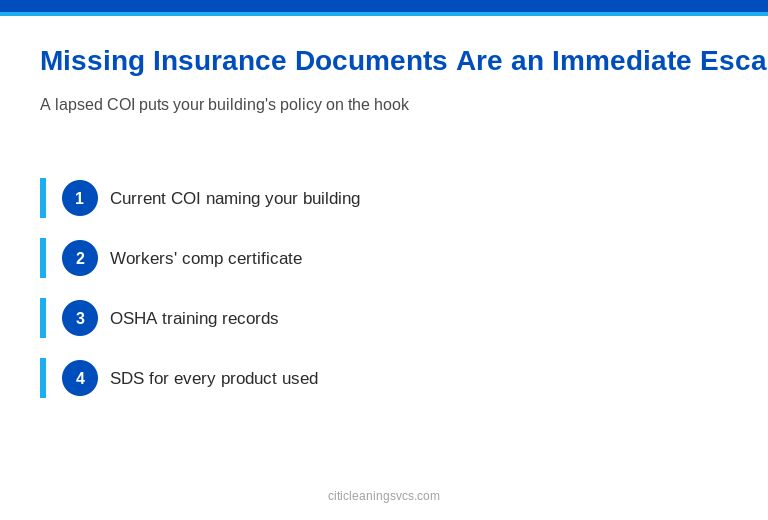
A missing or lapsed COI means that if a cleaner slips in your lobby and sues, your building’s general liability policy is on the hook. Most commercial leases and management agreements make lapsed vendor insurance grounds for immediate termination for cause — no cure period, no notice window.
If any of these come back with “we’re updating that” for more than 72 hours, treat it as a resolved decision — you are switching. See the OSHA guidance on cleaning-industry safety standards for the baseline every vendor should meet.
An annual CPI-based adjustment is normal. A surprise 12% increase mid-contract, or a series of unexplained “special project” line items on the invoice, is not. Price creep without a scope change is one of the clearest signals a vendor is testing what you will tolerate.
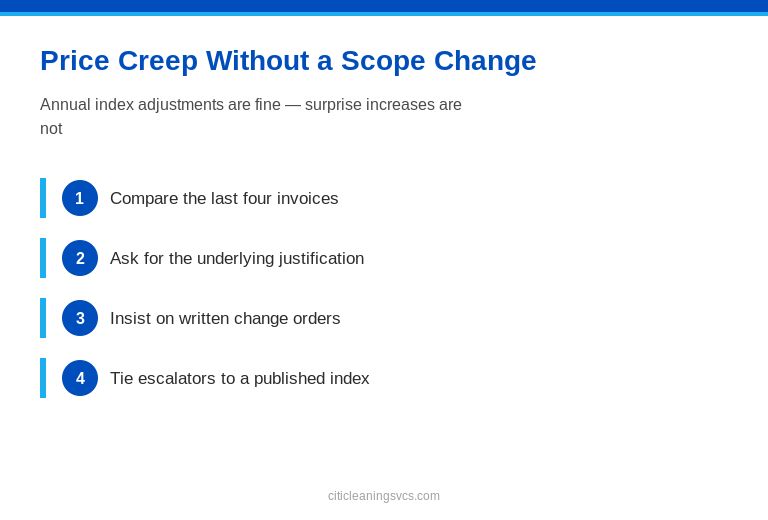
Pull the last four invoices and compare them line-by-line to your original contract. If the base rate has moved without an amendment, or if “supplies” or “extra service” fees keep appearing without a scope document, ask for the underlying justification in writing. Any vendor confident in their pricing will provide it.
A contract-free monthly rate with a transparent scope-of-work, a written change-order process for one-off projects, and an annual escalator tied to a published index — not to the vendor’s discretion. Citi’s contract-free model gives facility managers a 30-day exit without penalty, because we would rather keep clients through performance than through paperwork.
Cleaning crews carry keys, alarm codes, and after-hours access. When key control is loose — shared codes, unlogged key handoffs, cleaners letting each other in the back door — you have a security exposure that will not show up until something goes wrong.
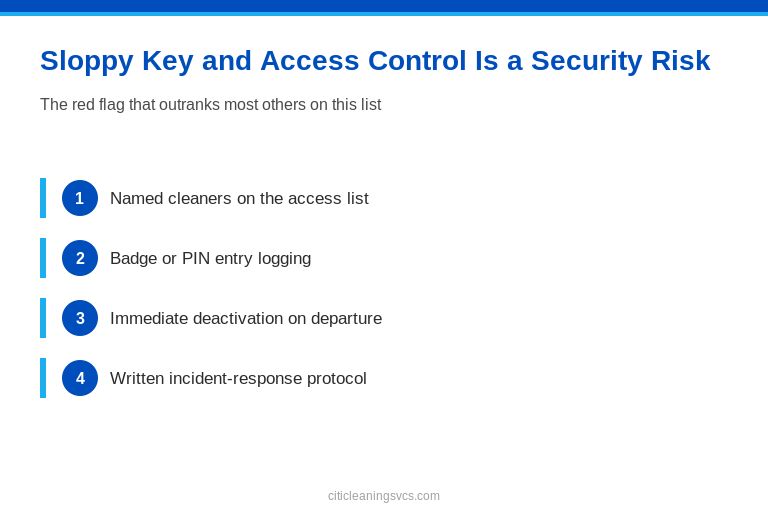
A functioning vendor treats key and code control as a compliance program: named cleaners on the access list, badge-based or PIN-based entry that logs every use, immediate deactivation when a cleaner leaves the crew. If your vendor cannot tell you within one business day exactly who has access to your building tonight, that is a red flag that outranks most of the others on this list.
The sales team was responsive. The account manager was warm. Then the contract was signed and now you are three weeks into an issue that started on a Monday and it is still open Friday. Communication decay after the honeymoon is the single strongest predictor that the vendor relationship is not going to recover on its own.
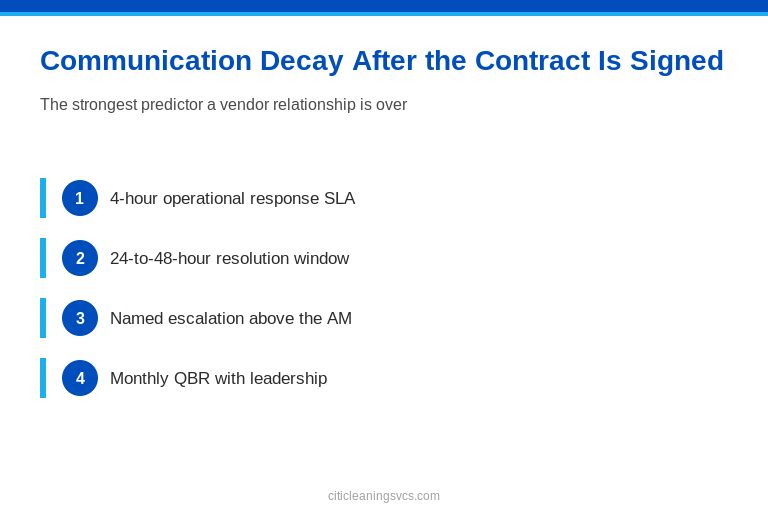
Modern operations expect a 4-hour response window on operational issues during business hours and a 24-hour resolution window on non-emergency items. If your vendor consistently misses both, the relationship is already broken — the paperwork just has not caught up yet.
Response time SLA of 4 business hours, resolution SLA of 24 to 48 hours depending on issue severity, a named escalation contact above the account manager, and a monthly QBR that puts leadership across the table from you at least four times a year. Any vendor that pushes back on those numbers is telling you they cannot meet them.
If you are hitting four or more of the red flags above, the switching decision is already made — you are just deciding when. Here is the 21-to-30-day timeline we walk facility managers through when they move to Citi Cleaning Services.
Pull the current contract, compile your complaint log, and write a corrected scope-of-work reflecting what your building actually needs today (not what it needed three years ago). Include restroom touch-up frequency, day porter hours if any, floor-care cycles, and consumables ownership.
Send the corrected scope to two or three qualified vendors. Weight your evaluation on supervision model, reporting, insurance, and reference calls — not on the low bid. See our companion piece on how to compare commercial cleaning bids for the side-by-side framework.
Sign with the new vendor. Give written notice to the incumbent per your contract terms. Coordinate a joint walk-through so nothing gets lost between crews, especially keys, codes, and supply inventory.
The new vendor starts. Walk the building on nights 1, 3, and 7 with the new supervisor. Log everything. Compare the first-week complaint count to your baseline — a competent vendor will see a 40-to-60% drop inside two weeks.
One bad month is a coaching opportunity. Two months of repeat complaints, missing supervisors, or missing insurance documents is a pattern — and patterns do not fix themselves without a scope change or a vendor change.
Standard commercial cleaning contracts run 30 to 60 days for termination without cause and are usually immediate for cause (missing COI, safety incident, security breach). Read the termination clause before you give notice.
Yes. A 30-day switching window overlaps the incumbent’s last week with the new vendor’s onboarding week, and a joint walk-through prevents supply, key, or code gaps. Most facility managers experience zero service gap when the plan is written down.
Not automatically. Start with a written scope review and ask for a rebid against a corrected scope. Only switch on price alone if the incumbent refuses transparency on how the rate is built.
Supervision model, cleaner turnover rate, insurance and OSHA compliance, reporting cadence, references from buildings similar to yours, and their termination-for-cause and termination-for-convenience terms.
The direct cost is usually zero if you time notice correctly. The indirect cost is the staff time to run a proper bid — 8 to 15 hours across three weeks. The cost of not switching a failing vendor is measured in tenant satisfaction and complaint volume.
Restroom appearance and complaint volume should improve inside two weeks. Deep-clean cycles and floor care catch up within 60 days. If you do not see a measurable delta in the first month, escalate — the new vendor is inheriting the same gaps.
A contract-free monthly arrangement with a 30-day termination window puts the burden on the vendor to earn your business every month. That is what Citi Cleaning Services has offered Central Florida facility managers since 2004, and it is why our average client stays with us for 10+ years.
If any four of the red flags above describe your current relationship, act now — the situation only gets more expensive to unwind the longer you wait. Here is the sequence to run this month.
Facility managers across Orange, Seminole, Lake, and Osceola counties who follow this sequence report a measurable improvement in tenant satisfaction inside 60 days. The services page has more on how we build accounts around supervision and retention — and our contract guide covers the clauses to insist on before you sign anywhere.
