
Most commercial cleaning contracts are written to protect the cleaning company, not you. Facility managers who skim past the boilerplate wake up locked into 24-month terms with penalty clauses that make switching vendors more expensive than tolerating bad service.
This clause-by-clause guide walks you through every section of a standard commercial cleaning agreement. You will learn which language protects you, which language quietly transfers risk to your budget, and the exact redlines to insist on before you sign anything.
We will also show why an increasing number of Central Florida facilities are moving to contract-free cleaning arrangements — and when a traditional contract still makes sense. If you already know the ten clauses cold and just need a sanity check on your current vendor, the redline list at the end of this guide is what you want.
The guidance below applies to every category of commercial cleaning service — from nightly janitorial services to specialty floor care programs and facility maintenance contracts.
Key Takeaways
- Ten clauses matter more than the rest — scope, frequency, pricing, term, insurance, supplies, quality assurance, access, indemnification, and modifications.
- Auto-renewal clauses over 30 days are the single biggest trap. They quietly extend your commitment before you even review performance.
- Scope-of-work language is where vendors hide unpaid future revenue. Every task, area, and frequency must be listed line by line.
- Insurance minimums are non-negotiable. Ask for a Certificate of Insurance naming your entity as additional insured.
- Contract-free arrangements shift power back to the buyer. The vendor has to earn the renewal every 30 days.
A commercial cleaning contract must include ten core clauses: scope of work, service frequency, pricing and payment terms, term and termination, insurance and bonding, supplies and equipment, quality assurance, confidentiality and access, indemnification and liability, and a modifications process. Miss any one of these and you have exposure.
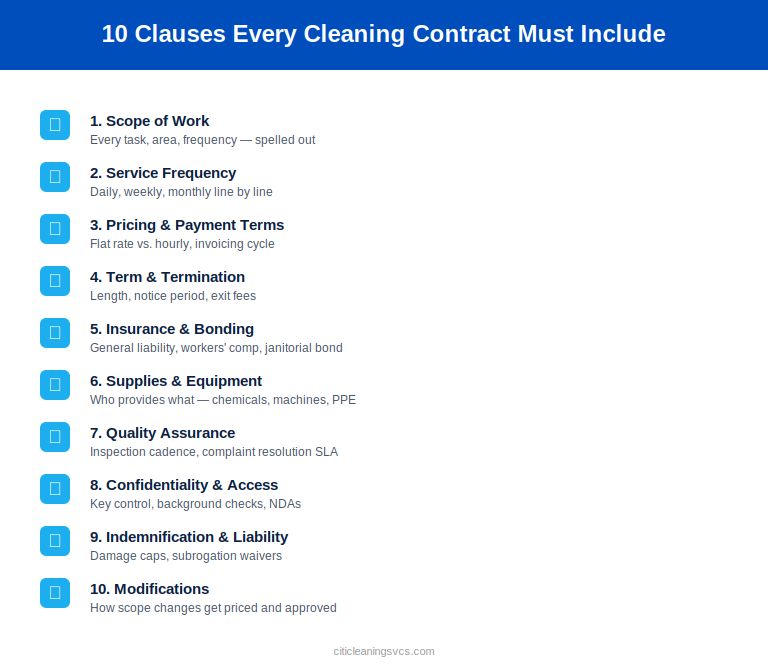
Every reputable cleaning company drafts around these ten sections. If a proposed contract skips one — for example, no insurance minimums or no quality assurance process — treat that omission as a red flag. It usually means the vendor is either inexperienced or hoping you will not notice until something breaks.
Work through each clause below with a printed copy of the proposed contract next to you. Mark up anything that does not match the plain-language requirements we lay out.
The scope-of-work clause tells the crew exactly what to do. It should list every room, floor, and area to be serviced, with each specific task named — vacuum carpeting, damp-mop hard floors, disinfect touch points, restock consumables.
Phrases like “general cleaning” or “standard janitorial services” do not belong here. They give the vendor room to argue later that a task you assumed was covered actually requires an add-on charge.
Each task in the scope should have a frequency attached: daily, three times weekly, weekly, monthly, quarterly. Some tasks — like high-touch disinfection in a warehouse breakroom — need daily attention. Others, like VCT floor stripping and waxing, are quarterly or semi-annual.
A frequency matrix inside the contract eliminates arguments about whether a task was skipped or was never in scope to begin with.
Pricing should be either a flat monthly fee or a clearly defined hourly rate with billable hour minimums. The clause must state the invoicing cycle (weekly, bi-weekly, monthly), payment terms (Net 15, Net 30), and any late fees.
Watch for pricing that “may be adjusted at the vendor’s discretion.” That single line lets them raise the price anytime with no cap.
The term clause states how long the contract runs. Termination language explains how either party can end the arrangement early, the notice period required, and any exit fees.
The safest term for a facility manager is 12 months with 30-day termination for convenience and no exit fee. Longer terms only make sense when the vendor offers a meaningful concession — a locked price or capital investment in equipment on your site.
The contract must specify minimum coverage limits for general liability (usually $1M/$2M), workers’ compensation (statutory), auto liability if the crew drives on your property, and a janitorial services bond covering theft.
Insist on a Certificate of Insurance (COI) naming your entity as additional insured, delivered before the crew steps on site. Without additional-insured status, their carrier can subrogate against you if a crew member is injured.
State clearly who provides consumables (paper products, hand soap, liners), cleaning chemicals, and equipment (vacuums, auto-scrubbers, buffers). A well-written clause spells out that the vendor supplies all chemicals and equipment and that the facility supplies restroom consumables — or vice versa.
Ambiguity here creates finger-pointing when the paper towels run out at 2 p.m. on a Tuesday.
The QA clause should define inspection cadence (weekly walk-through, monthly formal audit), the inspection checklist used, and the resolution SLA when something fails inspection.
Ask the vendor how they document inspections. A vendor without a documented QA process is trusting your goodwill to keep the account.
This clause covers key control, alarm codes, background checks on every crew member, and any non-disclosure requirements if your facility handles sensitive materials.
Require background checks on every worker with facility access. Require immediate notification when a crew member is removed from your account.
Indemnification decides who pays when something goes wrong — a slip-and-fall on a wet floor, damage to your equipment, or a data breach if a crew member sees something they should not have.
The clause should be mutual (each party indemnifies the other for its own negligence) and should include a damage cap tied to the annual contract value.
Facilities change. Departments expand. Buildings get added. The modifications clause tells you how scope changes get priced, approved, and added to the master agreement.
A modifications clause requiring written approval before any billing change protects you from surprise invoices. Verbal requests should never trigger new billing.
Ten clauses done. Every one of them protects budget, staff safety, or your ability to walk away. The next section covers the language buried inside those clauses that vendors use to shift risk back to you.
Six specific clauses in a cleaning contract are red flags: auto-renewal periods longer than 30 days, termination-for-convenience fees, vague scope language, missing insurance minimums, price escalators without caps, and stacked non-solicit and non-compete clauses. Any one of these should trigger a redline.
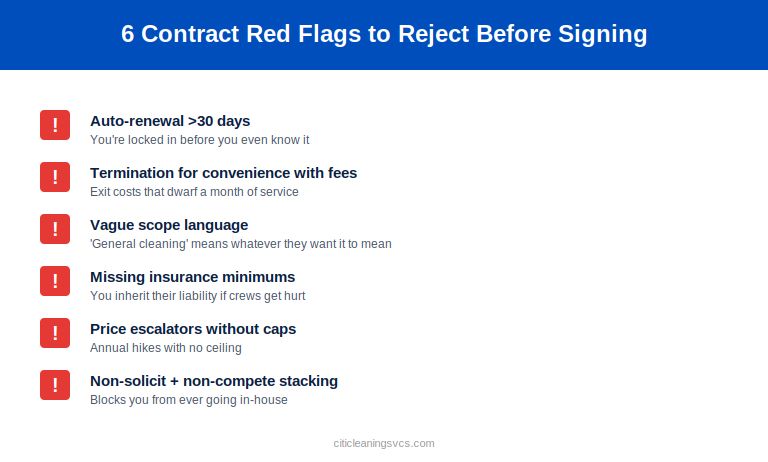
These clauses are not necessarily malicious. Many are standard boilerplate copied from templates. But once signed, they are enforceable. Cross them out or renegotiate before you sign.
Auto-renewal is a clause that automatically extends the contract if you do not send written cancellation before a deadline. Many contracts require 60 or 90 days notice before the term ends. Miss the window, and you are locked in for another full term.
Redline this to a 30-day rolling renewal with 30 days notice to cancel. That gives you monthly optionality without weekly hassle.
Termination for convenience means either party can end the contract without cause. When paired with a fee — often 3 to 6 months of billing — it is not really an exit option.
Insist on termination for convenience with 30 days notice and no fee. If the vendor pushes back hard, ask what they are worried about. A vendor confident in their service should not fear a monthly renewal decision.
“General janitorial services as needed,” “standard cleaning,” “reasonable maintenance” — this language is a blank check for scope disputes. Every task must be named.
If the proposed scope is vague, ask for a task-level matrix as an exhibit to the contract. Any professional cleaning company already has this document — they just did not send it.
A contract that says “vendor will maintain appropriate insurance” without specifying dollar amounts is meaningless. You cannot enforce a floor that was never set.
Specify $1M per occurrence and $2M aggregate for general liability, statutory workers’ comp, and a $10,000+ janitorial bond as minimums. Increase from there based on your facility size.
Annual price increases are reasonable — labor and supply costs rise. Uncapped increases are not. Some contracts allow annual escalation “based on operating costs” with no ceiling.
Cap escalators at the lesser of CPI or 3% per year. If the vendor needs more, they can come to you with a documented request.
A non-solicit clause prevents you from hiring away the vendor’s employees during and after the contract. A non-compete may prevent you from bringing cleaning in-house for a set period after termination.
Strike the non-compete outright. Limit the non-solicit to 12 months post-termination and only to specific employees actively assigned to your account.
Redline these six items, and you have removed most of the traps that turn a service agreement into a hostage situation.
Contract-free commercial cleaning is a month-to-month arrangement where either side can walk away with 30 days notice. It is the better choice for facilities that value flexibility, have changing needs, or want the vendor accountable every month. Traditional contracts still make sense when a facility needs price certainty for capital planning or when the vendor is investing on-site equipment in exchange for term commitment.
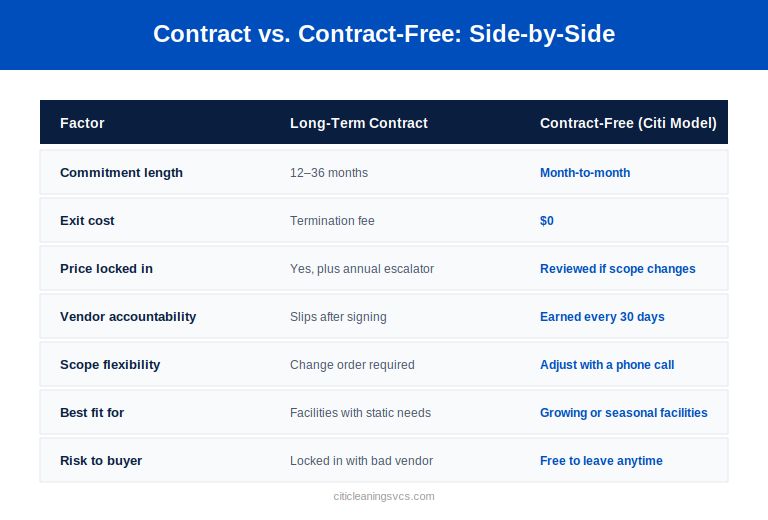
Citi Cleaning Services has run a contract-free model for our Central Florida clients across more than 20 years in business. It works because it forces us to earn the account every month. Our average client retention exceeds 10 years — proof that flexibility and vendor accountability are not in conflict.
That said, contract-free is not a magic bullet. Some facilities — particularly those with strict capital budgeting cycles or regulatory reporting that benefits from locked pricing — do better with a well-negotiated 12-month agreement.
Match the model to your facility. The right question is not “contract or no contract” but “what protection do I need, and what protection is the vendor offering?”
Before signing any cleaning contract, ask eight questions: what is explicitly included and excluded, how are add-ons priced, what insurance certificates will be provided, how do you handle background checks and key control, what is the inspection process, how are complaints escalated, what is the notice period and exit fee, and how are annual price increases capped. A vendor unable to answer any of these on the spot is not ready to run your account.
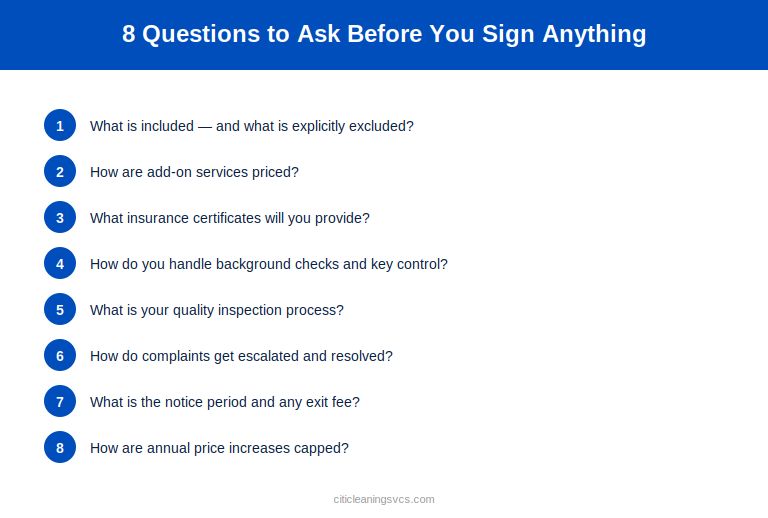
Bring this list to every vendor presentation. The answers separate professional operators from vendors selling on price alone.
Pay attention not just to the answers, but to how quickly they come. A seasoned operations manager will answer question one through eight in a single conversation with specifics. A hedged or shifting answer usually means the vendor is making it up as they go.
If the vendor promises to “send that information over later,” follow up within 24 hours. Slow response during the sales cycle is the best predictor of slow response after you sign.
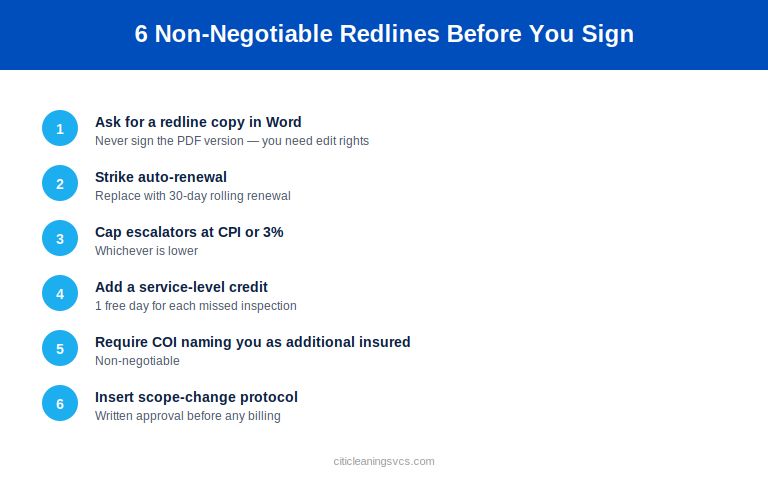
Six redlines belong in every commercial cleaning contract before it goes to signature: get an editable Word copy, strike auto-renewal, cap price escalators at CPI or 3%, add a service-level credit, require a COI naming you as additional insured, and insert a written-approval scope-change protocol. These six changes take one conversation and remove most of the risk.
Do not accept the argument that “these are our standard terms.” Every professional B2B contract is negotiable. A vendor unwilling to redline is telling you what their negotiating posture will look like when a problem comes up mid-contract.
According to the OSHA janitorial safety guidance, clear scope documentation and defined responsibilities also reduce workplace injury risk — both crew and facility staff know exactly what is being done and what chemicals are in use.
Send the redlined version back with a short cover email. Something like: “We are excited to move forward. Attached are our standard redlines. Please confirm you can accommodate before we schedule signing.” Polite, direct, and it establishes the norm that you review documents carefully.
Facility managers in industries with heavy foot traffic — warehouses, large retail, and transportation facilities — should push harder on the modifications clause. Seasonal volume swings often need scope adjustments mid-year, and a written change protocol keeps invoicing predictable.
Our own experience at Citi Cleaning Services — 20+ years serving Central Florida across offices, warehouses, retail, and transportation facilities — is that the vendors who redline gracefully are usually the same vendors who resolve problems gracefully later. Watch how they handle the paperwork. It tells you how they will handle the crew.
The ten most important clauses are scope of work, service frequency, pricing and payment terms, term and termination, insurance and bonding, supplies and equipment, quality assurance, confidentiality and access, indemnification, and modifications. Missing any one of these creates exposure. Scope of work and termination language matter most.
Twelve months is the sweet spot for most facilities. Longer terms should only be signed in exchange for meaningful concessions — locked pricing, on-site equipment investment, or dedicated staffing. Contract-free month-to-month arrangements work well for facilities that value flexibility.
Thirty days notice with no exit fee is standard for professionally negotiated cleaning contracts. Notice periods of 60 or 90 days paired with termination fees are red flags that should be renegotiated before signing.
Minimum coverage should include $1M per occurrence and $2M aggregate general liability, statutory workers’ compensation, auto liability if the crew drives on-site, and a janitorial services bond of at least $10,000. Always request a Certificate of Insurance naming your entity as additional insured.
Contract-free commercial cleaning is a month-to-month service arrangement where either party can end the relationship with 30 days notice, without termination fees or long-term commitment. It shifts power to the buyer because the vendor has to earn renewal every month.
Only if the contract explicitly allows it. Well-drafted agreements cap annual escalators at the lesser of CPI or a fixed percentage (usually 3%). Contracts that allow price increases “at vendor discretion” or “based on operating costs” without a cap should be redlined before signing.
Scope creep is when the vendor gradually adds tasks or areas without formal pricing changes, then later invoices for the added work as if it had been agreed. Prevent it with a task-level scope matrix as a contract exhibit and a modifications clause requiring written approval before any billing change.
A service-level agreement should specify inspection cadence, resolution timelines for complaints (24-hour response, 48-hour fix), and a service credit — typically one free service day for each missed inspection or unresolved complaint. Written SLAs give you leverage that verbal promises do not.
Reviewing a commercial cleaning contract is not a legal exercise. It is a business exercise you can run yourself in about 90 minutes. Follow this four-step plan the next time a proposal lands on your desk.
