Table Of Contents

Commercial Cleaning Contracts: What to Include, What to Avoid & Why Citi Goes Contract-Free

A commercial cleaning contract is supposed to protect you. Too often, it locks you into a mediocre service you can’t leave. This guide walks facility managers through exactly what belongs in a commercial cleaning contract, the clauses that quietly work against you, and why Citi Cleaning Services — after 20+ years serving Central Florida facility managers — chose to run its business without them.

You’ll learn the eight clauses every cleaning agreement should spell out, five common red flags that show up in fine print, and the ten questions to ask any provider before signing anything. By the end, you’ll know whether a contract is protecting your building — or just protecting the contractor.


Key Takeaways

  • Most cleaning contracts are written to protect the cleaner, not the facility. Auto-renewal, early-termination penalties, and vague scope language are the biggest offenders.
  • A strong cleaning agreement — contract or not — spells out scope, frequency, staffing, quality controls, insurance, and how you exit.
  • Contract-free service earns your business every month. Providers who work without long-term contracts have to keep performing to keep the account.
  • Auto-renewal clauses are the single most costly trap. They can lock you into another 12–36 months if you miss a 30–90 day cancellation window.
  • Citi Cleaning Services has run contract-free since 2004 — averaging 10+ years of client retention across 70+ trained cleaning professionals.


What a Commercial Cleaning Contract Actually Covers

A commercial cleaning contract is a written agreement that defines what a cleaning provider will do inside your facility, how often they’ll do it, and what happens when either side wants to make a change. At its best, it removes ambiguity and gives both parties a shared reference point when problems arise.

The problem is that most cleaning agreements are drafted by the provider, for the provider. Facility managers sign them under time pressure — often as part of a bid cycle — without reading the fine print that determines what happens 12 or 18 months later.
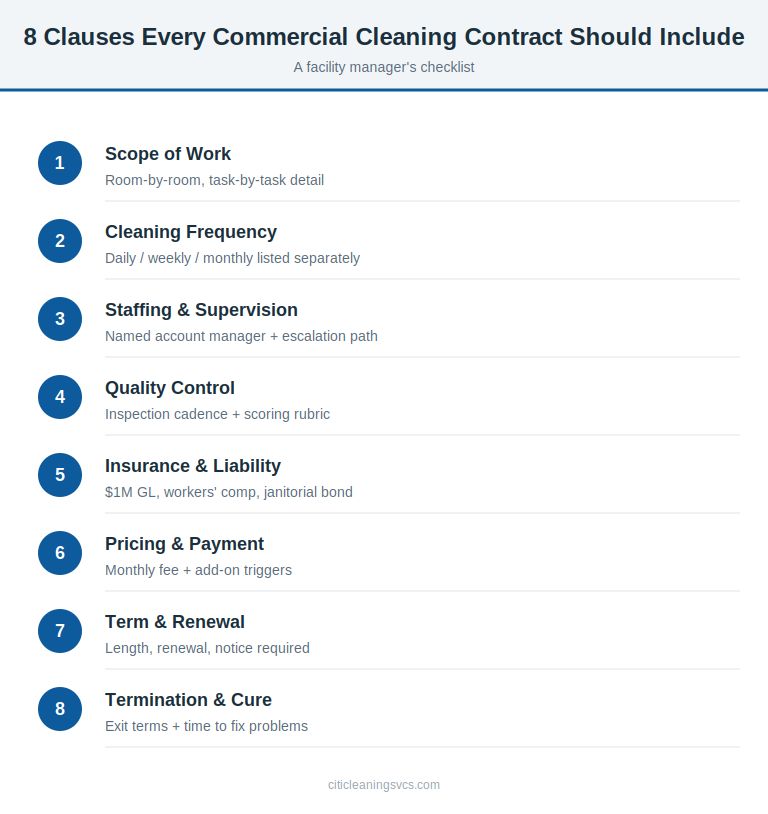
Eight clauses every commercial cleaning contract should include for facility managers


Here are the eight components that belong in any commercial cleaning agreement — whether you’re evaluating a five-year contract or a month-to-month service arrangement:

  • Scope of work. A room-by-room, task-by-task breakdown. Vague phrases like “general cleaning” or “as needed” are how service quality slowly disappears.
  • Cleaning frequency. Daily, weekly, monthly, and quarterly tasks listed separately. Restroom sanitization at three times per week is not the same as five.
  • Staffing and supervision. How many cleaners, on which shifts, and who supervises them. Named account manager and escalation path.
  • Quality control and inspections. How performance is measured — inspection frequency, scoring method, and what triggers a corrective action.
  • Insurance and liability. Minimum $1M general liability, workers’ compensation, and janitorial bond. Certificate of insurance naming your facility as an additional insured.
  • Pricing and payment terms. Monthly fee, what’s included, what triggers add-on charges (project work, restorative floor care, special events), and payment schedule.
  • Term and renewal. Length of the agreement, how renewal works, and what notice is required to change or exit.
  • Termination and cure periods. How either party ends the arrangement, what “cause” means, and how much time the cleaner has to fix problems before you can cancel.

Every one of these clauses matters. But five of them hide the traps that make bad contracts hard to escape. That’s next.


Red-Flag Clauses That Punish Facility Managers Later

The most expensive clauses in a cleaning contract are the ones that don’t look expensive when you sign. They compound quietly — extending your term, raising your rate, and blocking your exit — until you’re trapped with a service you no longer want.
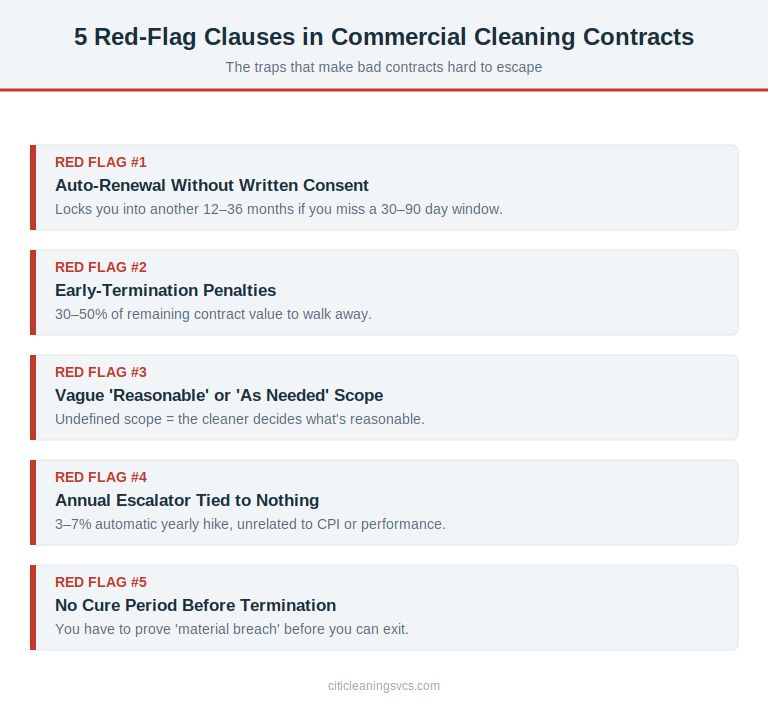
Five red-flag clauses to avoid in commercial cleaning contracts


Watch for these five specifically:

  • Auto-renewal without written consent. The contract renews for another full term unless you cancel in writing during a narrow window — often 30, 60, or 90 days before expiration. Miss it and you’re locked in for another year or more.
  • Early-termination penalties. Some contracts charge 30–50% of the remaining contract value if you cancel early. On a $6,000/month agreement with 18 months left, that’s $32,400 to $54,000 to walk away.
  • Vague scope with “reasonable” or “as needed” language. When scope isn’t defined, “reasonable” always means whatever the cleaner decides is reasonable. Your restrooms get wiped down twice a week instead of five and there’s no clause you can point to.
  • Annual escalator clauses tied to nothing. A 3–7% automatic annual increase, regardless of CPI, labor market, or performance. Over a five-year term, that’s a 15–40% price increase for the same service.
  • No cure period before termination for cause. Some contracts require you to prove “material breach” through a legal process before you can cancel — even when the cleaner is clearly failing. Good contracts give you a 30-day cure period with clear documentation triggers.

Individually, any one of these can be negotiated out. Stacked together, they turn a two-page agreement into a multi-year commitment you can’t leave without a lawyer.


The Contract-Free Alternative: How Month-to-Month Service Works

Contract-free commercial cleaning is exactly what it sounds like: a service agreement with no fixed term, no auto-renewal, and no termination penalty. You continue the service as long as it’s working. You end it when it isn’t.

Facility manager reviewing commercial cleaning service arrangement in Central Florida office


This is how Citi Cleaning Services has operated since 2004. Every client is on a month-to-month arrangement. Every account has to be re-earned by showing up, doing the work, and staying accountable. It sounds risky for the cleaner — and it is, if the cleaner isn’t good. That’s the point.

A contract-free model changes the incentive structure in three ways facility managers immediately feel:

  • The cleaner has to keep performing. A month-to-month client can leave in 30 days. That pressure keeps quality control tight, response times fast, and account managers responsive.
  • You get real transparency on pricing. No hidden auto-escalators. If costs need to change (a labor law shift, a facility expansion, a scope adjustment), it’s a conversation — not a line item that showed up because year two started.
  • You can respond to your building’s actual needs. Reducing hours in a slow quarter, adding a shift when a tenant moves in, layering on a floor-care project — none of it requires a contract amendment.

The tradeoff is that you have to trust the provider’s operational strength. A cleaning company that runs on locked-in contracts can survive underperformance. A contract-free company cannot. That’s why Citi’s average client relationship runs more than 10 years — the model doesn’t work unless the service does.


Contract vs. Contract-Free: A Side-by-Side Comparison

The choice isn’t really “contract or no contract.” It’s what you get in exchange for the commitment. Here’s how the two models compare across the factors facility managers weigh most.
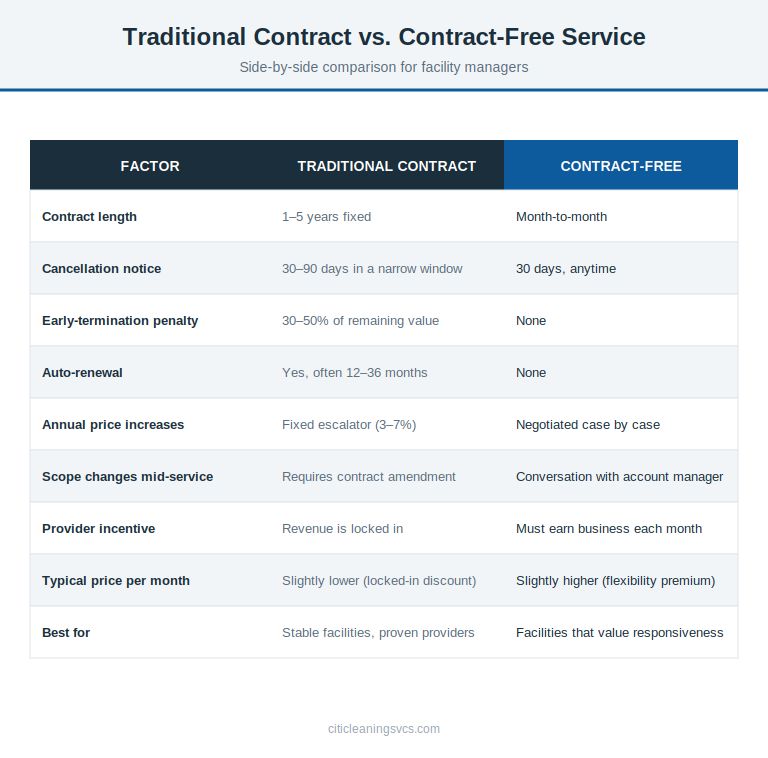
Comparison table showing traditional commercial cleaning contracts vs. contract-free month-to-month service


A few notes on the tradeoffs:

  • Long-term contracts can lower your unit price — sometimes. Providers who need locked-in revenue will discount to secure a multi-year term. If your budget is the primary driver and the provider’s operational quality is proven, that discount can be worth it.
  • Contract-free service usually costs slightly more per month — because the provider is carrying the risk of losing you. Facility managers who value flexibility, responsiveness, and clean exit terms treat that premium as insurance.
  • Neither model protects you from a bad provider. A well-written contract makes it possible to leave a bad cleaner. A contract-free arrangement makes it easy. Neither one makes the cleaner good.

The right answer depends on your facility, your risk tolerance, and how much confidence you have in the provider’s actual operations — which brings us to the questions you need to ask before you sign anything.


10 Questions to Ask Before You Sign (or Skip) a Cleaning Contract

Whether you’re negotiating a three-year agreement or evaluating a month-to-month provider, these ten questions surface how the company actually operates. The answers matter more than the contract terms.
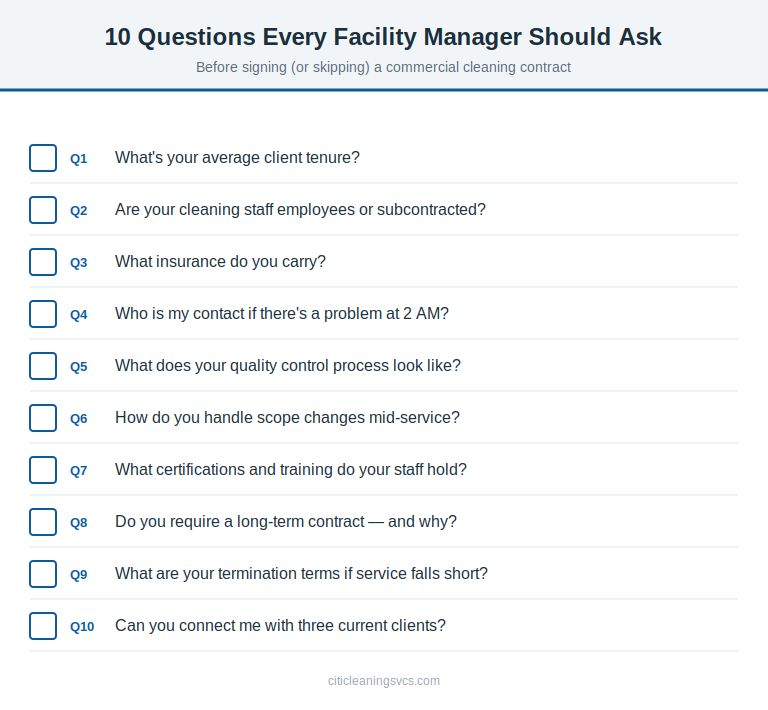
Ten questions to ask a commercial cleaning company before signing a contract


  1. What’s your average client tenure? A provider with a 10+ year average is telling you their service holds up over time. Sub-two-year tenure often signals churn — and the reason.
  2. Are your cleaning staff employees or subcontracted? Employees get trained, supervised, and stay accountable. Subcontractors rotate.
  3. What insurance do you carry, and can I get a certificate naming us as additional insured? $1M general liability minimum, plus workers’ comp and a janitorial bond.
  4. Who is my point of contact if there’s a problem at 2 AM? A named account manager with a direct phone line — not a general dispatch queue.
  5. What does your quality control process look like? Documented inspection frequency, scoring rubric, and reporting cadence. If they can’t explain it, it doesn’t exist.
  6. How do you handle scope changes mid-service? Change-order process, timeline, and pricing structure. Vague answers here become disputes later.
  7. What certifications and training do your staff hold? OSHA compliance, bloodborne pathogen training, chemical handling. Green Seal or GBAC alignment for sustainability programs.
  8. Do you require a long-term contract, and if so, why? The answer reveals their confidence in their own service. Providers who insist on multi-year lock-ins are often protecting themselves from their own churn.
  9. What are your termination terms if service falls short? Cure period length, documentation requirements, and any penalty structure.
  10. Can you connect me with three current clients in facilities similar to mine? Real references — not testimonials on the website. The willingness to provide them is itself the answer.

Any provider worth signing with — or working with month-to-month — will answer all ten without hesitation. If the answers get defensive or vague, that’s the answer.


Frequently Asked Questions

1. 🔍 What should be in a commercial cleaning contract?

A strong commercial cleaning contract spells out eight elements: scope of work (room-by-room, task-by-task), cleaning frequency, staffing and supervision structure, quality control and inspection process, insurance and liability coverage, pricing and payment terms, contract length and renewal terms, and termination procedures with a defined cure period.

2. 📊 How long is a typical commercial cleaning contract?

Traditional commercial cleaning contracts run one to three years, with some multi-facility agreements extending five years. Auto-renewal clauses can extend those terms indefinitely if the cancellation window is missed. Month-to-month contract-free arrangements are increasingly common with providers confident in their service quality.

3. ⚡ Can I cancel a commercial cleaning contract early?

Most fixed-term cleaning contracts include an early-termination penalty — often 30–50% of the remaining contract value. Some allow termination “for cause” if the provider fails to meet defined performance standards after a written cure period, typically 30 days. Always read the termination clause before signing.

4. 🏢 What’s the difference between a cleaning contract and a service agreement?

The terms are often used interchangeably, but a “service agreement” typically implies more flexibility — no fixed term, month-to-month billing, and simple termination language. A “contract” usually signals a fixed-term commitment with defined start and end dates, auto-renewal provisions, and formal termination procedures.

5. 🤝 Is it better to have a contract or go month-to-month with a cleaning company?

Fixed-term contracts can lower your per-month cost and lock in service levels. Month-to-month arrangements give you flexibility, cleaner exit terms, and force the provider to earn your business every month. The right choice depends on how much you trust the provider’s operational strength — and how much flexibility your facility needs.

6. 💰 Are contract-free cleaning services more expensive?

Contract-free commercial cleaning typically costs slightly more per month than a locked-in multi-year contract, because the provider absorbs the risk of losing the account with 30 days notice. Facility managers who value flexibility and accountability treat that premium as insurance against being stuck with a poor performer.

7. 🚀 What insurance should a commercial cleaning company carry?

At minimum: $1 million general liability, workers’ compensation covering all cleaning staff, and a janitorial bond (typically $10,000–$50,000). Request a certificate of insurance naming your facility as an additional insured before service begins. OSHA, ISSA compliance and industry certifications are also worth verifying.

8. 📈 What is an auto-renewal clause in a cleaning contract?

An auto-renewal clause automatically extends the contract for another full term — usually 12, 24, or 36 months — unless you provide written cancellation notice within a specific window before expiration, typically 30 to 90 days. Missing that window locks you into another full term, even if you’re already unhappy with the service.


The Bottom Line: Make the Contract Serve the Facility

The best commercial cleaning contract is one you never have to invoke — because the provider is performing, communication is clear, and either side can exit cleanly if that changes. Whether you get there through a well-negotiated fixed-term agreement or a contract-free month-to-month arrangement matters less than the underlying operational quality of the provider.

Contracts don’t create good service. Accountability does. That’s the argument for the contract-free model — and it’s why Citi Cleaning Services has kept that structure for more than two decades of serving Central Florida facility managers.


Your 4-Step Action Plan

  1. Audit your current cleaning agreement for auto-renewal windows, early-termination penalties, and vague scope language. Note the exact cancellation deadline and put it on your calendar.
  2. Document your facility’s actual scope needs — room count, task frequency, restroom traffic, floor types, special-event support. This becomes the baseline for any conversation with a new or existing provider.
  3. Ask any provider under consideration all 10 questions above. Compare the answers, not just the pricing. Note which providers give clear answers and which get defensive.
  4. Decide whether a fixed-term contract or a month-to-month arrangement fits your facility’s risk profile. If you choose fixed-term, negotiate out the auto-renewal, the escalator, and the early-termination penalty. If you go month-to-month, verify the provider’s client tenure numbers before committing.

Mary Kaizer

Mary Kaizer has over 25 years of experience in the commercial cleaning industry, with an extensive background in sales, operations, and quality control. Her hands-on leadership and commitment to excellence have helped countless businesses maintain cleaner, safer, and more efficient work environments.
Share:
Citi Cleaning Services, Inc.  All Rights Reserved. © Copyright 2026

Get a Free Quote

Please fill this form and we’ll get back to you within 1 business day
🔒 Your information will not be shared