
Commercial cleaning is the professional, recurring cleaning of non-residential buildings by trained crews using commercial-grade equipment and documented procedures. If you searched for the commercial cleaning meaning, that is the short answer; the rest of this guide shows what it covers in practice.
Citi Cleaning Services has cleaned Central Florida offices, warehouses, and retail properties since 2004, so these definitions come from daily field work. You will get a plain-English definition, a comparison with janitorial and residential cleaning, frequency tables, sample scopes of work, and the standards that separate professional crews from casual help.
By the end you will know what a commercial cleaning contract should list, which certifications to ask about, and how pricing works without a single made-up number. Start with the definition, because every other decision builds on it.
Key Takeaways
- Commercial cleaning means recurring, scheduled cleaning of businesses, institutions, and other non-residential buildings.
- Janitorial services are the daily maintenance core; commercial cleaning also includes periodic and specialty work.
- Scope is everything. A written list of areas, tasks, and frequencies is what you actually buy.
- Three credentials matter: ISSA’s CIMS, Green Seal’s GS-42 standard, and OSHA-compliant chemical training.
- Pricing follows scope and is quoted per square foot, per hour, or as a flat monthly fee.
- Central Florida adds conditions such as humidity, entry-mat grit, and seasonal traffic that a good plan accounts for.
Commercial cleaning is the scheduled cleaning and maintenance of offices, warehouses, retail stores, schools, and other business or institutional buildings. Trained crews follow a written scope of work, use commercial-grade equipment, and clean on a recurring basis, usually nightly or several times a week.
Three traits separate it from a one-time clean. It is recurring, it is documented, and it is accountable to a building owner or manager rather than to a household.
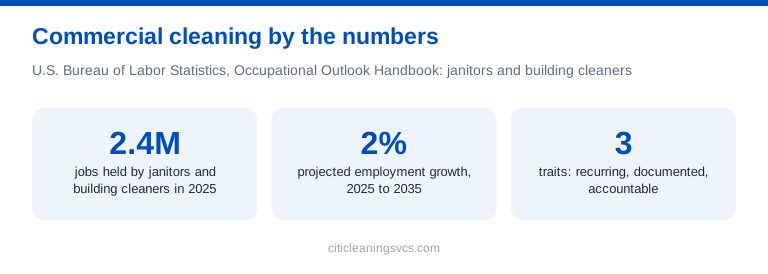
The scale of the trade is large. The U.S. Bureau of Labor Statistics reports that janitors and building cleaners held about 2.4 million jobs in 2025, with employment projected to grow 2 percent from 2025 to 2035.
That steady demand reflects a simple fact. Every occupied building needs someone to keep floors, restrooms, and shared surfaces in working order.
Commercial cleaning protects four things at once: the health of the people inside, the appearance of the property, the life of its surfaces, and its compliance with safety rules. Skipping it saves little and costs a lot.
Health comes first. Regular cleaning of restrooms and high-touch surfaces reduces the soil that spreads between people, and the CDC notes that cleaning with soap and water removes most germs from surfaces in most situations.
Appearance follows. Clients, tenants, and employees form opinions within seconds of entering, and a clean lobby tells them the building is managed.
Surface life is the quiet benefit. Grit acts like sandpaper on finished floors, so routine soil removal extends the time between costly refinishing cycles.
Compliance ties it together. Chemical training, labeled products, and safety data sheets are workplace rules, and a professional provider handles them as part of the service.
The word “commercial” separates this work from household cleaning, and the word “janitorial” describes one part of it. Residential cleaning serves homes, industrial cleaning serves heavy-process sites, and commercial cleaning sits between them.
The table below shows how the four terms differ in who they serve, how often they run, and what they emphasize.
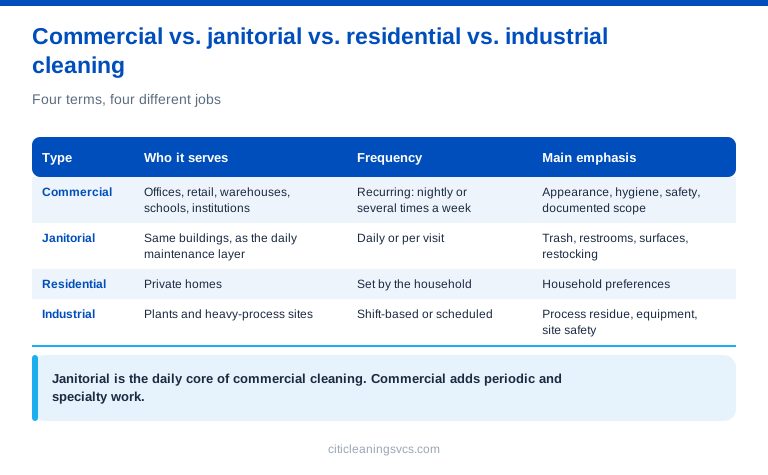
Janitorial work is the day-to-day layer: trash, restrooms, and surface upkeep. Commercial cleaning includes that layer and adds periodic projects such as floor refinishing and exterior washing.
Our breakdown of the difference between cleaning and janitorial services goes deeper on that split.
Residential and industrial cleaning appear in the comparison only to sharpen the definition. This guide focuses on commercial buildings.
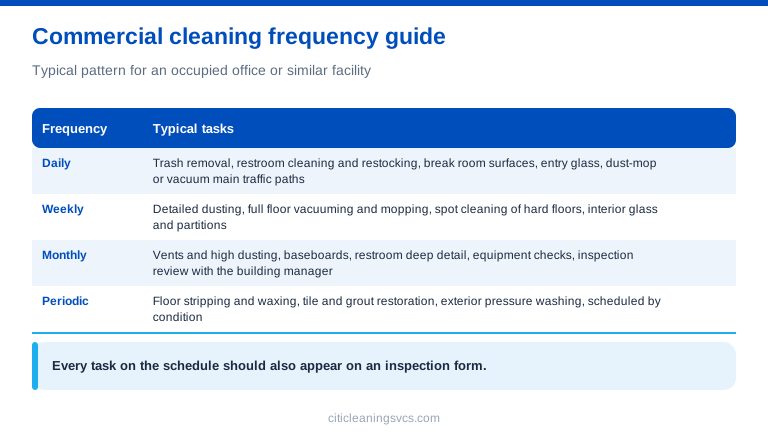
A commercial cleaning program is a calendar of tasks, not a single visit. Daily tasks protect health and appearance, weekly tasks keep wear in check, and monthly tasks handle what daily crews cannot reach.
Here is the typical frequency pattern for an occupied office or similar facility.
Restrooms get the most scrutiny because tenants and visitors judge a building by them. A full service cleans and sanitizes fixtures, wipes mirrors and partitions, refills dispensers, empties waste, and mops the floor.
Busy sites add a midday check so a restroom never reaches the end of the day in poor shape.
Floors are the largest surface in most buildings and the first thing visitors walk on. Daily work removes loose soil by vacuuming or dust-mopping, then damp mopping hard surfaces.
Different floor types call for different methods, which is why a scope should name each one.
Trash removal is simple but non-negotiable, and it protects both appearance and sanitation. Touch points such as door handles, light switches, and elevator buttons collect the most hand traffic.
Entrance glass sets the first impression, so it belongs on the daily list for most public-facing buildings.
Frequency is the lever you adjust. A lobby with heavy foot traffic may need daily mat vacuuming, while a low-traffic storage area may need a weekly pass.
Good providers tie each frequency to an inspection. If a task appears on the schedule but never on an inspection form, nobody is checking that it happens.
For a full contract-level view, read our clause-by-clause guide on what should be in a cleaning contract.
Specialty services handle surfaces and conditions that routine janitorial work cannot. In commercial buildings, the most common ones are floor refinishing, tile and grout restoration, and exterior pressure washing.
Hard floors drive the biggest share of this work. Vinyl composition tile needs periodic stripping and waxing to keep its protective finish, and our floor care services cover that cycle along with commercial floor waxing.
Tile and grout collect soil that mops leave behind. Our guide to commercial tile and grout cleaning explains the methods and when each fits.
Exterior surfaces matter too. Entrances, walkways, and loading areas collect grime that tracks inside, which is why many properties schedule pressure washing on a recurring calendar.
High-touch sanitizing is another common add-on. It focuses on door handles, elevator buttons, and shared fixtures, and it follows the cleaning-before-sanitizing order that the Centers for Disease Control and Prevention recommends for facilities.
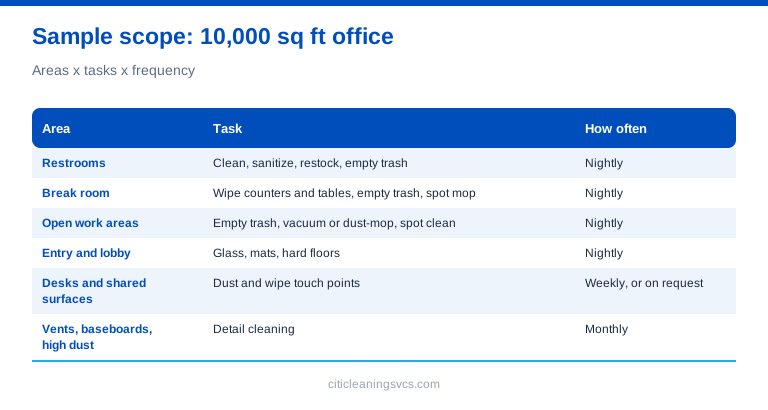
A scope of work turns a vague promise into a checklist. The three examples below show how the same service categories change with the building.
The office plan centers on restrooms, break rooms, and shared surfaces. Crews empty trash, clean and restock restrooms, wipe desks and touch points on request, and vacuum or dust-mop floors nightly.
Weekly work adds detailed dusting and spot treatment of hard floors. Monthly work covers vents, baseboards, and deep restroom detail.
Warehouse cleaning focuses on safety and dust control. Crews sweep or scrub aisles and dock areas, clear debris from walkways, and keep offices, restrooms, and break rooms in office-style order.
Weekly work adds scrubbing of high-traffic lanes and detail cleaning around dock doors, while monthly work covers corners, ledges, and equipment-adjacent areas that daily crews skip.
Floor care is the major variable here, because concrete and sealed surfaces need machines sized to the aisle. Our page on warehouse cleaning and our guide to what to expect from warehouse cleaning services cover the detail.
Retail cleaning protects the customer-facing experience. Crews clean entrances and glass doors, maintain sales-floor surfaces, service restrooms, and handle back-of-house areas after closing.
Weekly retail work adds detailed glass, display-adjacent floors, and fitting-room or customer-area detail. Monthly work focuses on high dusting, vents, and the back-of-house corners that customers never see but employees do.
Hours matter as much as tasks. Most retail work runs overnight so crews finish before the doors open, and our large retail cleaning page explains how that scheduling works.
Four misunderstandings cause most scope disputes. Clearing them up before you sign saves arguments later.
Misconception 1: “Cleaning is cleaning.” A written scope, trained crews, and inspections separate professional commercial cleaning from casual help. Without those, nobody can show what was done or when.
Misconception 2: “Everything is included.” Providers price what the scope lists. Periodic work like floor refinishing or exterior washing is usually quoted separately.
Misconception 3: “Cheaper means the same service.” Two bids with different task lists or frequencies are not comparable. The lower bid often just covers less.
Misconception 4: “Once it starts, it runs itself.” Even good crews need supervision and feedback. The best providers schedule inspections and share results.
A well-run crew works from a route and a checklist, not from memory. The pattern below describes a typical overnight office service.
The crew arrives after the last employees leave and checks in with the supervisor or a log. Supplies are staged on a cart, equipment is inspected, and any notes from the property manager are reviewed.
Work starts with trash and restrooms, because those tasks take the most time and carry the most risk if rushed. Break rooms and shared surfaces come next, followed by vacuuming and floor care.
The last step is a walk-through. The crew lead checks each area against the checklist, secures the building according to site rules, and records anything that needs attention, such as a leak, a burned-out light, or a damaged fixture.
That final log is valuable to the building manager. It turns a cleaning crew into an extra set of eyes on the property.
Any organization that occupies a non-residential building can hire commercial cleaners. In Central Florida, the steady buyers are office properties, logistics and warehouse operators, retailers, schools, and transportation facilities.
Local conditions shape the plan. Humidity affects how floors and restrooms hold up, sandy entrance traffic wears finishes faster, and tourism-driven foot traffic raises demand on lobbies and public restrooms.
Seasonal swings matter as well. Hurricane season can change schedules, and some facilities need extra attention before and after major weather events.
We staff those needs from our base in the Orlando area and serve facilities in Kissimmee, Lakeland, and the rest of the region. Our office building cleaning page covers the most common property type.
Three references tell you whether a provider operates professionally: ISSA’s Cleaning Industry Management Standard, the Green Seal GS-42 standard, and OSHA’s Hazard Communication rules. Ask any bidder which of these it follows and how it can prove it.
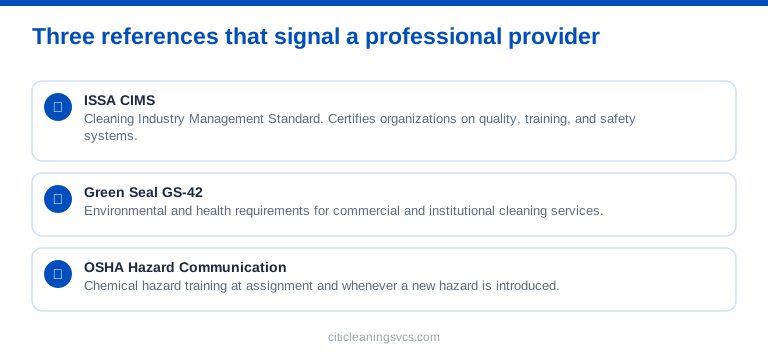
The Cleaning Industry Management Standard, known as CIMS, certifies organizations rather than individuals. It evaluates how a company manages quality, training, and safety.
Green Seal’s GS-42 sets environmental and health requirements for commercial and institutional cleaning services, covering both in-house and outside providers. A Green Seal-aligned program shows up in products, procedures, and record keeping.
OSHA’s Hazard Communication standard requires employers to train workers on hazardous chemicals when they start and whenever a new hazard enters the workplace. That training should be on file for every crew member.
Together these references cover management, environmental practice, and worker safety. A provider that can speak to all three is far more likely to run a consistent operation.
At Citi, our crews are OSHA-certified and our practices are Green Seal-aligned. We are family-owned, independently owned, and minority- and women-owned, with more than 70 trained professionals and clients who stay with us for more than ten years on average.
Commercial cleaning is priced by scope, not by a standard rate card. The same building can be quoted per square foot, per hour, or as a flat monthly fee, and each model rewards a different kind of buyer.
A fair comparison requires identical scopes. If two bids list different tasks or frequencies, the lower number often just means less work.
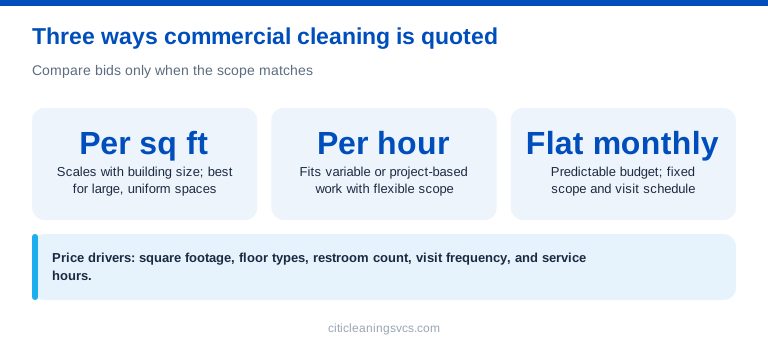
Several factors move the final quote: square footage, floor types, restroom count, visit frequency, and service hours. After-hours access and special equipment can also change it.
We do not publish rates because every building differs. Our cost guide, how much commercial cleaning costs, explains the drivers so you can read any bid with confidence.
Choose on proof, not promises. A strong provider shows a written scope, a named supervisor, training records, insurance documents, and references with similar buildings.
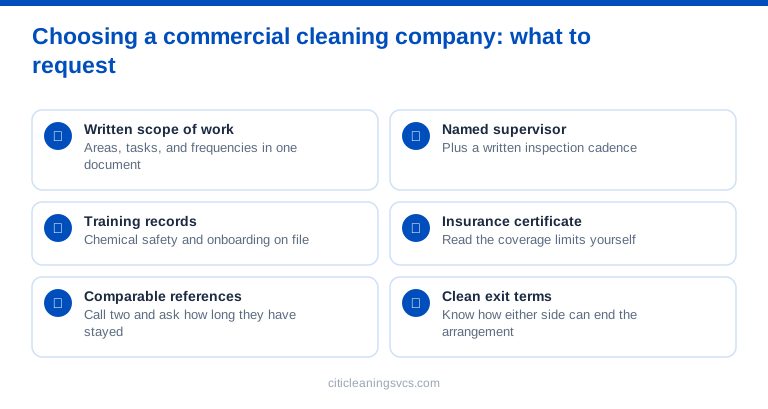
A walkthrough is your best chance to test a provider. Bring this short list and listen for specific answers.
Contract terms deserve the same scrutiny. Many buyers prefer arrangements without long lock-ins, and our post on contract-free commercial cleaning explains how those work.
When you compare finalists, put them side by side. Our guides on how to compare commercial cleaning bids and selecting a janitorial service provider give you scorecards you can reuse.
Finally, remember that a clean building is a managed process. The best predictor of month-six quality is whether the provider can show you how it supervises month one.
Commercial cleaning means the recurring, professional cleaning of non-residential buildings such as offices, warehouses, retail stores, and schools. Trained crews follow a written scope of work and a set schedule.
A commercial cleaner is a trained worker or company that cleans business and institutional buildings. The role includes routine tasks like restroom care and floor maintenance, plus periodic specialty work.
Janitorial services are the daily upkeep layer, such as trash removal, restroom care, and surface cleaning. Commercial cleaning includes that layer and adds periodic and specialty work like floor refinishing and pressure washing.
Commercial cleaning serves buildings with employees, customers, and regulatory duties, and it runs on a recurring schedule. Residential cleaning serves private homes and follows a different model.
A typical program includes trash removal, restroom cleaning, floor care, and surface cleaning on set frequencies. Periodic items such as stripping and waxing or exterior washing are added by agreement.
Occupied offices and public-facing spaces are usually cleaned nightly or several times a week. Low-traffic areas can run on a lighter weekly schedule.
Price depends on square footage, floor types, restroom count, visit frequency, and service hours. Providers quote per square foot, per hour, or as a flat monthly fee, so compare bids that share the same scope.
Ask about CIMS from ISSA, alignment with Green Seal GS-42, and OSHA-compliant chemical safety training. Request documentation rather than relying on a logo.
Commercial cleaning is a managed, recurring service built on a written scope, a schedule, and accountability. Janitorial work is its daily core, and specialty services complete the picture.
The buyers who get the best results define the scope first, verify credentials second, and compare bids last. That order keeps the conversation on what the building actually needs.
