
Commercial tile and grout is a paradox — the tile itself is one of the most durable flooring surfaces you can install, but the grout lines are among the most fragile. Neglect them for six months in a high-traffic facility and you end up with a floor that looks aged and dingy no matter how often the crew mops it.
This guide walks through the five most common commercial tile and grout cleaning methods, what each one actually costs per square foot, and the specific warning signs that tell you it is time to bring in a professional crew. You will also learn the seven preventive habits that add years to a tile installation.
The pricing ranges and process steps come from 20+ years of running commercial floor care programs across Central Florida — everything from break rooms in warehouses to full-facility tile in retail environments and office buildings.
Key Takeaways
- Grout is where tile floors visually fail. The tile stays new for decades; the grout stains in months without proper care.
- Five cleaning methods cover every scenario — daily damp mop, weekly deck brush, monthly grout brush, quarterly hot water extraction, and annual sealing.
- Professional deep-clean pricing runs $0.55-$1.75 per square foot depending on soil load, tile type, and whether sealing is included.
- Call a professional when grout has visible staining that mopping will not remove, when sealer is past 18 months old, or before a lease turnover.
- Prevention costs 10x less than restoration. Walk-off matting, neutral pH cleaners, and quarterly extraction keep tile new-looking for years.
Commercial tile and grout take 10 to 100 times more foot traffic than residential tile, which changes everything about how they need to be cleaned. Home tile might see 200 footsteps per day. A warehouse breakroom tile floor sees 3,000+ footsteps. That traffic embeds soil into the porous grout at a pace no home cleaning routine can keep up with.
The second difference is grease and food service exposure. Commercial kitchens, cafeterias, and breakrooms deposit oils onto tile that a neutral cleaner cannot dissolve. That requires alkaline pre-treatment and mechanical agitation.
The third difference is regulatory. OSHA slip-and-fall standards, health department requirements in food-service areas, and ADA-related surface friction all set a minimum bar for commercial tile that residential tile does not have to meet.
Treating a commercial floor with home-tile methods produces slow, invisible degradation. By the time it looks bad, restoration costs multiple times what preventive care would have cost.
Five methods cover the full commercial tile and grout maintenance cycle: daily damp mopping with a neutral pH cleaner, weekly deck brushing with wet vacuum recovery, monthly grout brushing, quarterly hot water extraction, and annual re-sealing. Each has a specific role, and you cannot substitute one for another.
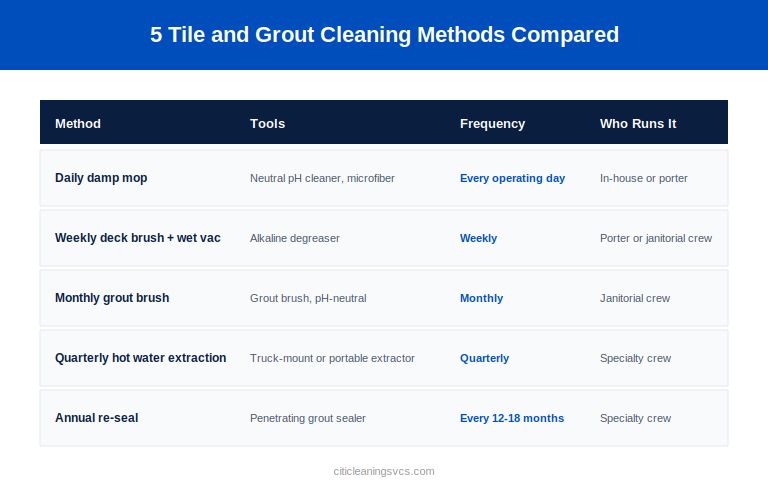
The mistake most facilities make is running only the first method — daily damp mopping — and expecting the floor to hold up. Daily mopping keeps surface dirt from accumulating, but it does not lift the soil embedded in the grout pores. Over months, that soil builds up. The floor develops the tell-tale gray or brown grout lines that mopping cannot fix.
The next four methods are what keep grout from failing visually. Weekly deck brushing and wet vac lifts surface soil before it embeds. Monthly grout brushing scrubs the grout lines directly. Quarterly hot water extraction (also called steam or vapor extraction) uses 195°F water and high suction to pull soil from deep in the grout pores. Annual re-sealing restores the protective barrier that prevents new soil from embedding.
Match your method to the surface’s condition and your traffic patterns. High-traffic entrances need weekly deep work. Low-traffic conference room tile can go quarterly.
A professional commercial tile and grout deep clean follows seven steps in order: dry sweep or vacuum, alkaline pre-spray, mechanical agitation with a grout brush, hot water extraction, neutral pH rinse, forced air drying, and application of a penetrating sealer. Skipping steps or reordering them reduces effectiveness dramatically.
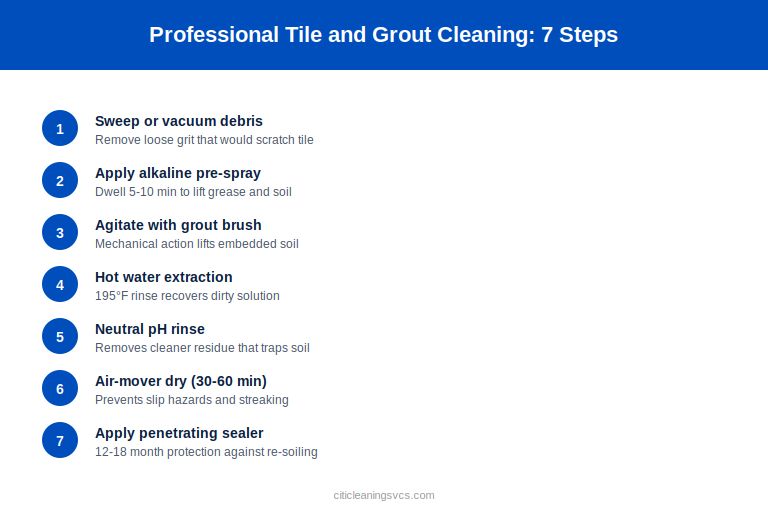
Step 1: Dry sweep or vacuum. Loose grit is abrasive and will scratch the tile surface if you skip it and go straight to wet cleaning. Two minutes of dry work protects hours of wet work.
Step 2: Alkaline pre-spray. An alkaline cleaner (pH 10-12) breaks the bond between soil and grout. Let it dwell 5 to 10 minutes. Do not let it dry — reapply if you need more time.
Step 3: Mechanical agitation. Use a stiff grout brush or a rotary machine with a grout-brush attachment. Scrub every grout line in a defined pattern so you do not miss sections. Agitation is where 80% of the actual cleaning happens.
Step 4: Hot water extraction. A truck-mount or high-powered portable extractor delivers 195°F water under pressure and immediately recovers the dirty solution. This is the step home cleaning methods cannot replicate.
Step 5: Neutral pH rinse. Alkaline residue attracts soil back into the grout within days. A neutral rinse removes it. Skip this step and your floor re-soils in a week.
Step 6: Forced air drying. Air movers dry the floor in 30 to 60 minutes. Wet floors are slip hazards and dry with streaks if left to air-dry naturally.
Step 7: Penetrating sealer. A quality penetrating sealer provides 12 to 18 months of protection against re-soiling and stains. Never skip this on a facility floor.
Commercial tile and grout deep cleaning runs $0.55 to $1.25 per square foot for cleaning only, and $0.85 to $1.75 per square foot when sealing is included in the same visit. Regrouting runs $4 to $8 per linear foot. Color-sealing grout runs $1.25 to $2.50 per square foot. These are Central Florida market ranges for 2026.
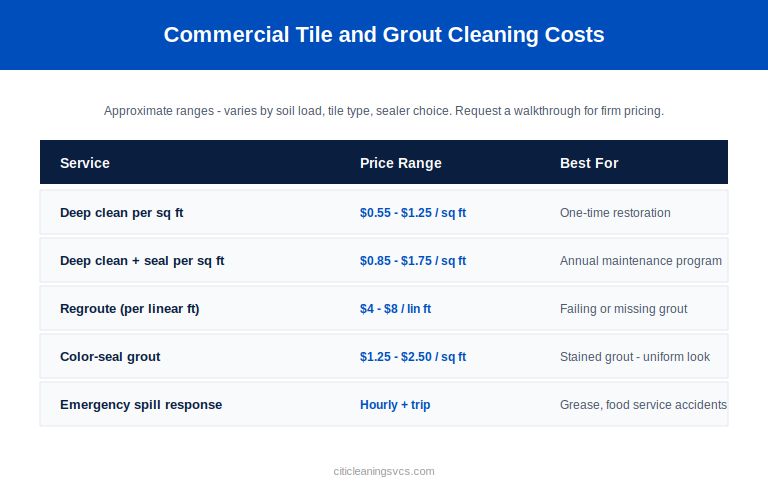
The variables that move the price up: heavy soil load, food service or grease exposure, tile type (natural stone costs more than porcelain), grout width (wider grout takes longer), and access constraints (moving furniture, working around business hours).
Variables that move price down: repeat customer on a scheduled program, larger square footage in one visit (economies of scale), and combining tile cleaning with other floor care work like VCT stripping and waxing in the same visit.
The honest way to compare quotes: ask for the price per square foot including sealer, plus the specific chemical products used, plus how many hours the crew estimates on-site. A vendor quoting $0.35 per square foot is probably skipping the extraction step or the sealer — both are how “cheap” tile cleaning becomes an expensive re-clean six months later.
According to Tile Council of North America (TCNA) guidance, proper maintenance can extend a commercial tile floor’s usable life to 50 years or more. Poor maintenance shortens that to under 10.
Call a professional tile and grout cleaner when grout has visible staining that mopping will not remove, when the last sealer application was over 18 months ago, when the floor is being prepped for lease turnover or an inspection, or when the affected area exceeds 500 square feet with high soil load. Everything else can usually be handled by the in-house cleaning team.
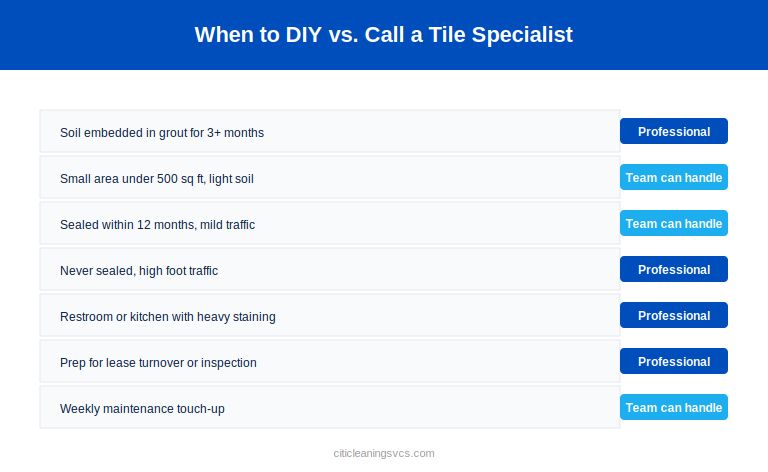
The rule of thumb: your team can maintain, but only a professional can restore. Maintenance means daily damp mopping and weekly deck brushing. Restoration means bringing 195°F extraction equipment, alkaline pre-treatment, and penetrating sealer to a floor that has degraded beyond what daily care can fix.
Trying to restore in-house without the right equipment usually produces one of two outcomes. Either the crew does not have enough extraction power and the floor looks marginally better for two weeks. Or the crew uses a stronger chemical, strips the sealer, and creates a floor that re-soils faster than before.
The economics also favor calling a professional for restoration. Renting the right extraction equipment for a weekend costs more than a professional visit, and the labor time comes out of your team’s regular cleaning schedule.
Restaurant, healthcare, and food-processing facilities have the shortest window between professional visits. Retail and office space can typically stretch to quarterly.
Seven preventive habits extend the life of a commercial tile floor and reduce how often you need professional restoration: sweep entrances multiple times daily, install extended walk-off matting, use only neutral pH cleaners for daily maintenance, change mop water frequently, re-seal on schedule, respond to spills within five minutes, and stick to a quarterly extraction cadence rather than reactive cleaning.
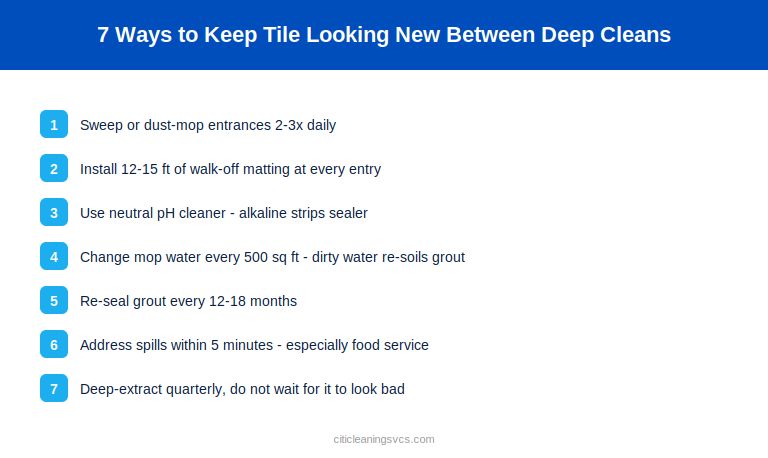
Sweep or dust-mop entrances 2 to 3 times per day. Grit tracked in from outside is the single largest source of embedded grout soil. Frequent sweeping is the highest-ROI preventive action.
Install 12 to 15 feet of walk-off matting at every entrance. The first 6 feet catch water, the next 6 feet catch soil. Anything less and grit walks straight onto your tile.
Use neutral pH cleaners for daily work. Alkaline cleaners strip sealer. Acid cleaners etch grout. Neutral pH (7-8) protects both.
Change mop water every 500 square feet. Dirty mop water re-deposits soil into grout pores. Bucket-and-wringer systems with dual chambers help.
Re-seal grout every 12 to 18 months. Sealer wears off from foot traffic and cleaning chemicals. A fresh coat every year keeps the protective barrier intact.
Respond to spills in 5 minutes. Especially in food-service areas. Grease and colored liquids stain grout permanently if left more than an hour.
Stick to a quarterly extraction cadence. Do not wait for the floor to look bad. Scheduled extraction is cheaper than reactive restoration by a factor of three to five.
Facilities that adopt these seven habits typically reduce their annual tile and grout maintenance budget by 20-30% while achieving a better-looking floor.
Four problems account for most commercial tile and grout service calls: gray or dark grout lines from embedded soil, cracked or missing grout, efflorescence (white powder residue), and slippery tile from residue buildup. Each has a defined professional fix that a maintenance crew cannot replicate.
Gray or dark grout lines — the most common complaint — result from soil embedded deep in the grout pores. The fix is alkaline pre-treatment, mechanical agitation, hot water extraction, and re-sealing. In severe cases, color sealing restores a uniform look without regrouting.
Cracked or missing grout is a structural problem. The fix is grout removal with an oscillating tool, re-grouting with matching color and formulation, curing, and then sealing. Attempting to spot-fill cracks with new grout without removing the old material creates uneven texture and color.
Efflorescence — the white powder that appears on grout lines — is mineral salts leaching to the surface from moisture underneath. The fix is identifying the moisture source (leaks, high humidity, improper installation) and then treating with an efflorescence remover.
Slippery tile from residue buildup often comes from over-application of sealer or from using self-shine floor finishes designed for VCT on tile that should not be shining. The fix is stripping the built-up finish with a compatible stripper and re-sealing correctly.
Diagnosing the actual cause matters more than jumping to a fix. The wrong fix (regrouting a floor with efflorescence, for instance) makes the underlying problem worse.
Tile and grout maintenance also intersects with other facility care programs. Related reading: what facility maintenance covers, how often to strip and wax VCT floors, and Citi’s facility maintenance program. Facilities in warehouse environments, transportation hubs, and education campuses tend to have the most demanding tile care requirements — heavier grit tracking, more spills, and shorter maintenance windows. If you would like an on-site walk-through of your current program, the Citi Cleaning Services team has run floor care programs across Central Florida for over 20 years.
Most commercial facilities need professional tile and grout cleaning every 3 to 6 months. Restaurants, healthcare facilities, and food-processing areas need it every 30 to 90 days. Low-traffic office and conference room tile can stretch to every 6 to 12 months. The trigger to move up the schedule is visible grout darkening between quarterly visits.
Daily cleaning uses a neutral pH cleaner (pH 7 to 8) with a microfiber mop. Deep cleaning uses an alkaline pre-spray (pH 10 to 12) followed by hot water extraction and a neutral rinse. Avoid acid cleaners and bleach on grout – they etch the grout and strip sealer. Chemical brand names vary, but the pH ranges matter more than the brand.
Not always. Basic deep cleaning is priced separately from sealing. Ask specifically whether the quote includes a penetrating grout sealer applied after cleaning. If it does not, expect to add $0.30 to $0.50 per square foot for sealer. Sealer is the single most important step for keeping the floor clean between visits.
A professional crew can deep clean 500 to 1,000 square feet per hour depending on soil load and tile type. Add 30 to 60 minutes for drying time before the floor is walk-safe. Sealer applications add another 30 minutes plus 4 to 8 hours cure time before heavy foot traffic returns.
Yes, in most cases. Hot water extraction with proper alkaline pre-treatment restores 80 to 90 percent of stained grout. For the remaining stubborn areas, color sealing coats the grout in a uniform color and eliminates the appearance of staining entirely. Full regrouting is only needed when grout is structurally cracked or missing.
Yes – scheduled maintenance runs roughly 20 to 30 percent of the cost of restoration when a floor has been neglected. A quarterly $500 maintenance visit prevents a $3,000 restoration two years later. It also extends the usable life of the floor from under 10 years to 50 or more years per Tile Council of North America guidance.
Natural stone tiles – marble, travertine, slate – are sensitive to acid cleaners and need specialty products. Porcelain and ceramic tile tolerate a wider range of chemicals but grout lines still need neutral pH care. Terrazzo has its own honing and polishing requirements. Always identify tile type before selecting cleaner and method.
Deep tile and grout cleaning is typically a separate line item from routine janitorial service. Daily damp mopping belongs in the janitorial scope. Quarterly hot water extraction and annual sealing should be scheduled specialty work priced per square foot. Bundling both into one contract simplifies scheduling but keep them as distinct line items for budget clarity.
Assessing and improving your tile and grout program is a straightforward exercise. Run this four-step plan in the next two weeks to catch problems before they become expensive.
