
Comparing commercial cleaning bids is not a spreadsheet problem. It is a scope problem.
This guide shows you a defensible framework for a commercial cleaning bid comparison that surfaces hidden costs, aligns apples-to-apples, and prevents the “cheapest wins” mistake that costs you a full re-bid a year later. You get a side-by-side template, a weighted scoring model, and the reference-call questions that predict long-term quality.
Family-owned providers like Citi Cleaning Services have watched facility managers run this process across Central Florida offices, warehouses, retail, and education campuses for 20+ years. The pattern is consistent: the bids that look “cleanest” on the surface are almost always the ones with the loosest scope.
The tactic worth reading twice: how you weight retention rate versus price per hour (Step 4). Get that wrong and your vendor becomes a rotating door.
Key Takeaways
- Normalize scope first. Never compare prices before you have matched task lists and frequencies.
- Use a side-by-side template. Line-item alignment is what exposes gaps most FMs miss.
- Hunt for hidden costs. Consumables, rush fees, callout charges, and renewal escalators are where budgets break.
- Weight retention over price. A vendor with 10+ year client tenure signals operational stability.
- Confirm with real references. The 6th-month check is more predictive than the 1st-month honeymoon.
You cannot compare two bids until they describe the same job.
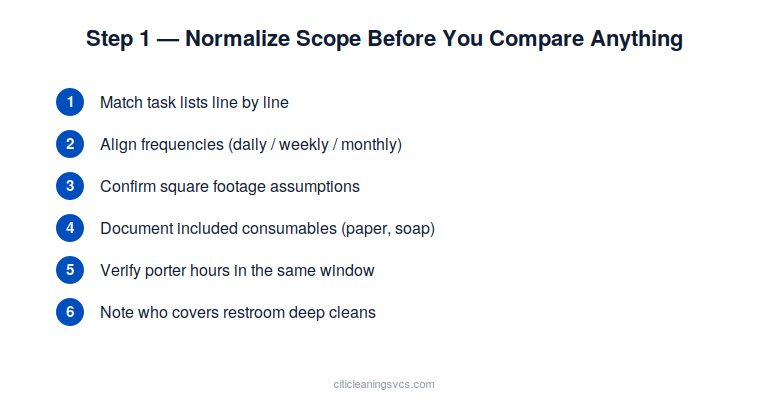
Every vendor writes proposals differently. Some list every task. Some bundle. Some quietly exclude what feels obvious. Your first move is to translate every proposal into a common format.
Normalize these four dimensions:
If a bid does not spell out one of these, that is not an oversight. It is a signal to ask for it in writing before scoring.
Alignment is what makes the rest of this process defensible.
A spreadsheet is the cheapest quality-control tool you own.
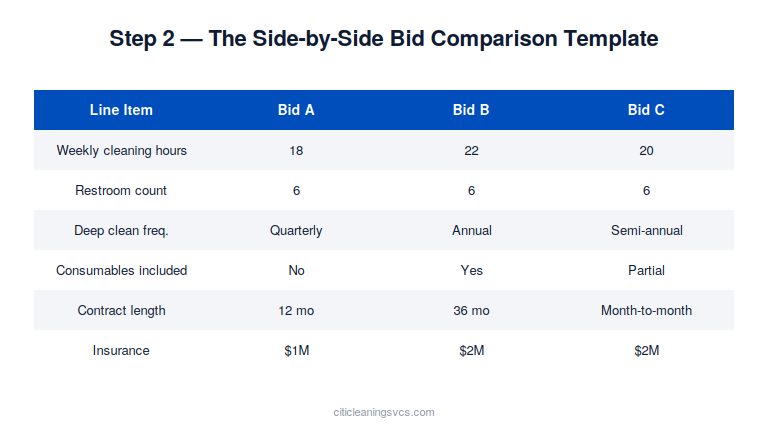
Once scope is normalized, put every bid into columns on a single sheet. Rows should include: task categories, weekly hours, restroom counts, deep-clean cadence, consumables, contract length, insurance limits, workers’ comp certificate, and the total monthly rate.
Two rules for the template:
See our related guide on what should be in a commercial cleaning contract for the standard contract language every finalist bid should include.
When you can look across the row and see 18 hours vs 22 hours vs 20 hours in three columns, the differences stop hiding.
The bids that look cheap almost always have the deepest hidden costs.
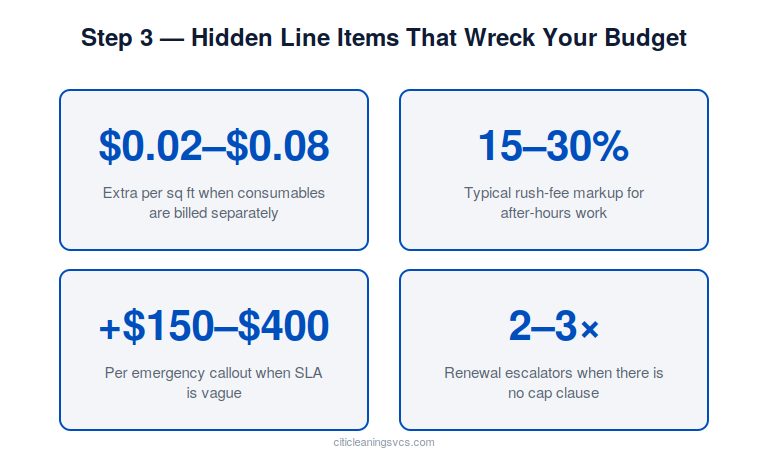
The five common places money leaks:
The ISSA (International Sanitary Supply Association) publishes cost-benchmarking data facility managers can reference when a bid feels 30% under market.
If a vendor cannot answer these five in writing, you do not have a comparable bid.
Price alone is a bad decision. A weighted score forces you to name what actually matters.
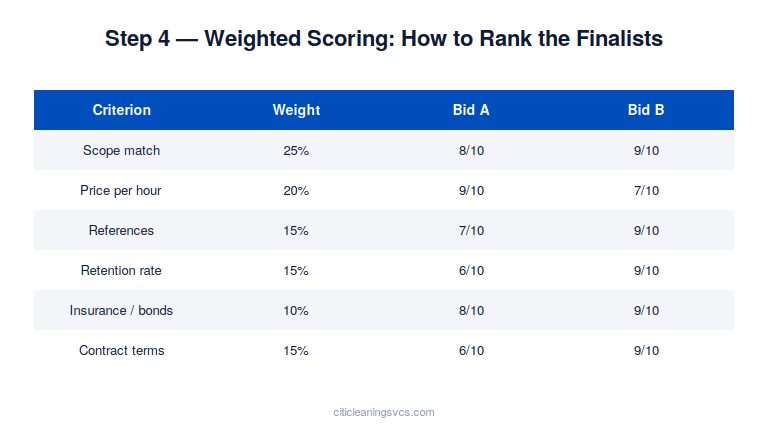
A defensible weighting for most Central Florida facilities:
Notice retention is weighted equal to price. That is intentional. A cleaning company with 10+ year average client retention operates differently than one with 12-month churn. Retention is the leading indicator of the service you actually receive after month three.
Cross-reference with our guide to the warning signs of a failing cleaning vendor before you finalize weights.
Score each bid 1–10 on every criterion. The final number tells you where to focus your reference calls.
Every vendor gives you their best references. Your job is to ask questions those references cannot rehearse.
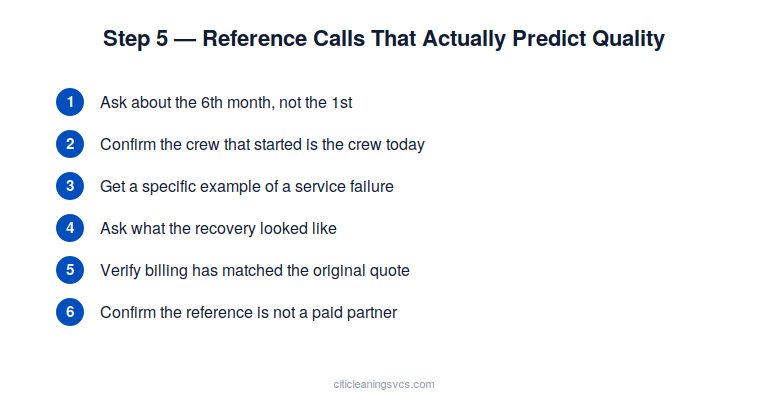
The seven questions that separate good from great:
Ask specifically about the sixth month — not the first. The honeymoon month is easy. The sixth month reveals whether the vendor’s operations model actually scales.
The whole process is short when you follow it in order.
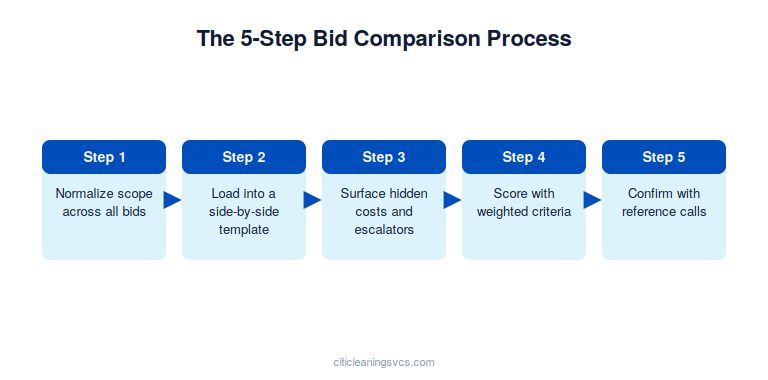
Normalize scope. Load into a template. Surface hidden costs. Score with weights. Confirm with references. Every skipped step is a landmine six months later.
Family-owned providers like Citi Cleaning Services welcome buyers who run a rigorous bid process because the outcome usually maps to a fit. Contract-free arrangements, M/WBE certification, 10+ year average client retention, and OSHA-certified crews all show up cleanly on a weighted scorecard.
Comparing price before normalizing scope. Two bids with different task lists cannot be compared until you translate them into a shared template.
Only if it also wins on scope match and retention. Lowest bid usually reflects a narrower scope, a shorter task list, or a leaner staffing model.
Three to five is standard. Fewer than three limits comparison. More than five typically wastes your time and theirs.
Month-to-month or annually renewable with a defined cap. Multi-year contracts with 5%+ escalators are where facilities get locked into worsening service.
General liability of M–M per occurrence, workers’ compensation compliant with state law, and a certificate naming your facility as additional insured.
Verify each vendor walked the same space. Some quote rentable, others cleanable. Ask for a floor plan markup showing zones included and excluded.
Four to six weeks from RFP release to selection. Faster than that skips due diligence. Slower than that risks losing the strongest vendors to other work.
For facilities with sustainability commitments or larger portfolios — yes. For most Central Florida offices under 50,000 sq ft, credentials matter less than references and retention.
