
Choosing the wrong commercial cleaning company costs more than the invoice line item. It costs tenant complaints, missed inspections, insurance headaches, and — eventually — the cost of switching all over again.
This guide walks through the exact evaluation process our operations team at Citi Cleaning Services uses when we help facility managers, procurement leads, and property owners audit their existing janitorial spend. We built the framework from 20+ years serving Central Florida buildings (Citi was founded in 2004) and roughly 100 vendor transitions we have supported over the last five years.
You will walk away with a weighted scorecard, a reference-call template, a scope-of-work checklist, and the specific insurance and compliance documents to request before you sign anything. Print it, share it with your team, and use it every time an incumbent contract comes up for renewal.
Key Takeaways
- Use a weighted 100-point scorecard, not a vibe. Reputation (25), operations (25), pricing transparency (15), insurance and compliance (15), technology (10), sustainability (10).
- Insurance verification is a five-minute deal-breaker. Request a COI, workers’ comp proof, and a bond before any pricing conversation.
- Structured reference checks beat online reviews. Call three vertical-matched clients and ask five specific questions each.
- The scope of work is the contract’s heart. Vague scopes cause 80% of vendor disputes; specific scopes prevent them.
- Prefer contract-free, month-to-month arrangements so the provider earns your renewal every month.
- Right-fit is more important than lowest bid. The lowest bid often wins the first year and loses the second when service degrades.
Most commercial cleaning RFPs are decided on price. The building sends a scope, three or four vendors bid, and the middle-lowest bid wins. Ten months later the property manager is fielding tenant complaints and drafting another RFP.
The pattern repeats because RFPs measure the wrong thing. Price is easy to compare on a spreadsheet. Retention, supervision cadence, crew training, and emergency responsiveness are not. So they get ignored — and those are the exact variables that determine whether the account works.
The framework below flips that pattern. It measures the difficult-to-see variables first, price last. Vendors who score high on operations tend to price at market; vendors who score low almost always underbid on purpose.
By the end of the guide, you will have a repeatable score you can defend to leadership, a paper trail your risk team will approve, and a clear-eyed view of which vendor actually deserves the contract.
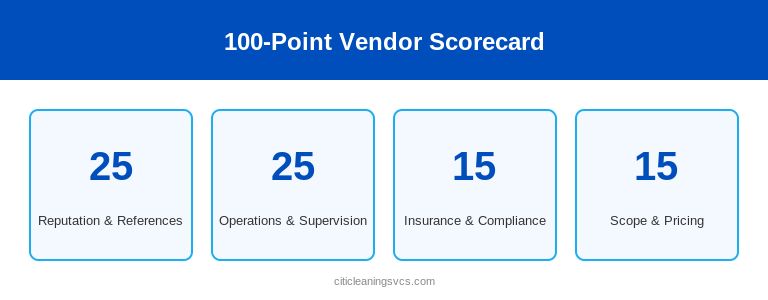
Use this scorecard to compare vendors side by side. Score each category from 0 to the maximum shown. The winner is not always the highest total, but any vendor under 70 points should be dropped.
Reputation and References (25 points). Client retention (10), industry-vertical experience (5), verified references (5), online review consistency across three platforms (5). A vendor with 10-year clients in your industry scores full marks. A vendor with mixed reviews and only one long-tenure client scores half.
Operations and Supervision (25 points). Documented supervisor cadence (7), crew retention rate (7), on-site training program (5), quality assurance walk-throughs (6). Ask specifically how many supervisor visits per month, what training new hires receive in their first two weeks, and how QA is documented.
Insurance, Bonding, and Compliance (15 points). Certificate of insurance with correct limits and additional insured (5), workers’ compensation coverage (3), janitorial bond (3), Sunbiz filing and business tenure (4). Any missing document zeros the category.
Scope and Pricing Transparency (15 points). Written scope with frequency, tasks, exclusions (5), pricing broken out by service line (5), no auto-renewal or termination penalties (5). Look for line-item transparency, not a monthly lump sum.
Sustainability and Health (10 points). Green Seal-aligned products (4), SDS binder on cart (3), microfiber and HEPA-vac protocols (3). LEED-familiar providers score highest here.
Technology and Communication (10 points). Digital inspection reporting (4), work-order tracking (3), 24/7 phone with human answer (3). Ask for a screenshot of the reporting tool before scoring.
The scorecard forces evaluators to look past the pitch deck. Every score becomes an artifact you can attach to the procurement file — which matters when a decision gets questioned six months later.
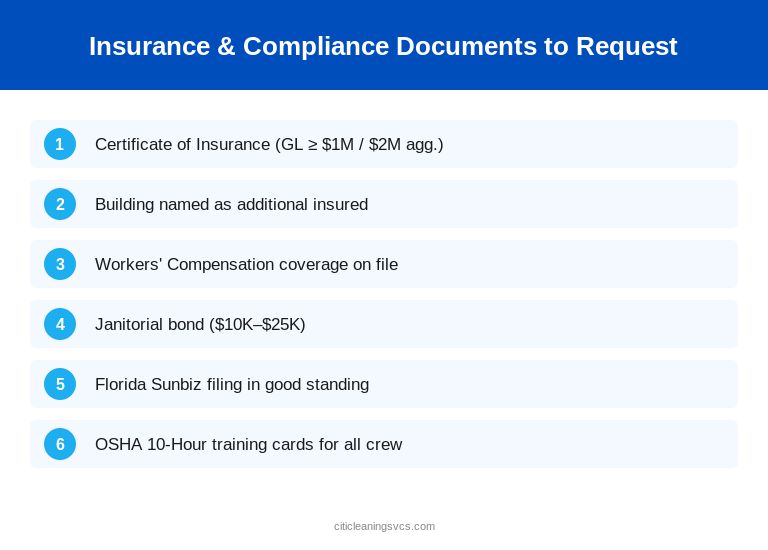
Do not accept a single price quote from any vendor who has not produced the following documentation. This is the fastest way to cut a shortlist from ten vendors to four.
Certificate of Insurance (COI). Require general liability of at least $1M per occurrence and $2M aggregate. Ask that your building or property management company be listed as additional insured. A legitimate provider emails the COI within 24 hours; hesitation here is disqualifying.
Workers’ Compensation. Florida law requires workers’ comp for construction contractors with 1+ employees and non-construction contractors with 4+. The Florida Division of Workers’ Compensation maintains the public database — verify each vendor there.
Janitorial bond. A janitorial bond (typically $10,000–$25,000) protects your building against theft or property damage by cleaning crews. It is inexpensive for legitimate providers and unusual for underqualified ones. Ask for a copy.
Florida Sunbiz filing. Search Sunbiz for the vendor’s active registration. Look for consistent filings, no lapses, and 5+ years of operating history. Fly-by-night shops rebrand every couple of years.
Insurance and compliance verification is the single highest-leverage 30 minutes in the vendor evaluation. It eliminates most of the risk before the operational review even begins.
Every provider hands over a reference list. Fewer than 15% of prospects actually call the numbers. Call all three.
Ask each reference the same five questions. Consistency lets you score responses across vendors on the same axis.
Question five is the litmus test. A confident “yes” plus a specific reason wins the reference call. A hesitation of two seconds or a diplomatic non-answer is a warning.
Also ask for one reference from a client who left the provider in the last 12 months. Legitimate operators can produce this and will explain the parting honestly — usually a scope mismatch or a change in the client’s ownership. A refusal to provide any former client is a red flag.
Reference calls verify the provider can hold a long-term account. Online reviews cannot do that; they measure isolated interactions, not multi-year relationships.
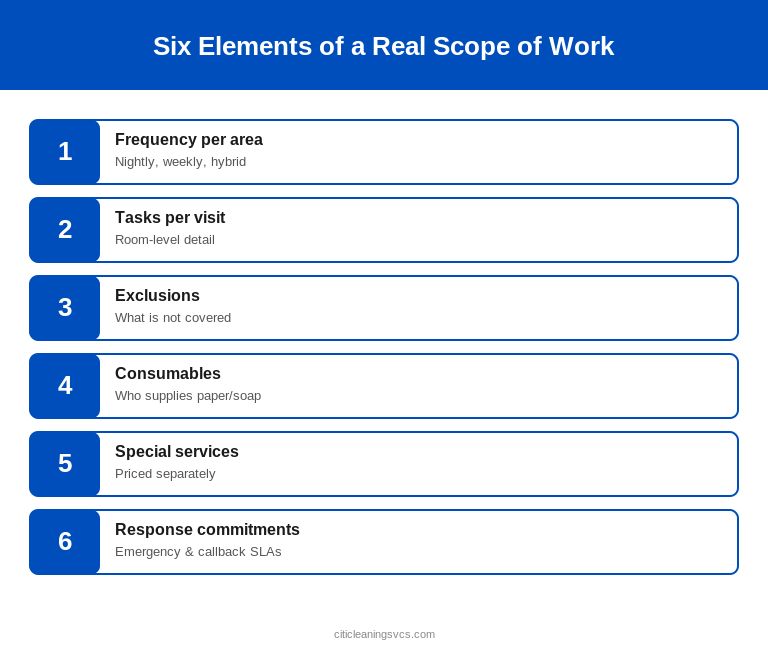
The scope of work is the contract’s heart. Vague scopes create 80% of the disputes that follow. Specific scopes prevent them.
A real janitorial scope specifies six elements at a minimum:
Ask for a written scope within five business days of the site walk. If what you receive is a one-page brochure with a monthly price and no room-level detail, the vendor is guessing. Move on.
For related reading on scope specifics see our clause-by-clause contract guide, how to read a cleaning proposal, and our bid-comparison tool.
A daytime professional office and a 24/7 distribution warehouse do not need the same provider. The evaluation must measure fit, not just capability.
For professional office buildings, prioritize consistent night crews (6 p.m.–10 p.m. or 10 p.m.–2 a.m.), weekly supervisor walks, and low crew turnover. Ask each vendor for their turnover rate. Under 25% annually is best-in-class; over 60% predicts service problems.
For warehouses, distribution, and light industrial, prioritize weekend deep-clean crews plus day porters for restrooms and break areas. Confirm the vendor understands OSHA slip-and-fall standards and can staff crews across dock schedules. See our warehouse cleaning service page for typical Central Florida scopes.
For retail centers and mixed-use, day porter coverage during business hours is essential. Verify the vendor can staff a single porter position without rotating four different people through it every month.
For educational and public-sector facilities, background-checked crews, district-compliance paperwork, and an insurance program that names the district as additional insured are baseline expectations.
Citi runs all four service models across our Central Florida book, plus additional deployments in Jacksonville, Ocala, and Miami. See our full services overview and janitorial services in Orlando for detail.
Operational fit is what predicts a two-year renewal. A vendor who cleans well but does not fit the operational rhythm of your building will get complaints — and eventually a rebid.
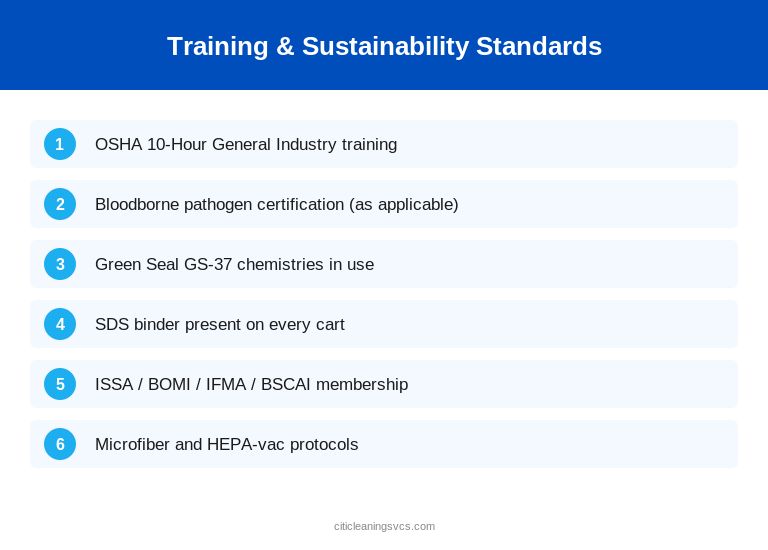
Ask for documentation on three specific certification areas. Legitimate providers can produce them without hesitation.
OSHA training. Every crew member should complete OSHA 10-Hour General Industry training in their first 60 days. Bloodborne pathogen training is a separate module and matters for restrooms, gyms, medical waiting areas, and schools.
Green Seal and product safety. Confirm cleaning chemistries carry Green Seal GS-37 certification or equivalent. Ask for the SDS binder and verify it is current. Providers who cannot produce SDS documentation are operating outside federal regulation.
Industry association membership. Membership in ISSA, BOMI, IFMA, or BSCAI signals investment in the profession. Most fly-by-night operators skip the dues.
Citi’s crews are OSHA-certified, Green Seal-aligned, carry SDS documentation on every cart, and follow microfiber-and-HEPA protocols in every space. These are procedural standards, not marketing lines — verify them the same way with any vendor you evaluate.
Training and sustainability standards separate providers who invest in their crews from providers who churn through gig labor. The difference shows up in year two.
Cleaning contracts often bury three traps that only surface when you try to leave.
Auto-renewal clauses. Multi-year contracts frequently renew for another full year unless you send written cancellation 60–90 days before the anniversary. Miss the window and you are locked in for another 12 months at the vendor’s escalated rate.
Early termination penalties. Some contracts require two to three months of service fees to cancel early. That penalty exists specifically because the vendor knows you will want to leave when service slips.
Unilateral price escalations. Look for language that lets the provider raise rates 5–15% annually “for CPI adjustments” or “scope creep” without your explicit approval. Cross those clauses out or negotiate a cap.
The cleanest structure is contract-free — month-to-month with 30 days’ written notice on either side. It aligns incentives: the provider earns your business monthly, and you keep the relationship because service is good, not because leaving is expensive.
Citi has run contract-free since 2004. Clients renew because we perform, not because paperwork locks them in. For deeper reading see our commercial cleaning contracts guide.
Contract terms decide what happens on your worst day. Read them carefully before you sign anything.
Before committing to a 12- or 24-month agreement, run a 30- to 90-day pilot with the top-scoring vendor. Use a defined scope, weekly QA walk-throughs, and an exit clause that lets you extend or terminate at the end of the pilot.
During the pilot, track four things every week:
A pilot period costs the vendor nothing and gives you real data before you commit budget for a year. Reputable providers welcome pilots because they close well; underprepared vendors resist them for the same reason.
See our companion pieces on red flags that a vendor is failing and the janitorial services comparison guide for the metrics to track during a pilot.
Piloting before signing is the last, cheapest defense against a bad multi-year commitment. Use it.
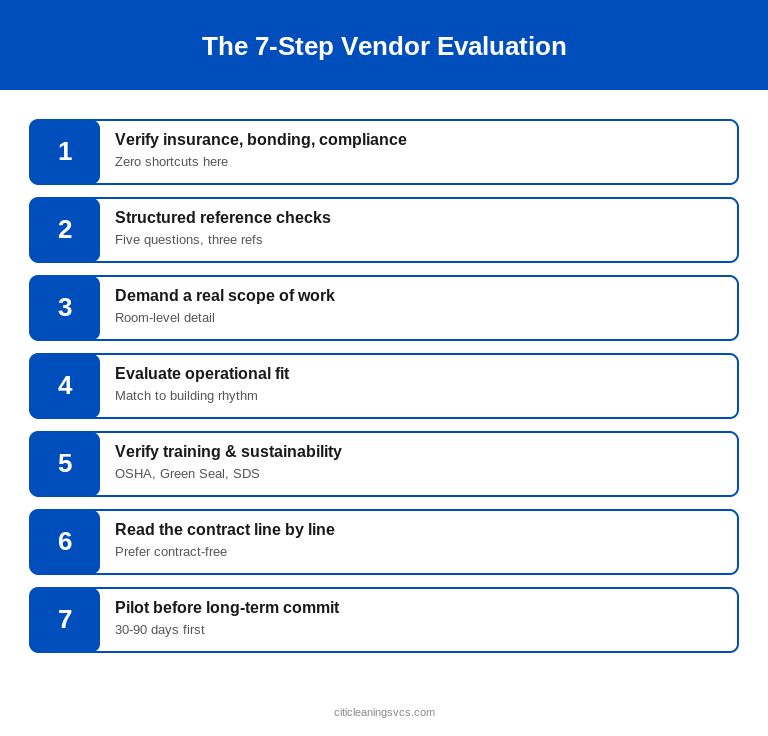
The evaluation framework above is a repeatable process. Any vendor that clears every step deserves consideration; any vendor that stumbles on more than two should be dropped.
Total time investment: roughly 8–12 hours spread across three to four weeks. That investment prevents months of complaint tickets, tenant escalations, and the eventual cost of another RFP cycle.
If you are running procurement in Orlando, Kissimmee, Sanford, Winter Park, Lake Mary, or elsewhere in the Central Florida corridor, reach out to Citi Cleaning Services at (407) 540-1850 or visit citicleaningsvcs.com for a full evaluation walk-through. We keep our COI, workers’ comp, bond, and OSHA cards updated so procurement teams can request documentation any business day and receive it the same day.
Every hour spent on structured evaluation saves ten hours on complaint resolution later. See how much commercial cleaning costs and our complete guide to commercial cleaning for context on typical Central Florida budgets.
Client retention. A provider whose average client stays 5+ years is winning the operational trade-offs that separate a functional account from a failing one. Retention is a lagging indicator of every other variable you are trying to measure.
Normalize scope first. Ensure every bid is scoped to the same square footage, frequency, and task list. Then compare per-square-foot per-visit pricing, not monthly totals. See our bid comparison guide for the full template.
Three to four weeks from RFP release to signed pilot agreement. That includes shortlisting (1 week), documentation review (3 days), site walks (1 week), reference checks (3 days), and contract negotiation (1 week).
For portfolios under six buildings, a single provider usually delivers better pricing, consistency, and account management. For larger portfolios, splitting by region or facility type can create healthy competition and reduce concentration risk.
Ask how they will access the building after hours, what supervisor cadence they commit to, what their crew turnover rate is, and what has gone wrong at similar accounts. Watch the specificity of the answers — vague answers predict vague service.
Not always, but usually. Underbid vendors typically win the first year by cutting insurance, training, or supervision — then their service degrades in year two. Weight price at 15 out of 100 in your evaluation, not 60.
Overlap the incumbent and the new provider by 5–10 business days. Do a joint walk-through at the start of the overlap. Confirm the new crew has building access, alarm codes, and consumables restocked before the incumbent’s last shift.
Month-to-month with 30 days’ notice is the buyer-friendly standard. If the vendor requires a longer term, cap it at 12 months with an early-termination clause you can invoke if scope-of-work KPIs are missed for two consecutive months.
The evaluation framework is powerful only if you use it. Here is the compressed version for your next vendor decision.
