
A commercial cleaning proposal is a legal document dressed up as a sales pitch. Most facility managers read it once and sign.
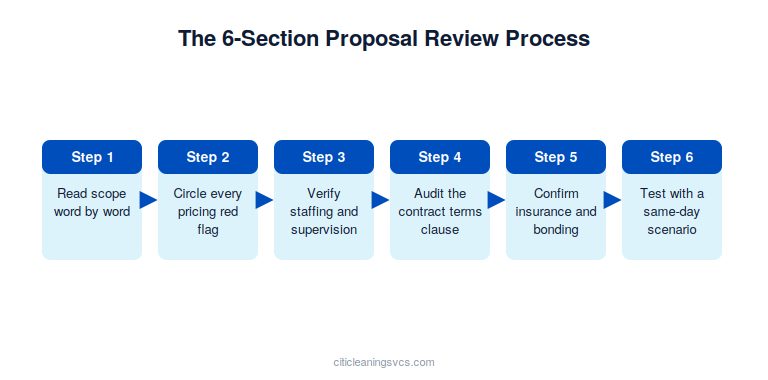
This guide flips the perspective. It shows you how to read a cleaning proposal the same way a seasoned facility manager reads a construction contract — section by section, red flag by red flag. You get the exact clauses to hunt, the hidden line items vendors bury, and the same-day scenario test that predicts operational fit.
Family-owned providers like Citi Cleaning Services have written and reviewed thousands of these documents across Central Florida in 20+ years. The patterns are consistent: the traps are almost always in Sections 2 and 4 — pricing and contract terms.
The one clause worth reading twice: auto-renewal with a 90-day notice window (Section 4). It is how facilities end up trapped in a contract they already outgrew.
Key Takeaways
- Read the scope like an inspector. If a task is not spelled out, it will not get done reliably.
- Circle every pricing surcharge. Consumables, callouts, and escalators are where budgets break.
- Verify staffing by name. A named account manager is worth more than a fancy service tier.
- Audit contract terms harder than price. Auto-renewal and cancellation clauses control your exit.
- Test with a same-day scenario. Ask what happens if you need a spot clean at 2 PM Wednesday.
The scope page is where the whole relationship gets defined.
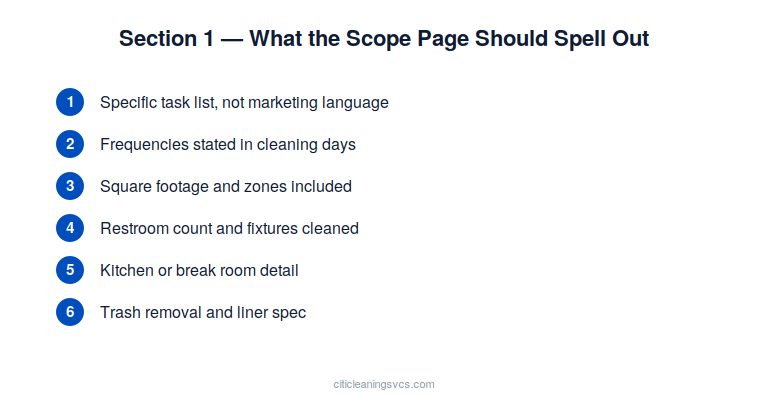
Vague scope is the #1 predictor of a bad service relationship. If the proposal says “general cleaning of common areas,” that phrase is legally elastic. It means whatever the vendor decides on a given Tuesday.
What the scope must spell out:
See our companion piece on what should be in a cleaning contract clause by clause for the standard language every scope section should include.
If a scope section is under one page for a facility above 15,000 sq ft, something is missing.
The base rate on page 3 is not the number you will pay.
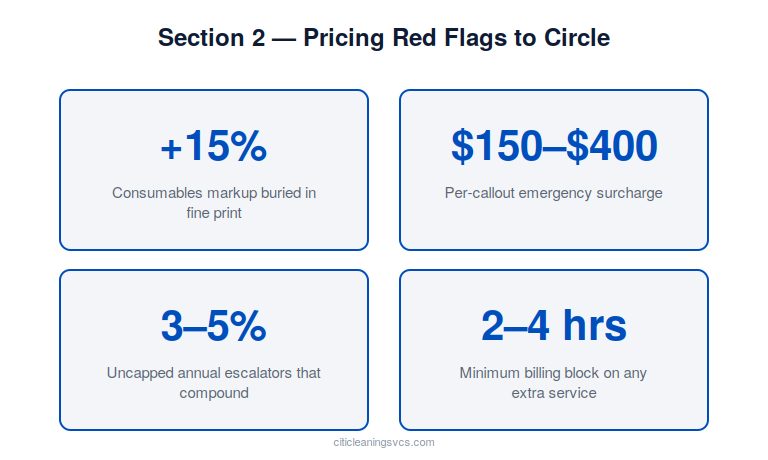
Vendors bury surcharges in appendices, footnotes, and the sentence right before the signature line. Your job is to find every one.
The five pricing red flags to circle:
According to BSCAI (Building Service Contractors Association International), transparent line-item pricing is a hallmark of professional providers.
Circle everything. Then ask for a version that removes the surcharges or names them explicitly on the front page.
People do the work. The proposal should name them.
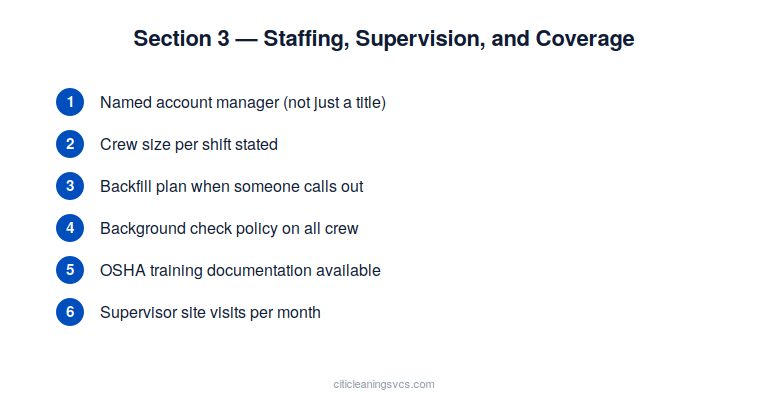
A proposal that describes “professional trained crews” without a specific staffing plan is describing a marketing bullet, not a service model.
What the staffing section must include:
Family-owned providers with 70+ trained cleaning professionals and 10+ year average retention typically detail this section thoroughly. That is the operational depth showing up on paper.
If the section reads as generic, ask for a named org chart before you sign.
Contract terms decide what happens when the relationship goes wrong.
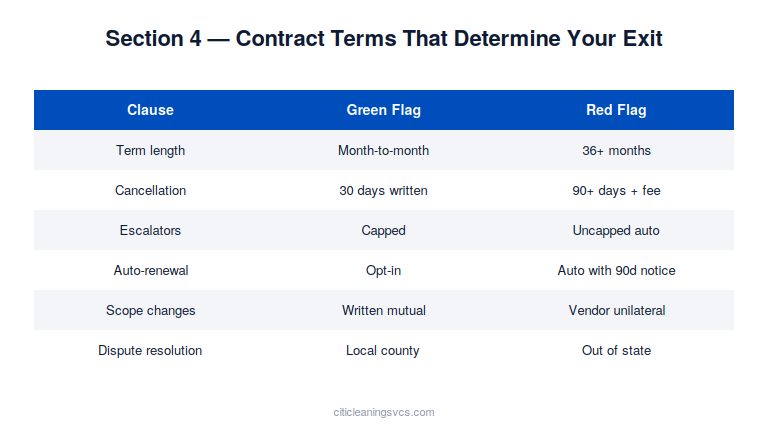
Most facility managers spend 10 minutes on price and 10 seconds on terms. That is backwards.
The six clauses that actually matter:
Contract-free arrangements exist for a reason. If a vendor cannot accept month-to-month, ask why.
Every professional provider carries the coverage. The proposal has to show it.
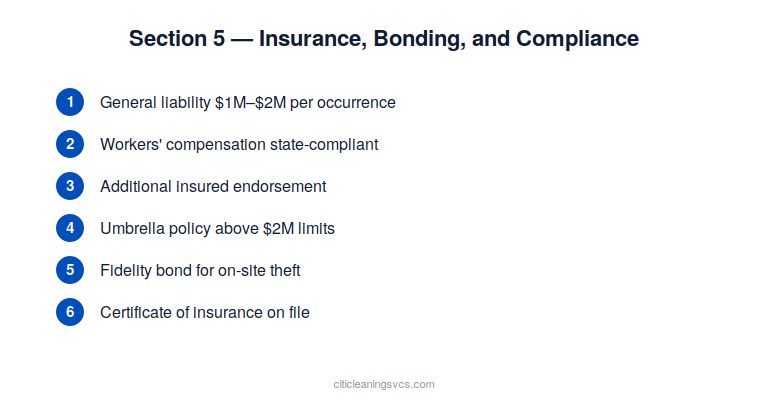
Insurance is the boring section. It is also the section that protects your building, your tenants, and your job.
What to verify:
Ask for the actual COI before you countersign. The proposal states the coverage — the COI proves it. Cross-reference with our warning-signs guide if a vendor delays producing it.
The final step is a stress test the vendor did not know was coming.
Ask this exact question: “It is 2 PM Wednesday and we have a spill in the main lobby before a 5 PM tenant tour. What happens?”
What the answer should include:
A provider with 24/7 service availability and a Central Florida focus answers this question in one breath. A provider with a national call center puts you on hold.
Vague scope language. Phrases like “general cleaning” without a specific task list mean whatever the vendor decides in the moment. Insist on named tasks and frequencies.
For facilities above 15,000 sq ft, expect 8–15 pages. Anything under 4 pages is skipping detail you need.
Yes, but they must be capped in writing. A 3% cap is common. Uncapped or CPI-linked escalators without a ceiling can compound significantly over a multi-year term.
Ask why. Most professional providers can offer contract-free arrangements. A hard requirement for a multi-year term usually reflects the vendor’s financial model, not yours.
Yes. The proposal states the coverage. The COI proves it. Get the COI in your file before the first cleaning day.
Only after normalizing scope and total weekly hours. Two different hourly rates on two different scopes are not comparable numbers.
2–4 hours for spills, safety hazards, or high-visibility zones. Anything longer is not truly 24/7 service.
For facilities with diversity procurement goals — yes, directly. For all facilities — it signals operational rigor because the certifications require documented HR, safety, and compliance practices.
