
Commercial janitorial services cover the recurring, scheduled cleaning work that keeps an office, retail space, or facility sanitary between deep cleans. Most contracts bundle trash removal, restroom sanitation, floor care, surface disinfection, and supply restocking into daily, weekly, or monthly visits.
Pricing depends on square footage, visit frequency, facility type, and the specific tasks in scope — not a flat industry rate.
This guide breaks down exactly what belongs in a commercial cleaning and janitorial services scope of work, what shapes the price you’ll pay, and how to compare bids from different janitorial services companies without getting burned by vague proposals.
You’ll walk away with a scope-of-work checklist, a frequency planning framework, and a side-by-side comparison method you can use on your next round of bids.
We wrote this because most “janitorial services” pages online are thin sales pitches, not real answers. Facility managers deserve a straight explanation of scope, cost drivers, and evaluation criteria — so that’s what follows.
Key Takeaways
- Scope varies by contract — janitorial services typically cover daily/weekly/monthly task tiers, not one fixed checklist.
- Pricing is driven by square footage, frequency, and facility type, not a universal per-hour rate.
- Service frequency should match traffic — high-traffic lobbies and restrooms need daily attention; storage areas don’t.
- Comparing bids apples-to-apples requires matching scope line-by-line, not just comparing bottom-line price.
- Contract-free agreements give facility managers more flexibility than long-term lock-in contracts.
- Certifications like OSHA training and Green Seal-aligned practices signal a provider takes safety and sustainability seriously.
Commercial janitorial services include the recurring cleaning tasks needed to keep a facility sanitary, safe, and presentable — trash removal, restroom sanitation, floor care, surface disinfection, glass cleaning, and supply restocking. These tasks are scheduled on a recurring basis, distinguishing janitorial work from one-time deep cleans or specialty projects.
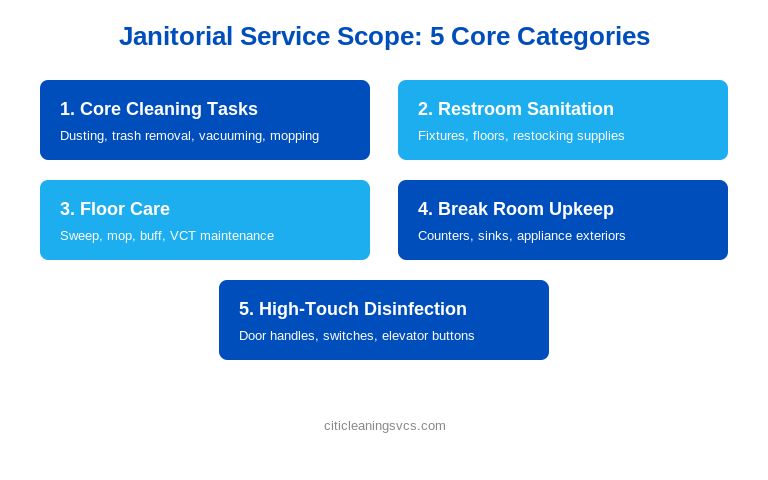
Every facility is different, but most scopes of work break down into five core categories. Understanding these categories helps you spot gaps in a provider’s proposal before you sign anything.
General cleaning covers dusting, trash and recycling removal, vacuuming, and mopping in common areas, hallways, and workstations. This is the baseline every janitorial contract should include.
Restrooms get the highest cleaning frequency in almost every contract. Expect toilet and sink sanitizing, mirror cleaning, floor mopping, and restocking of soap, paper towels, and toilet paper.
Floor care includes routine sweeping and mopping plus periodic deeper maintenance like buffing, scrubbing, or vinyl composition tile maintenance. Carpeted areas typically get vacuumed daily and spot-treated as needed.
Break rooms need counter wiping, appliance exterior cleaning, sink sanitizing, and trash removal. Common areas like lobbies and conference rooms usually get daily surface wiping and glass cleaning.
Door handles, light switches, elevator buttons, and shared equipment get disinfected on a set rotation. This category expanded significantly in facility contracts after 2020 and remains standard practice today.
In short: a complete janitorial scope covers general cleaning, restrooms, floors, break rooms, and high-touch surfaces — anything less is a partial contract. Next, let’s map out exactly how often each of these tasks should happen.
Use this matrix as a starting checklist when reviewing any janitorial proposal. Confirm each row is addressed and at what frequency.
| Area | Typical Tasks | Common Frequency |
|---|---|---|
| Restrooms | Sanitize fixtures, restock supplies, mop floors, empty trash | Daily |
| Lobbies & Entryways | Dust, vacuum/mop, glass cleaning, trash removal | Daily |
| Offices & Workstations | Trash removal, surface dusting, vacuuming | Daily or 3x/week |
| Break Rooms & Kitchens | Counter and sink sanitizing, appliance wipe-down, trash | Daily |
| Hard Floors | Sweep, mop, spot buff | Daily to weekly |
| Carpeted Areas | Vacuum, spot treat | Daily to weekly |
| High-Touch Points | Disinfect door handles, switches, rails | Daily |
| Interior Glass | Clean doors, partitions, low windows | Weekly |
| Deep Floor Care | Strip, wax, buff, or deep-scrub | Monthly to quarterly |
| Air Vents & High Dusting | Dust vents, ledges, light fixtures | Monthly |
Keep this matrix next to any proposal you’re reviewing and check off what’s actually written into the scope, not just implied. Now that you know what should be covered, let’s look at how to plan the right frequency for your facility.
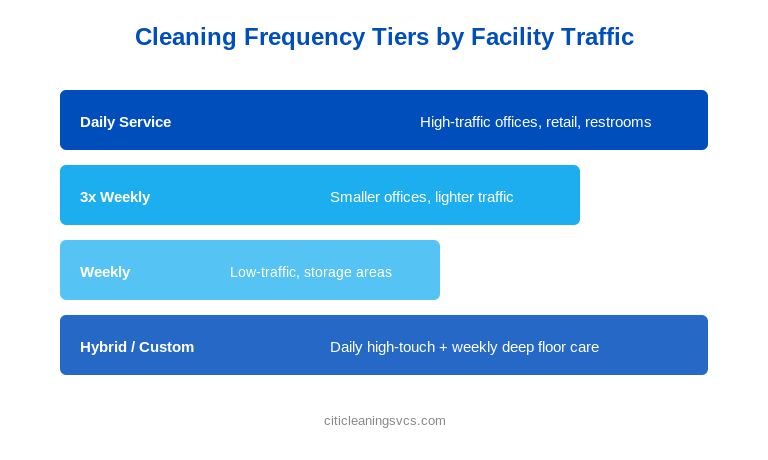
Cleaning frequency should match foot traffic and how the space gets used — high-traffic areas need daily attention, while storage or rarely used rooms need far less. Most commercial facilities land on one of four frequency tiers: daily, three-times-weekly, weekly, or a hybrid schedule that mixes daily high-touch cleaning with less frequent deep tasks.
Getting frequency right matters as much as getting scope right. Too little service leaves a facility looking neglected; too much wastes budget on areas that don’t need it.
Daily janitorial service fits offices, medical-adjacent spaces (non-clinical), retail, and any facility with regular foot traffic. Restrooms, break rooms, and entryways almost always need daily attention regardless of overall facility traffic.
Smaller offices or facilities with lighter traffic often do well on a Monday-Wednesday-Friday schedule. This tier works when restroom and trash volume don’t build up quickly between visits.
Weekly service suits low-traffic spaces like small satellite offices or storage-heavy facilities. It’s rarely sufficient for restrooms in any occupied building.
Many facilities mix frequencies by area — daily restroom and lobby service paired with weekly deep floor work. A good janitorial services provider will build a custom frequency plan around your actual usage patterns instead of selling a one-size-fits-all package.
Bottom line: match frequency to traffic, not to a generic template, and revisit the schedule seasonally if occupancy changes. Once frequency is set, the next question is what actually drives the price tag.
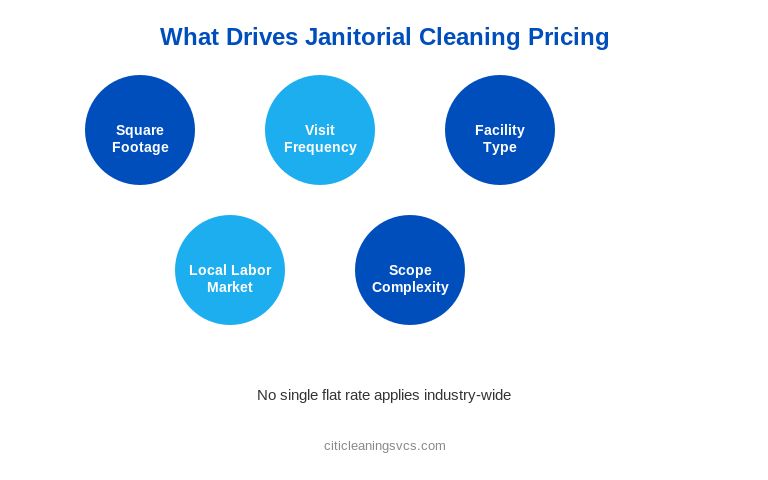
Janitorial pricing is driven by square footage, visit frequency, facility type, labor market, and the specific tasks included in scope — not a single flat industry rate. Two facilities of the same size can have very different quotes depending on how many of these factors apply.
Understanding these drivers helps you evaluate whether a quote is reasonable or whether it’s missing something.
Larger facilities generally cost more in total but often see a lower rate per square foot due to efficiency of scale. Layout matters too — a facility with many small rooms takes longer to clean than open floor plans of the same size.
More visits per week means more labor hours, which means higher monthly cost. This is usually the single biggest lever facility managers can adjust to fit budget.
Warehouses, medical-adjacent offices, and retail spaces all have different cleaning demands. Facility type affects everything from chemical selection to how much time restrooms and high-touch surfaces require.
Local labor costs directly affect janitorial pricing, which is why rates vary by metro area. Central Florida pricing, for example, differs from rates in larger national markets.
Specialty add-ons like floor stripping and waxing, high dusting, or window cleaning above ground level add cost beyond baseline janitorial service. A detailed cleaning proposal should itemize these separately from routine tasks.
Supply quality also plays a role. Providers using higher-grade paper products, liners, and dispensing systems typically build that cost into the base rate rather than surprising you with restocking fees later.
Third-party industry sources report commercial janitorial rates commonly fall in a broad per-square-foot range depending on these factors, so treat any single quoted number with skepticism until you know what’s included. If a bid looks unusually low, check whether frequency or scope has been quietly reduced. Next, let’s look at whether outsourcing actually costs less than staffing in-house.
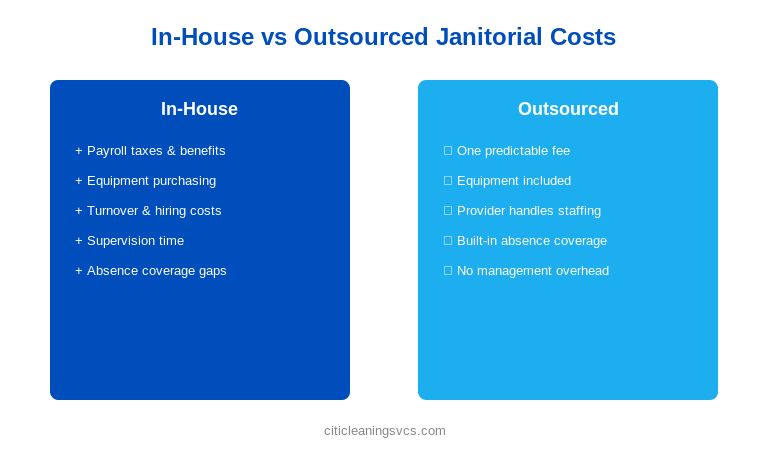
Outsourced janitorial services usually cost less than in-house staffing once you account for payroll taxes, benefits, equipment, supplies, and management overhead. In-house teams can make sense for very large single-site campuses, but most mid-size facilities save money and administrative time by outsourcing.
Here’s the full cost comparison most facility managers miss when they only look at hourly wage.
A contracted commercial cleaning and janitorial services provider typically bundles labor, supervision, equipment, and supplies into one predictable line item. Coverage for sick days and vacations is handled by the provider, not your facility team.
You also gain access to a broader talent pool and backup staffing. If a crew member calls out sick, an established provider sends a replacement instead of leaving your facility uncleaned for the day.
Very large single-site facilities with 24/7 operations sometimes justify a dedicated in-house crew. Even then, many facilities blend a small in-house team with an outsourced provider for overflow and specialty work.
The short version: outsourcing shifts fixed labor costs into a predictable service fee and removes the administrative burden of hiring, training, and covering absences. With cost drivers covered, let’s move into how to actually compare quotes from different providers.
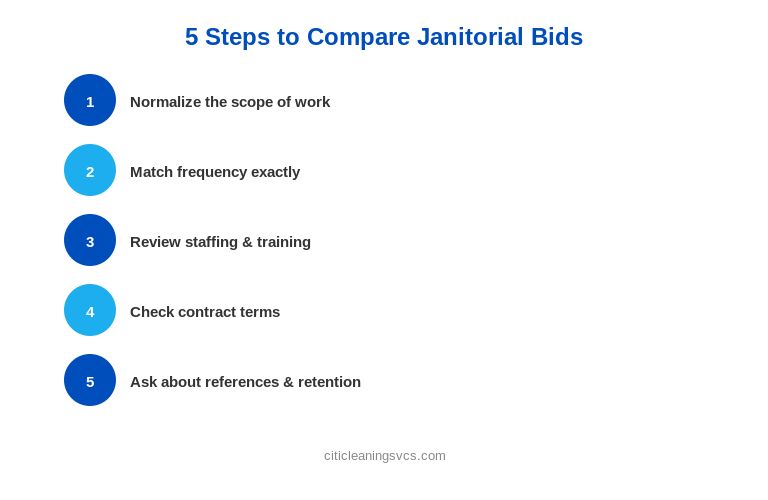
Comparing janitorial bids accurately means matching scope, frequency, and contract terms line-by-line before comparing price. Comparing bottom-line numbers alone almost always leads to picking the provider who cut the most corners.
Use this process every time you collect more than one proposal.
List every task each provider included and flag anything missing. A bid that skips high-touch disinfection or restocking supplies isn’t actually cheaper — it’s incomplete.
Confirm each provider is quoting the same visit frequency for the same areas. A weekly quote will always look cheaper than a daily one, but they aren’t the same service.
Ask how providers train and supervise crews, and whether staff carry OSHA safety training. This affects consistency and liability exposure more than most facility managers expect.
Look for lock-in length, cancellation terms, and price escalation clauses. A structured bid comparison tool makes this step far less error-prone than eyeballing three separate PDFs.
Provider client retention length is one of the most honest signals of service quality. A company with a track record of long-term client relationships is doing something right operationally.
In practice: the lowest number on a bid sheet is meaningless without confirming it covers the same scope and frequency as the competing bids. Once you’ve normalized the numbers, watch for these red flags before signing anything.
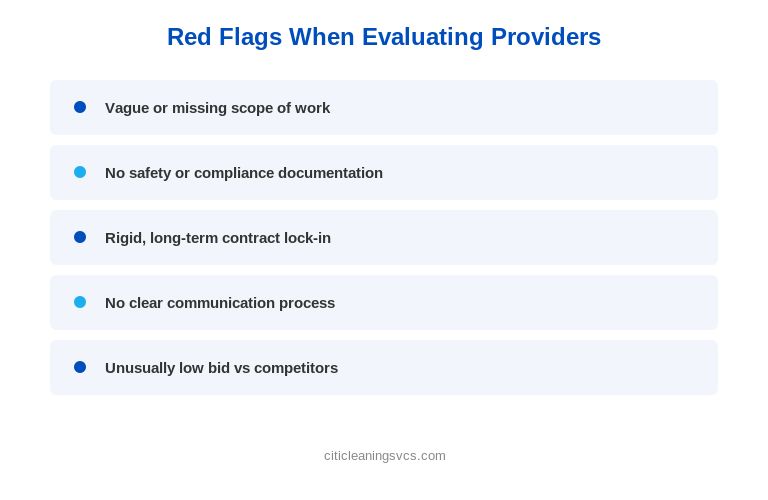
The biggest red flags in janitorial proposals are vague scope language, no mention of safety training, and long-term contract lock-in with steep cancellation penalties. Spotting these early saves facility managers from a bad year-long agreement.
If a proposal says “general cleaning” without listing specific tasks and frequencies, ask for clarification in writing. Vague scope is the number one source of disputes between facility managers and providers.
Providers should be able to confirm OSHA-related training for their crews. If a company can’t answer basic safety questions, that’s worth noting before you sign.
Some providers lock clients into multi-year agreements with steep early-termination fees. A contract-free service model gives facility managers the flexibility to switch if service quality drops.
Ask how you’ll report issues and how quickly they get resolved. A provider without a defined communication process usually means slow response times down the road.
A bid significantly below every other quote is usually cutting frequency, staffing hours, or supply quality somewhere you can’t see on paper. Go back to the scope matrix and confirm what’s actually included.
Watch for these patterns before you sign, not after service starts falling short. Last, let’s cover the contract terms and service-level details worth locking in writing.
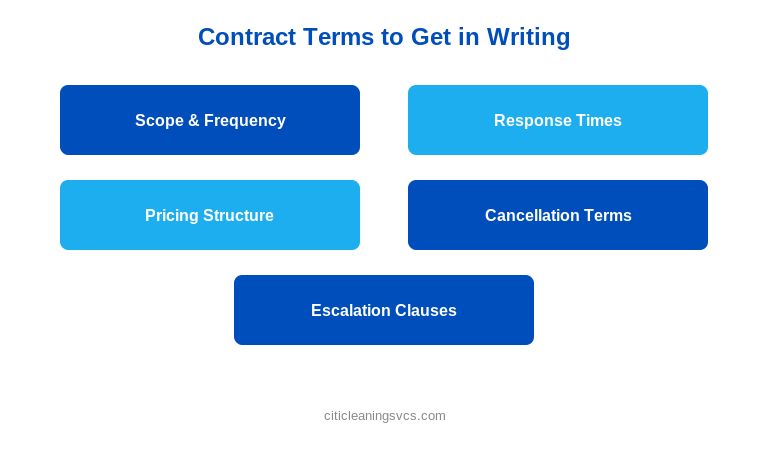
A solid janitorial services agreement spells out scope, frequency, response times, and cancellation terms in writing — verbal promises don’t hold up when service quality slips. Treat the written contract as the actual source of truth, not the sales conversation.
Every task from your scope matrix should appear in the contract with its frequency attached. If it’s not written down, it’s not guaranteed.
Ask how quickly the provider responds to a missed cleaning or a quality complaint. This detail rarely shows up unless you ask directly.
Providers offering 24/7 availability can typically resolve issues same-day, which matters most for facilities with strict appearance standards like retail storefronts or corporate lobbies.
Understand whether pricing is fixed for a term or subject to annual increases, and what triggers those increases. Clear pricing structure prevents surprise invoices mid-contract.
Check the notice period required to change or cancel service. Providers offering contract-free agreements typically require just 30 days’ notice instead of a multi-year commitment.
Get every term in writing before service starts, and revisit the agreement annually as your facility’s needs change. With scope, cost, and contract terms covered, here’s a fast reference for the questions facility managers ask most.
Janitorial services refer to recurring, scheduled maintenance cleaning, while commercial cleaning is a broader term that can include one-time deep cleans and specialty projects. Most providers use the terms interchangeably in marketing, but the scope of work should clarify which tasks are recurring versus one-time.
Janitorial pricing varies widely by square footage, frequency, facility type, and local labor market, so there’s no single industry-wide rate. Get an itemized proposal from a provider that walks your specific facility to get an accurate number.
Most providers can start within one to two weeks of signing, depending on staffing and equipment needs for your facility size. Facilities switching providers should overlap the transition to avoid a service gap.
Yes — most commercial janitorial contracts include supplies and equipment as part of the service fee. Confirm this in writing, since some providers bill supplies separately.
A complete contract includes scope of work, frequency by area, pricing structure, response time commitments, and cancellation terms. Vague or missing sections in any of these areas are worth clarifying before signing.
Outsourcing is usually cheaper once payroll taxes, benefits, equipment, and turnover costs are factored in. In-house staffing can make sense for very large, single-site facilities with round-the-clock operations.
Restrooms in occupied commercial buildings should be cleaned daily at minimum, with high-traffic facilities sometimes needing multiple visits per day. Restocking supplies should happen on the same schedule to avoid running out mid-day.
Look for OSHA-related safety training, Green Seal-aligned cleaning practices, and a track record of long-term client retention. These signals matter more than marketing claims about quality.
Commercial janitorial services should cover a clearly defined scope, match frequency to your facility’s traffic, and come with pricing you can actually explain to your finance team. Providers who can’t answer basic questions about scope, safety training, or contract flexibility aren’t worth your budget.
Use the framework in this guide before your next round of bids, not after service has already started disappointing you.
Facility managers who follow this process consistently end up with more predictable service and fewer contract surprises. Central Florida facilities can reference Citi Cleaning Services as one example of a family-owned, M/WBE-certified provider operating on a contract-free model, but the evaluation framework above applies no matter which full-service cleaning provider you’re considering.
For additional context on cost benchmarks and provider vetting, see our guides on commercial cleaning pricing, selecting a janitorial service provider, and the difference between janitorial and cleaning services. Safety-conscious facility managers should also review OSHA’s Hazard Communication Standard and the Building Service Contractors Association International for industry benchmarks on training and standards.
