
A day porter handles the visible mess your building generates during business hours. A night porter runs the deep cleaning your building needs after everyone leaves. Most facilities need both — and getting the mix wrong is the reason your restrooms look bad by lunch.
This guide compares day porter and night porter services on tasks, staffing ratios, monthly costs, and the exact facility conditions that call for each. You will finish it with a clear decision framework for your building.
The examples pull from 20+ years of running janitorial and porter programs across Central Florida — offices, warehouses, transportation hubs, and multi-tenant retail.
Key Takeaways
- Day porters solve visibility problems. If your building looks worse at 3 p.m. than it did at 7 a.m., you have a day porter gap.
- Night porters solve deep-clean problems. Floor care, disinfection, and heavy vacuuming happen when the building is empty.
- Standard staffing is 1 day porter per 20,000-40,000 sq ft of active business space, adjusted for foot traffic.
- Monthly cost runs $1,800-$7,800 depending on hours and coverage — significantly less than the reputational cost of a bad-looking building.
- Most Central Florida facilities over 30,000 sq ft need both. Split the tasks by time of day, not by cost.
A day porter works during business hours (typically 7 a.m. to 5 p.m.) handling visible, high-touch issues — restrooms, spills, breakrooms, lobbies. A night porter works after-hours (6 p.m. to 6 a.m.) handling deep cleaning tasks that require the building to be empty — floor care, thorough vacuuming, disinfection.
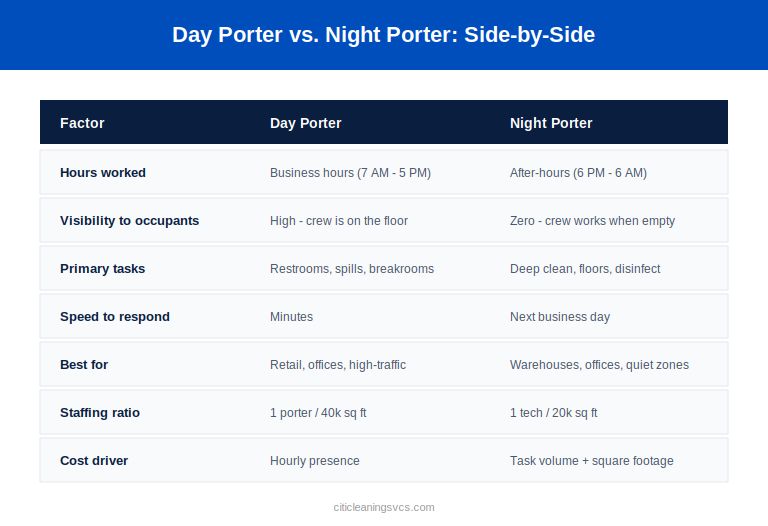
The distinction is not about the tasks themselves. It is about when the tasks fit your operations. A porter running an auto-scrubber in a busy retail aisle at 11 a.m. is not doing anyone any favors. The same porter running that machine at 10 p.m. after close is invisible and effective.
Facility managers who confuse the two roles either short-staff during the day (and get complaints from occupants) or over-pay for after-hours coverage that is not addressing the visible problem.
A day porter is your visible cleaning presence during business hours. The role is reactive by design — the porter reads the building in real time and handles issues before occupants have to report them. Restroom rounds, spill response, breakroom resets, and lobby touch-ups fill most of the shift.
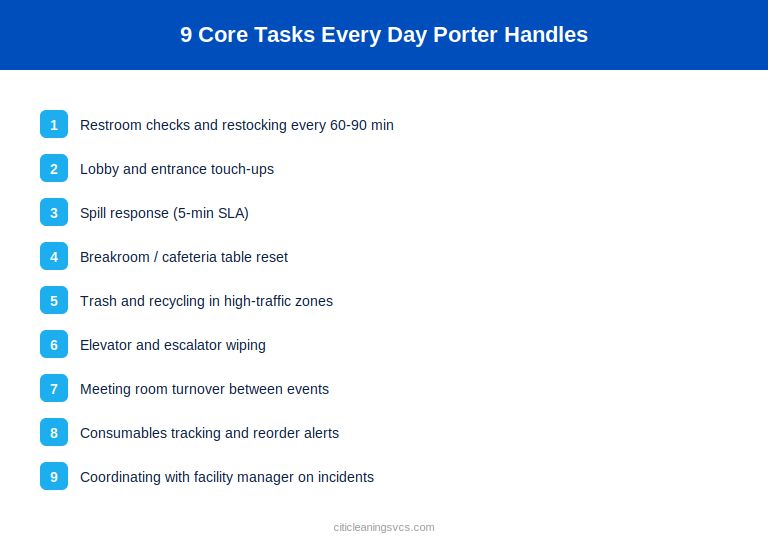
Well-run porter programs use a documented rotation. Restrooms get checked every 60 to 90 minutes. Lobbies get walked every hour. Breakrooms and common areas get resets after lunch and mid-afternoon.
The porter is also your building’s first-line responder. Spills, biohazards, plumbing incidents, and unexpected mess all flow through the porter before they become facility manager problems. Response time under five minutes is the professional standard.
Beyond reactive work, day porters handle standing tasks: elevator wiping, door and glass cleaning, exterior smoking area sweeps, and consumables tracking. When toilet paper is running low in Building C, the porter sees it before an occupant complains.
A night porter runs the tasks that require an empty building — heavy vacuuming, floor scrubbing, hard-floor stripping and waxing, deep restroom disinfection, trash consolidation, and setup for the next business day. The role is task-driven, not reactive.
Night crews work through a route sheet by area: sweep, vacuum, mop, disinfect, empty trash, restock, lock down. The pace is faster because there are no occupants in the way, and the noise from equipment is not disturbing anyone.
Night porters also handle specialty work that fits an after-hours window: VCT floor stripping and waxing, recoating on a scheduled cycle, and burnishing for high-gloss surfaces. These tasks need drying time that is impossible during business hours.
In multi-tenant buildings, night porters coordinate with security to enter and lock down each tenant space. Key control, alarm codes, and access logs matter more at night than during the day.
The standard staffing ratio is one day porter per 20,000 to 40,000 square feet of active occupied space. Foot traffic, tenant density, and food service on-site push the ratio tighter. Quiet office buildings can stretch to 40,000+ sq ft per porter.
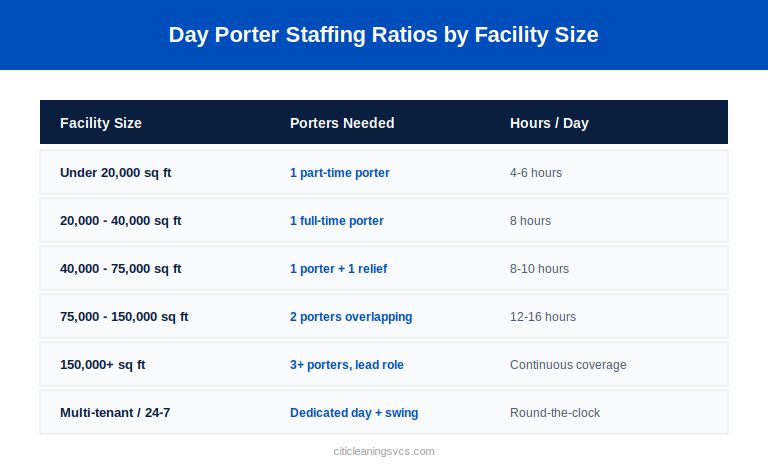
Under-staffing shows up first in restroom quality. When one porter is covering 60,000 sq ft with 300 occupants, the restroom rotation collapses. Complaints spike. Vendor gets blamed. The real issue is the ratio, not the crew.
Over-staffing shows up as porters idle in break rooms. That is a scoping conversation with the vendor — reduce hours, not headcount, to right-size the coverage window.
For campus-scale facilities (multiple buildings), a lead porter model works well. The lead handles escalations and quality checks while individual porters run their assigned buildings.
The choice between day porter and night porter comes down to five questions about your facility. Answer them in order — the result tells you which coverage model fits.
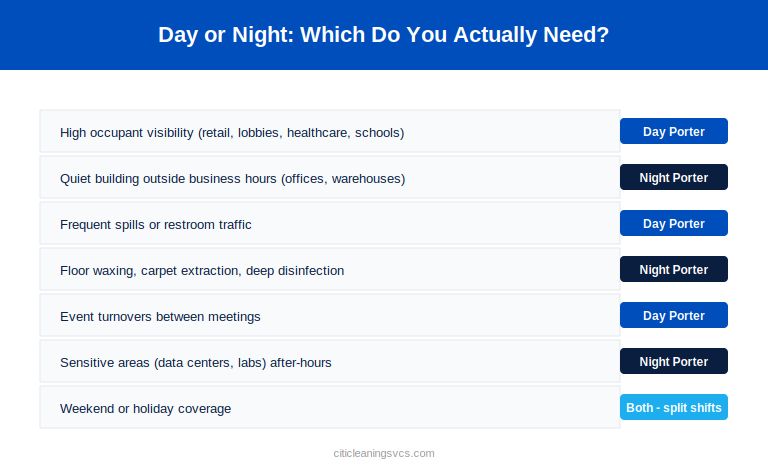
Question 1: Does foot traffic hit its peak during business hours? Retail, healthcare, schools, and lobbies see continuous traffic 8-6. That volume creates visible mess that needs a day porter to catch in real time.
Question 2: What deep-clean tasks do you need done monthly? Floor care, disinfection cycles, high dusting, and carpet extraction all need after-hours windows. Those tasks demand a night crew.
Question 3: Do you have restroom volume over 300 uses per day? Any facility with that volume needs restroom rounds during the day. Night-only cleaning cannot keep pace.
Question 4: Are there sensitive areas that must be cleaned when occupants are gone? Data centers, executive suites, and secure spaces often require after-hours access — a job for night porters with the right clearance.
Question 5: What is your building’s daytime feel? Some facilities value the presence of visible cleaning staff (retail, hospitality, healthcare). Others prefer invisible operations (Class A office, some professional services). Match the coverage model to the feel.
Most facilities over 30,000 sq ft need a combination. Day porter for visible response, night crew for deep work.
Monthly day porter costs run $1,800 to $7,800 depending on hours per day and total coverage. A part-time porter (4 hours) suits small retail. A full-time porter (8 hours) is the standard for most 30,000-60,000 sq ft commercial buildings. Multi-porter or 24/7 coverage moves the number into the five figures.
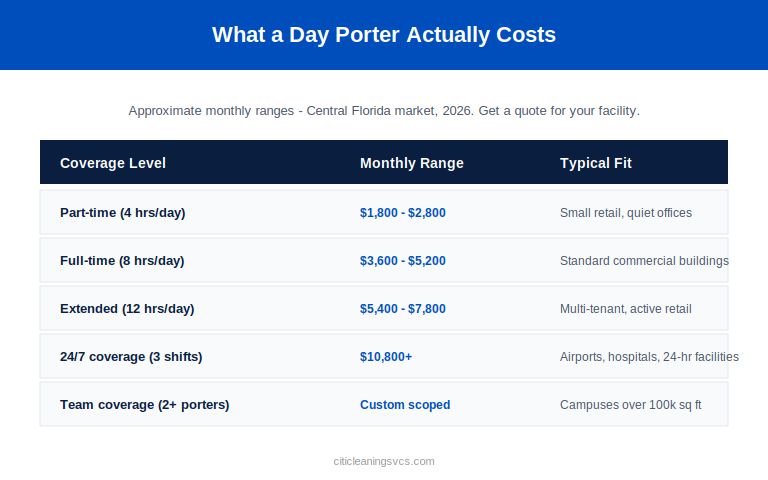
The variables that move price: hourly wage rate, benefits load, supplies included in the scope, and any specialty equipment (backpack vacuums, hospital-grade disinfectants) required for the site.
Compare quotes on the total scoped hours, not the hourly rate. A vendor quoting $22/hour for 6 hours may cost less than a vendor quoting $18/hour for 8 hours — but the second vendor is delivering more coverage. Cost per covered hour is the honest metric.
According to U.S. Bureau of Labor Statistics data on janitorial roles, median hourly wages have climbed steadily. Vendors quoting far below market are either understaffing or churning their workforce. Both hurt service quality.
Add a day porter when three signals appear: rising restroom complaints, spills going unaddressed for hours, and lobby appearance dropping by mid-afternoon. These are the leading indicators that night-only cleaning is not enough.
Restroom complaints are the loudest signal. If facility staff or occupants are reporting empty paper towels, wet floors, or unpleasant conditions in the middle of the day, no amount of after-hours cleaning fixes the problem. A day porter running scheduled rounds resolves it in a week.
Second signal: spill response time. Track how long it takes for someone to respond to a coffee spill in a hallway. If the answer is “next morning,” you have a day porter gap.
Third signal: appearance drop. Walk your lobby at 8 a.m. and at 3 p.m. If the delta is dramatic, you are seeing the compounding effect of daily traffic with no midday reset. A porter with a lobby round every 60 minutes eliminates it.
Starting scope for a new day porter contract: 4 hours per day, five days a week, with clear response SLAs. Grow from there based on measured outcomes.
Three mistakes come up repeatedly when facilities scope porter services: rolling day porter tasks into the night crew’s route sheet, under-communicating restroom expectations, and missing the coverage window for lunch and shift changes.
Mistake 1: Rolling day tasks into the night route. If lobby touch-ups are on the night crew’s list but nobody sees them at 2 p.m., they are not solving the visible problem. Split day and night tasks by outcome, not convenience.
Mistake 2: Under-communicating restroom cadence. “Keep the restrooms clean” is not a scope. “Check every restroom every 90 minutes, restock consumables, wipe fixtures, sign the log” is a scope. Documented cadence is what makes porter service consistent.
Mistake 3: Missing the lunch coverage window. Most porters take a lunch break at the same time occupants create the biggest mess. Stagger the porter lunch, or add a relief porter for the noon-2 p.m. peak.
Facilities that align porter scope with actual traffic patterns run cleaner buildings on the same monthly budget. It is a scoping problem more often than a headcount problem.
The industry association ISSA (International Sanitary Supply Association) publishes cleaning time standards that help right-size these programs — well worth the reference when negotiating scope.
For facility managers looking to benchmark their current program, our related guides on what facility maintenance covers, office cleaning best practices, and the difference between janitorial and cleaning services pair well with this porter comparison. Facility teams in warehouse settings, office buildings, and education facilities tend to have very different porter needs — the frameworks above are meant as a starting point, not a formula. If you want a walk-through of your specific building, the Citi Cleaning Services team has built porter programs across Central Florida for over 20 years.
A day porter handles visible cleaning tasks during business hours: restroom checks and restocking every 60-90 minutes, lobby and entrance touch-ups, spill response within five minutes, breakroom resets, and elevator or high-touch surface wiping. They serve as the first-line response for any unexpected cleaning issues that arise during the workday.
A day porter works during business hours handling visible, reactive tasks – restrooms, spills, lobbies. A night porter works after-hours handling deep cleaning tasks that need an empty building – floor care, thorough vacuuming, disinfection. Most commercial facilities over 30,000 square feet need both.
Monthly day porter costs in Central Florida run $1,800 to $2,800 for part-time (4 hours/day), $3,600 to $5,200 for full-time (8 hours/day), and $5,400 to $7,800 for extended coverage (12 hours/day). Multi-porter or 24/7 arrangements start at $10,800 monthly.
Standard staffing is one day porter per 20,000 to 40,000 square feet of active occupied space. Facilities under 20,000 sq ft usually need only a part-time porter. Facilities over 75,000 sq ft typically need two porters with overlapping shifts.
No – deep cleaning tasks like floor stripping, waxing, burnishing, and carpet extraction are night porter or specialty crew work. Day porters handle reactive tasks that fit inside a business-hours window. Trying to run floor care during the day disrupts operations and creates safety hazards.
Look for OSHA 10 or OSHA 30 certification, bloodborne pathogen training, chemical handling (SDS) training, and background check documentation. Facilities in specialized sectors like schools or transportation may require additional clearances such as fingerprinting or industry-specific safety training.
Yes, but with limits. A single porter can cover 2-3 small buildings on a rotating schedule if they are within walking distance and combined square footage stays under 40,000. Beyond that, response times degrade and restroom rounds get missed. A lead porter model with dedicated staff per building works better for campuses.
Five minutes for spills, ten minutes for restroom issues reported by occupants, and immediate for biohazards. These are the professional standards used across commercial cleaning contracts. Response times over 15 minutes indicate under-staffing or a scope problem worth renegotiating.
Picking the right porter model is a scoping exercise you can run in one week. Follow this plan the next time you assess porter needs.
