
Choosing a commercial building cleaning vendor is one of the highest-leverage decisions a property manager makes. The right partner protects tenant satisfaction, keeps insurance premiums stable, and buys back hours on your calendar. The wrong one shows up in every complaint log, every renewal conversation, and every quarterly budget review.
This guide walks property managers through the full commercial building cleaning vendor selection process — from writing a scope of work, to running a competitive bid, to evaluating supervision and reporting, to a 30-day cutover that does not disrupt tenants.
It is written specifically for property managers running multi-tenant, mixed-use, and single-owner commercial portfolios in Central Florida, though the framework works anywhere.
Key Takeaways
- Commercial building cleaning covers 8 core service categories, and the scope you write directly determines the bids you receive — vague scopes get vague bids.
- Weight vendor selection on supervision model, insurance, and reporting — not on the low bid. Low bids that skip supervision cost more within 6 months.
- A vendor evaluation scorecard with 10 to 12 weighted criteria removes gut-feel from the decision and stands up in ownership reviews.
- Contract-free monthly arrangements protect property managers by keeping the vendor accountable every 30 days without a multi-year lock-in.
Commercial building cleaning is the coordinated program that keeps common areas, restrooms, offices, and exterior touch-points clean, safe, and presentable. It covers eight service categories at the base scope level.
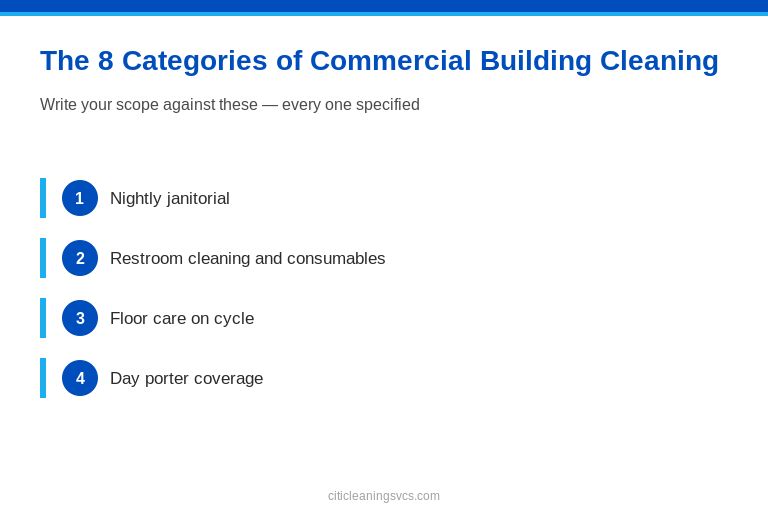
A property manager writing a scope of work should specify frequency, task list, and quality standard for each of the eight — not just check a box that says “nightly cleaning.”
Property managers get burned on cleaning vendors for one recurring reason: the selection process weights price too heavily and supervision too lightly. A vendor 15% under market on price is almost always cutting supervision, training, or turnover management to protect their margin.
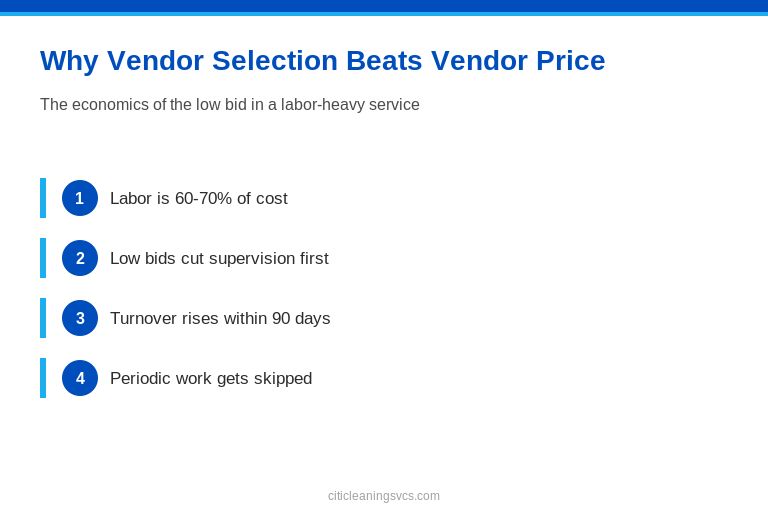
Here is what that looks like six months later:
The cost of switching mid-year is measured in staff hours, tenant frustration, and lost momentum. The cost of picking the right vendor the first time is measured in reduced complaints, lower turnover, and a program that runs without you.
Commercial cleaning is a labor business — 60 to 70% of the cost is labor. A vendor bidding 15% under market can only get there by cutting labor hours, cutting supervision hours, or cutting periodic-work amortization. All three show up in your complaint log within 90 days.
Run every commercial cleaning vendor selection through the same seven-step framework. Deviation from the framework is where bad decisions come from.
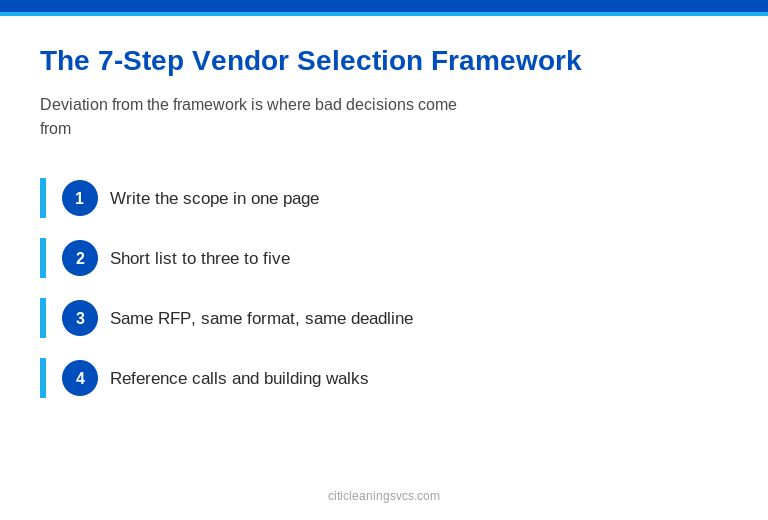
One page per building. Every service category, task list, frequency, and quality standard defined in writing. The scope you write determines the bids you receive. If the scope is vague, expect vague bids and expect scope creep.
Three to five vendors. Sources: property manager referrals, industry associations (BOMA, IREM), and the incumbent (yes, include them). Rule out any vendor without OSHA-aligned safety training, a current COI, and at least three references from buildings of comparable type.
Same scope to every vendor. Same response format. Same deadline. Anything less makes comparison impossible.
See the scorecard framework in the next section. Weight supervision, insurance, and reporting above price.
Three references per finalist. Ask: “What surprised you six months in?” and “What would you do differently if you were re-bidding today?”
Fifteen minutes at each of two current accounts tells you more than a 90-minute sales meeting. Look at restrooms, look at the floor near the entryway, and ask the tenant contact one question about response time.
Written scope, written SLA, contract-free monthly terms if available, and a 30-day cutover plan.
A weighted scorecard makes the selection defensible and reproducible. Below is the framework Central Florida property managers most commonly use.
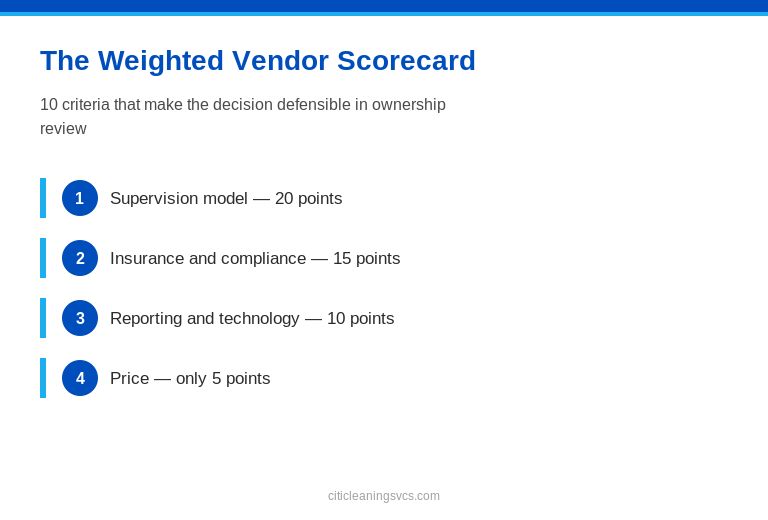
Total the scores, review with ownership, and select. Any bidder scoring above 80/100 is a viable partner; below 65/100 is a no.
This is where a lot of vendor selections fall apart post-signing. Verify these items in writing before the contract goes into effect.
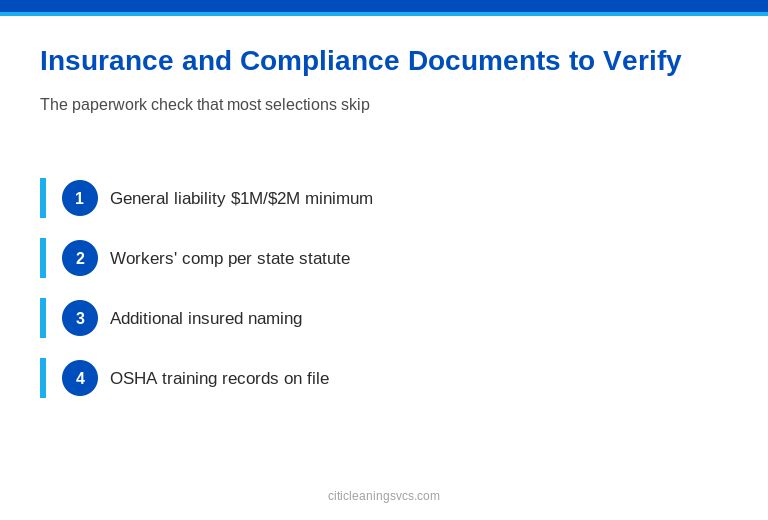
Every certificate must name the building and the ownership entity as additional insured. Set a calendar reminder for COI renewal — a lapsed certificate exposes the building to uncovered liability.
Citi Cleaning Services is family-owned, M/WBE-certified, OSHA-certified, and Green Seal-aligned, with all insurance and compliance documentation available within one business day of request. We have served Central Florida property managers since 2004 with 70+ trained professionals and a 10+ year average client retention rate.
Property managers face a fork on contract structure: sign a multi-year contract with a locked rate and stiff termination penalties, or go contract-free with month-to-month accountability.
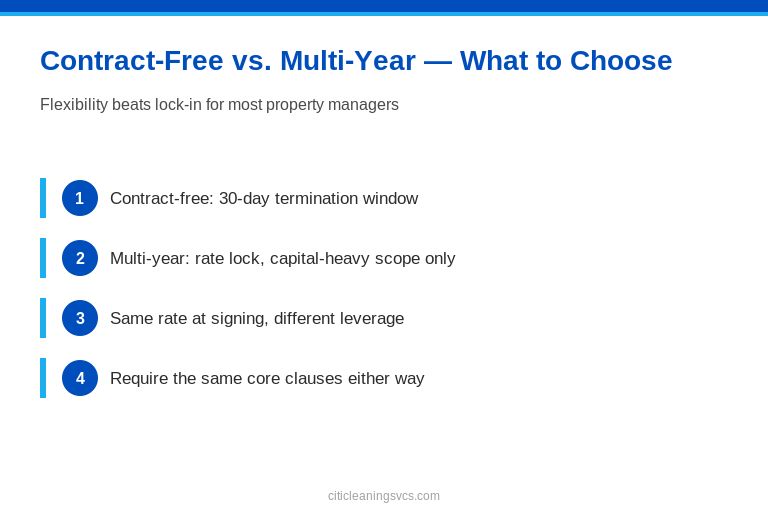
Locks in rate for 24 to 36 months. Vendor has predictable revenue. Property manager loses flexibility if service quality drops — termination-for-convenience typically requires 60 to 90 days notice plus a cure period. Termination-for-cause is possible but adversarial.
Month-to-month arrangement with 30-day notice on either side. Rate typically the same as a 12-month contract. Vendor is accountable every month because losing the account requires no cause. Property manager keeps leverage indefinitely.
For most property-managed commercial buildings, contract-free wins. Ownership review committees prefer the flexibility, and a competent vendor should welcome the model because a healthy program is not at risk on any given month. Multi-year contracts make sense when ownership wants pricing certainty tied to a lease or budget cycle, or when the vendor absorbs meaningful capital cost (custom equipment, dedicated staff at scale) that requires an amortization period.
See our clause-by-clause cleaning contract guide for the full detail on what to insist on.
Property managers cannot manage what they cannot see. A qualified vendor delivers three reporting layers.
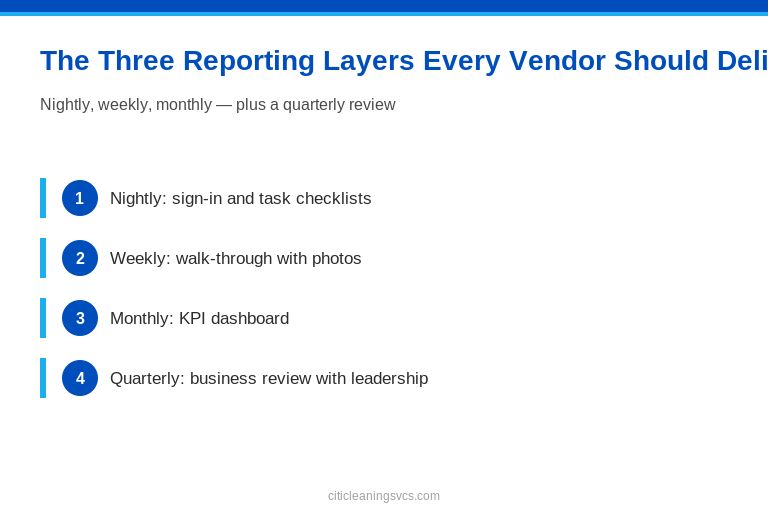
Cleaner sign-in and sign-out timestamps, task-completion checklist per zone, photo-verified periodic work. Accessible in a portal or shared workspace within 24 hours.
Supervisor walk-through report with photos, complaint log with root-cause notes, supply-usage summary. Ideally a 15-minute Monday-morning email digest to the property manager.
KPI dashboard covering complaint volume, response time, complaint-resolution time, preventive-work completion rate, and supply cost per square foot. Reviewed in a monthly stand-up between property manager and account manager.
Vendor leadership across the table from property manager and ideally ownership. Trend data. Scope-adjustment recommendations. Renewal or continuation discussion. QBRs are where the strategic value of a vendor relationship gets demonstrated — a vendor that skips them is signaling they do not expect to be around long.
A vendor change should never disrupt tenants. Property managers who follow this 30-day plan experience zero service gap on cutover.
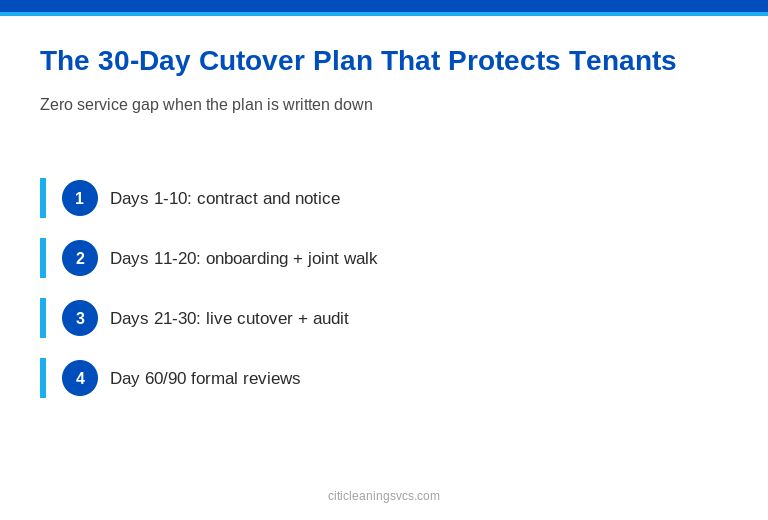
Scorecard finalized, vendor selected, contract executed, ownership notified. Incumbent given written notice per their contract terms.
New vendor onboards staff, receives keys and access, completes a joint walk-through with the incumbent, and documents any hidden pain points (which HVAC closet the electrical panel is behind, which suite has an unusual key, etc.).
New vendor takes over on day 21. Property manager walks the building on nights 1, 3, and 7. Complaint log runs continuously. Day-30 review with the new account manager sets the baseline for month-two performance.
Formal reviews at day 60 and day 90 confirm the vendor is meeting the scorecard commitments. A well-run cutover shows a 40 to 60% drop in complaint volume by the end of month one.
Track four metrics for 30 days: repeat complaints per zone, restroom appearance at 4 PM, on-site supervisor presence, and response time on operational issues. If any two are trending badly, start a competitive bid.
Three to five is the sweet spot. Fewer than three limits comparison; more than five overloads your evaluation time and dilutes vendor engagement — top vendors deprioritize wide-field bids.
Six to eight weeks for a competitive bid on a mid-size building: two weeks to write the scope and short-list, two weeks for bids, two weeks for scoring and references, one to two weeks for contract and start date.
Portfolio consolidation gets you a rate advantage and simplified vendor management, but requires a vendor with the crew depth and geographic coverage to service every location without drift. Ask for a scorecard by location before consolidating.
Weighting price above supervision. A low bid without supervision costs more within six months in tenant complaints, turnover, and remediation. Weight supervision and reporting at 30% of the total scorecard.
Rates vary widely by market, scope, and building profile — a 40,000-square-foot office in Central Florida bids very differently than the same square footage in a warehouse. Focus on rate transparency (labor + supply + periodic + management) rather than a rate benchmark. See our cost breakdown guide.
Restroom appearance and complaint volume should improve within two weeks. Deep-clean cycles and floor care catch up within 60 days. Day-30 KPIs versus baseline should show a meaningful delta or you have chosen the wrong vendor.
A contract-free monthly arrangement runs month-to-month with a 30-day termination window on either side. It removes multi-year lock-in and keeps the vendor accountable every month. Citi Cleaning Services has built its Central Florida business on the contract-free model since 2004 because performance is what should retain a client — not paperwork.
Property managers who follow this sequence run cleaner selections and end up with better vendors. The framework is straightforward, defensible in ownership review, and consistently produces vendors that outperform the ones selected on price alone. Here is the plan for the next 30 days.
The property managers who consistently outperform their peers on vendor-driven KPIs run this same playbook every 24 to 36 months, whether or not the incumbent is failing. The purpose is not just replacement — it is calibration and market discipline on the vendor.
Property managers across Orange, Seminole, Lake, and Osceola counties who use this framework report a measurable drop in complaint volume inside 60 days and a saner vendor-management calendar within a quarter. See our homepage for our full scope, our how to read a cleaning proposal guide for a side-by-side bid framework, and the janitorial-provider selection questions for the interview list that catches vendors before they get on your paper.
