
Outsourcing janitorial services costs Central Florida facility managers 15 to 35 percent less than running in-house cleaning teams — once you model the total cost of ownership honestly. The comparison looks close on the pay-rate line and swings decisively once you add workers comp, PTO, turnover, equipment, supervision, and management overhead.
This 2026 comparison guide models the real math side by side. It covers the fully-loaded hourly cost of an in-house janitor, the hidden line items facilities miss (workers comp, unemployment, HR administration, equipment amortization, supervision), the total cost of ownership over 3 years, the quality and coverage tradeoffs, and the situations where in-house still wins.
By the end, you will have a printable TCO worksheet, a decision framework you can run with your CFO in one afternoon, and a clear answer for the boardroom question every facility manager gets asked: “why are we spending money on an outside cleaning company when we could hire our own crew?”
Key Takeaways
- True fully-loaded cost of an in-house janitor in Central Florida runs $28–$38 per hour — not the $16–$20 base wage.
- Outsourced pricing averages $22–$32 per hour billed, all-in, with insurance, equipment, and supervision baked in.
- Hidden costs add 55–75% to a base janitor wage: workers comp, taxes, PTO, benefits, unemployment, HR.
- Turnover in cleaning runs 200% annually. Each hire costs $2,500–$4,000 in productivity and training.
- Outsourcing wins on flexibility — scaling headcount up or down without HR, unemployment, or severance.
- In-house wins only when scale is 30+ FTE, quality bar is uniquely high, and management bandwidth exists.
Every in-house cleaning cost model that starts with the hourly wage understates the true number by 55 to 75 percent. The wage is the tip of the iceberg — the water line hides workers comp, payroll taxes, benefits, PTO, uniforms, supervision, and equipment amortization.
Below is the honest fully-loaded rate for a Central Florida in-house janitor in 2026. These numbers come from public compensation data and 20+ years of running commercial cleaning operations across Orange, Seminole, Lake, and Osceola counties.
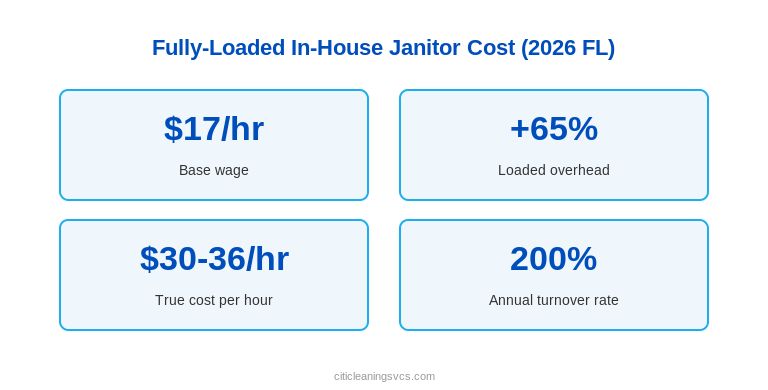
Add every line and a $17/hr base wage becomes a $30–$36/hr fully-loaded cost. That is before you count the productivity loss during the 200% annual turnover cycle documented by the U.S. Bureau of Labor Statistics for the accommodation and food services / janitorial sector.
You now have the honest loaded rate. Next, the outsourced comparison side by side.
Outsourced billing in Central Florida runs $22–$32 per hour of covered labor in 2026. The bill is one line item — no separate lines for insurance, uniforms, equipment, supervision, or HR. Every one of those is baked in.
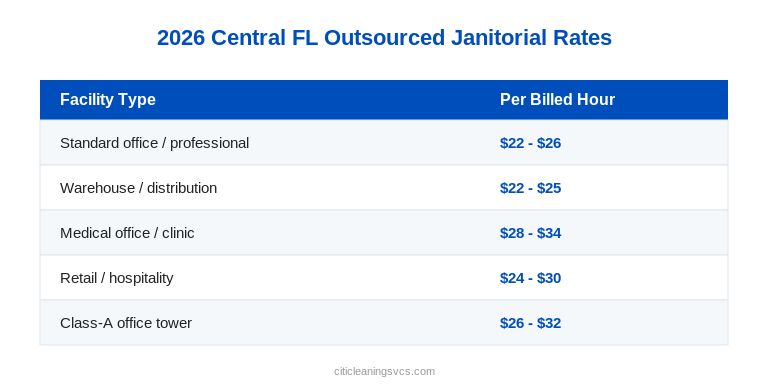
Outsourced rates vary by facility complexity, shift timing, and volume. Below is a realistic 2026 range.
A vendor that carries insurance, W-2 employees, and modern equipment cannot compete on price with an uninsured 1099 crew. The gap is what buys accountability. For a deeper look at cost benchmarks, see our commercial cleaning cost guide.
You now have both sides of the hourly comparison. Next, the total cost of ownership over 3 years.
The hourly-rate comparison is a lie until you extend it to 3 years and add every real cost. Below is a working TCO for a 60,000 sq ft office in Central Florida requiring 6 janitors + 1 lead per night, 5 nights per week, 260 nights per year.
Assumptions: 7 FTE at $17/hr base wage, 8-hour shifts, benefits provided, standard equipment.
3-Year In-House Total: ~$1,530,000 (~$510,000/year).
Assumptions: 7 covered positions at $25/hr blended billed rate.
3-Year Outsourced Total: ~$1,110,000 (~$370,000/year).
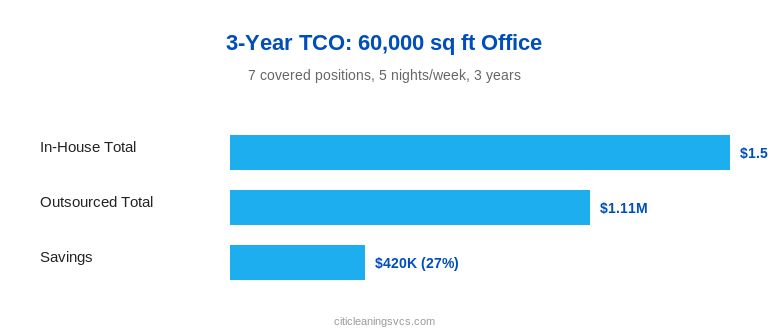
Outsourcing saves roughly $420,000 over 3 years — a 27 percent reduction — for this 60,000 sq ft office scenario. The savings scale with facility size until the 30+ FTE breakpoint (where in-house economies start to appear if managed extremely well). Numbers change with wage rates, benefits generosity, and vendor selection, but the direction almost always favors outsourcing.
You now see the 3-year math. Next, the risks in-house cost models forget to price.
Every CFO who insists in-house is cheaper is looking at the wage line and ignoring the exposures below. These do not show up in a spreadsheet — but they show up in a claim or a labor complaint at the worst possible moment.
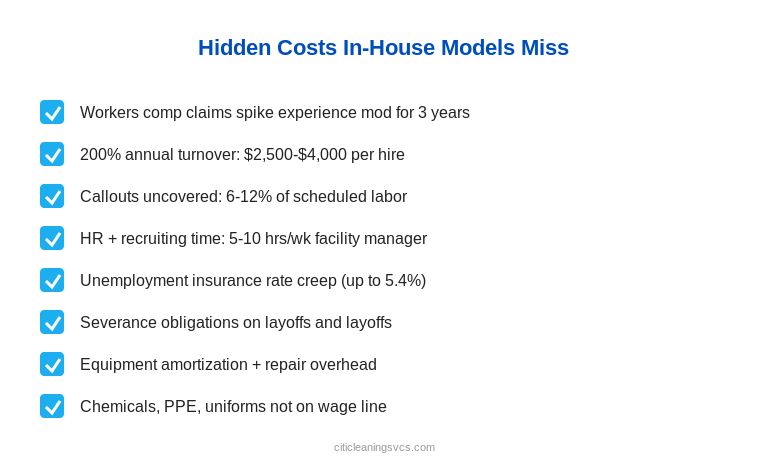
Janitorial (NCCI class code 9014) is a mid-risk class in Florida with rates around $5–$9 per $100 of payroll. Slip-and-fall on wet floors, chemical splash, back injuries from equipment, and needle sticks in restrooms drive claims. A single serious claim can spike your experience mod factor and increase premiums across all classes for 3 years.
Outsourcing shifts this exposure to the vendor’s policy. Your building is a named insured on the vendor’s certificate — your workers comp mod is unaffected.
The ISSA tracks industry turnover at approximately 200% annually for hourly cleaning positions. Every janitor who quits triggers 4–8 weeks of degraded quality while the position backfills. Multiply by 7 FTE and roughly half your team is churning through onboarding at any given moment.
A well-run outsourcing partner absorbs turnover invisibly. Backfill happens overnight; quality stays consistent because the vendor’s bench and route structure absorb the churn.
In-house cleaning consumes 5–10 hours of facility manager time per week — recruiting, coaching, scheduling, complaint response. At a $100K facility manager salary loaded, that is $12,000–$25,000 per year of leadership bandwidth going into custodial ops instead of tenant retention, capital projects, or vendor negotiations. Outsourcing consolidates most of that into a single monthly review with the vendor account manager.
For a full breakdown of the operational tradeoffs, see our companion piece on what property owners need from a janitorial partner.
You now know the risks the wage-only model misses. Next, one more hidden cost that catches CFOs by surprise.
In-house cleaning teams generate unemployment insurance claims when positions are eliminated, hours reduced, or performance issues force separations. Florida’s SUTA rate for high-turnover employers can climb to 5.4% of the first $7,000 of wages per employee, and a track record of claims drives that number up. Severance obligations under state law and internal HR policy add another layer.
Outsourcing eliminates all of this. When facility demand shrinks — a tenant leaves, a wing closes for renovation, a shift is cut — you scale the contract down without HR paperwork, UI claims, or severance. When demand grows, you scale up without recruiting cycles. This scalability is worth 3–5% of total cleaning spend annually on its own, before any other savings show up.
Outsourcing is the right answer for the vast majority of Central Florida facilities under 100,000 sq ft or 30 FTE of cleaning demand. But in-house does win in specific situations. Choosing correctly matters more than defaulting either direction.
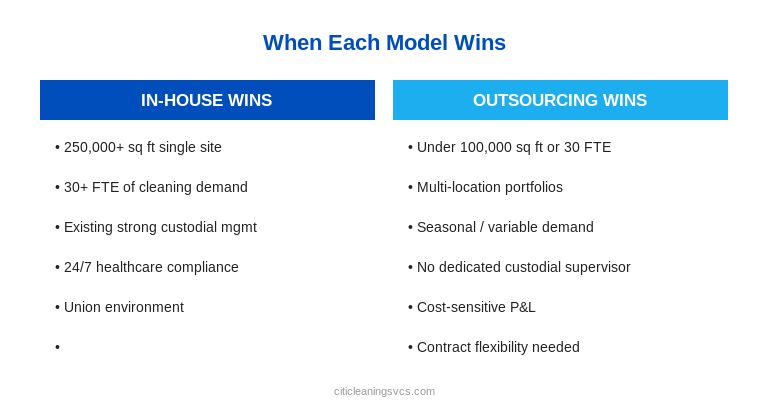
You now know when each model fits. Note that a facility can move between models over time — many Orlando and Winter Park properties start in-house, hit a turnover crisis, and switch to outsourcing within 18–24 months of that inflection point. The reverse move (outsourced back to in-house) is rare and usually driven by a change in ownership or a strategic decision unrelated to cost. Next, the hybrid approach that captures most of the upside.
Facilities that want branded daytime presence without owning a full custodial team use a hybrid model: 1–2 in-house day porters plus an outsourced night janitorial crew. This captures the best of both worlds when set up correctly.
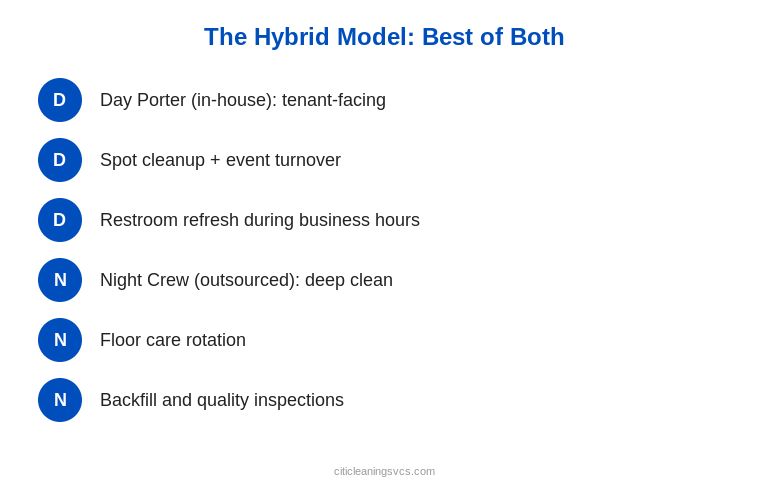
The hybrid keeps your facility’s brand-facing custodial role in-house — which some tenants and executives value — while pushing the labor-intensive, turnover-prone nightly work to an outsourced partner. Related reading: day porter vs. night porter services.
Citi Cleaning Services is a family-owned, minority/women-owned (M/WBE) Central Florida provider that has staffed commercial janitorial teams since 2004, with 70+ trained pros and 10+ year average client retention. All crews are OSHA-certified and Green Seal-aligned. Contracts run month-to-month, 24/7 coverage, across Orange, Seminole, Lake, and Osceola counties — plus additional clients in Jacksonville, Ocala, and Miami. Phone: (407) 540-1850. See our homepage for the full service list and our guide on commercial janitorial services pricing and inclusions.
You now know the hybrid pattern. Next, the industry benchmarks that keep both models honest.
Whether you run in-house or outsource, the same KPIs decide whether the model actually works. Facilities that track these numbers make better decisions than facilities that only look at the invoice or the payroll line.
Blended cleaning cost per rentable square foot per year is the single most useful cross-comparison metric. Central Florida benchmarks in 2026:
If your in-house cost is above the outsourced benchmark by 20% or more, the answer is not “cut wages” — it is “compare the models honestly.” For pricing detail on evaluating outside bids, see our guide on how to compare commercial cleaning bids.
Track a monthly inspection score against a defined checklist. Track tenant/employee complaints per month per 10,000 sq ft. An outsourced partner should hit 92%+ inspection scores and fewer than 1 complaint per 10,000 sq ft per month. An in-house team should meet the same bar; if it does not, the “savings” are not real. For details on what to expect from a warehouse partner specifically, see our warehouse cleaning services guide.
Count how many shifts per month go partially or fully uncovered because of callouts. Track hours until backfill arrives. In-house teams routinely lose 6–12% of scheduled labor to callouts with no backfill. Outsourced vendors typically backfill within a shift and keep uncovered hours under 2%. This is often the metric that ends the “in-house is cheaper” argument.
You now have the KPIs. Next, the FAQs facility managers ask most.
Yes — for facilities under about 30 FTE of cleaning demand, outsourcing runs 15–35% cheaper on a total-cost-of-ownership basis in Central Florida. The gap widens once workers comp, PTO, benefits, and turnover are properly costed.
A $17/hr base wage becomes $28–$38/hr fully loaded — adding payroll taxes, workers comp, benefits, PTO, uniforms, supervision, equipment amortization, and HR overhead.
Industry turnover runs approximately 200% annually. Each hire costs $2,500–$4,000 in productivity loss and training. Outsourcing shifts this cost to the vendor.
Central Florida outsourced pricing runs $22–$32 per billed hour depending on facility type — offices at the lower end, medical and Class-A at the upper end.
Workers comp exposure, property damage liability, inconsistent quality, and no backfill when someone quits. The savings on paper disappear at the first claim.
Single-site campuses over 250,000 sq ft with 30+ FTE, strong existing supervision, low turnover culture, and stable long-term demand. Outside those conditions, outsourcing is almost always cheaper.
Yes. Most Central Florida transitions run 30–45 days with parallel operations for the first 2 weeks. Some in-house staff are often hired by the outsourced vendor, preserving institutional knowledge.
Model a 3-year TCO with every hidden line item included. Compare apples to apples. Present the risk reduction (workers comp, turnover, unemployment) alongside the cost delta. Most CFOs sign off after seeing an honest model.
