
Your warehouse floor sees more daily impact than almost any other surface in your facility. Forklifts, pallet jacks, and foot traffic grind dust, oil, and debris into concrete around the clock, and that wear shows up fast if nobody is managing it.
That combination creates a hazard that costs far more than a cleaning invoice ever will. A single slip-and-fall claim in an industrial facility can run into the tens of thousands of dollars once you count medical costs, lost productivity, and workers’ comp exposure — and that’s before you factor in the operational disruption of an injured team member off the floor.
This guide breaks down what warehouse cleaning services actually include for facilities like the ones served by Citi Cleaning Services, why safety compliance has to sit at the center of the program, and how to evaluate a warehouse cleaning company before you sign anything. You’ll also get a safety checklist you can hand to your own team today, along with a straightforward look at how pricing and shift-based scheduling actually work in practice.
• Warehouse cleaning services cover far more than sweeping floors — they include high-bay dust removal, dock area sanitation, and OSHA-aligned safety protocols.
• Slip-and-fall incidents cost employers an average of around $40,000 per claim, making prevention cheaper than the alternative.
• Shift-flexible scheduling is non-negotiable for facilities running 24/7 or multi-shift operations.
• A qualified industrial warehouse cleaning crew needs specific training, PPE, and equipment that general office cleaners don’t carry.
• The right partner is contract-free, OSHA-certified, and locally responsive — not locked into a national call center.
• Pricing should be itemized by scope and frequency, not bundled into a single unexplained number.
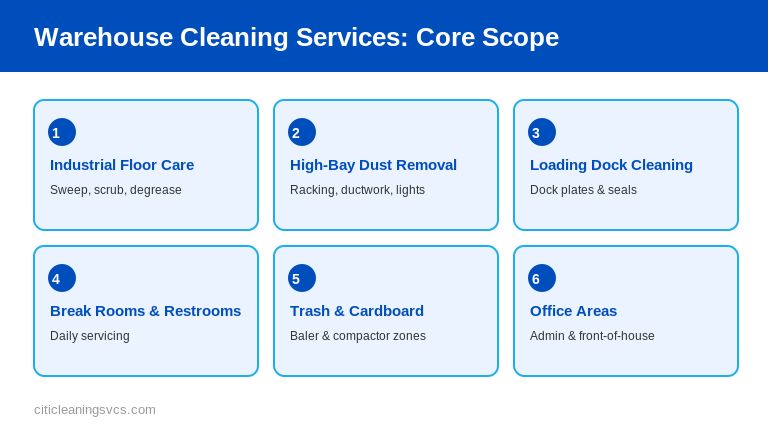
Warehouse cleaning services cover floor care, high-level dust removal, dock sanitation, break room and restroom servicing, and trash management across a facility built for freight, not foot traffic.
Most facility managers underestimate the scope until they see it broken down. A generic janitorial contract built for office space simply doesn’t map onto a 100,000-square-foot distribution center, and pricing that ignores this difference usually signals a vendor who hasn’t walked many warehouses.
Warehouse environments generate dust from cardboard, shrink wrap, and pallet debris that settles on racking, sprinkler heads, and overhead beams. That dust is a fire load and an air-quality problem, not just an eyesore, and it accumulates in places a standard mop-and-vacuum crew never reaches.
A properly scoped program typically includes:
Ask any prospective vendor to walk your facility before quoting. If they price a warehouse the same way they’d price a suite of offices, that’s a sign they don’t understand the scope.
Facilities with cold storage, mezzanine levels, or automated conveyor systems add even more variables. Each of those features changes how a crew accesses and cleans the space safely, and a proposal that doesn’t ask about them probably wasn’t built for your building specifically.
Two areas get skipped most often: high-bay dust above 12 feet and the transition zones around dock doors where weather and debris both collect. Confirm both are explicitly written into your proposal before you sign anything, since a generic cleaning proposal won’t always spell these out.
Scope defines everything else in this guide — pricing, staffing, and safety planning all flow from it. Next, let’s look at why safety has to be the anchor of that scope, not an afterthought.
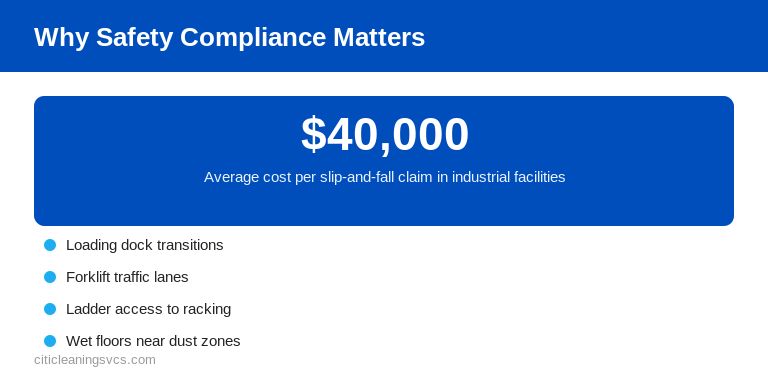
Warehouse cleaning is fundamentally a safety program first and a cosmetic service second. Slip-and-fall incidents in industrial facilities average roughly $40,000 per claim once medical costs and lost time are counted.
Facility managers often budget for cleaning as a line item competing with other soft costs. That framing misses the point — a poorly cleaned warehouse floor is a liability line item wearing a maintenance disguise.
Warehouses combine wet floors, forklift traffic, ladder access to racking, and loading dock transitions — all recognized by the Occupational Safety and Health Administration as high-risk zones for slips, trips, and falls. A cleaning crew that doesn’t understand these hazards can actually create new ones, like leaving a wet aisle unmarked near a forklift lane.
A safety-first industrial warehouse cleaning partner should be able to show you:
Some facilities pair overnight cleaning with a day porter or night porter for continuous coverage during business hours. Request copies of training records during vendor evaluation, not just a verbal assurance. A vendor confident in its safety program will hand these over without pushback.
Safety compliance is the line item that protects every other line item in your budget. With that foundation set, scheduling around your actual operating hours is the next variable to get right.
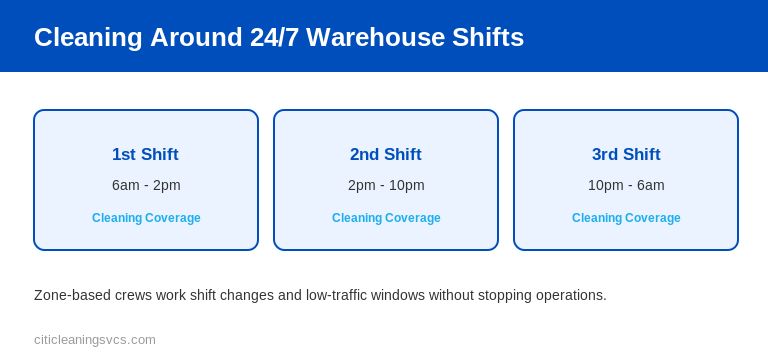
Warehouse cleaning has to work around your production schedule, not the other way around. That means shift-flexible scheduling — cleaning during shift changes, overnight windows, or rolling gaps in a 24/7 operation.
A distribution center running three shifts doesn’t have a quiet 6 p.m. window the way an office building does. Cleaning crews have to work in the margins: between shift changes, during lulls in outbound trucking, or in designated zones while production continues elsewhere.
Seasonal freight surges make this harder. A facility that runs a steady two-shift schedule most of the year might add a third shift during peak season, and the cleaning plan needs to flex with it instead of falling a step behind.
This requires coordination most national janitorial vendors aren’t built for, since their staffing models are usually optimized around a standard business-hours block. A warehouse cleaning company serving your facility — often as part of a broader facility maintenance program — needs:
Ask any vendor how they’d handle cleaning around a live third shift before you sign anything. Their answer, and how quickly they give it, tells you whether they’ve actually done this before or are improvising on the spot.
Scheduling flexibility only works if the crew showing up is qualified to work in an industrial environment. That’s where staffing requirements come in.
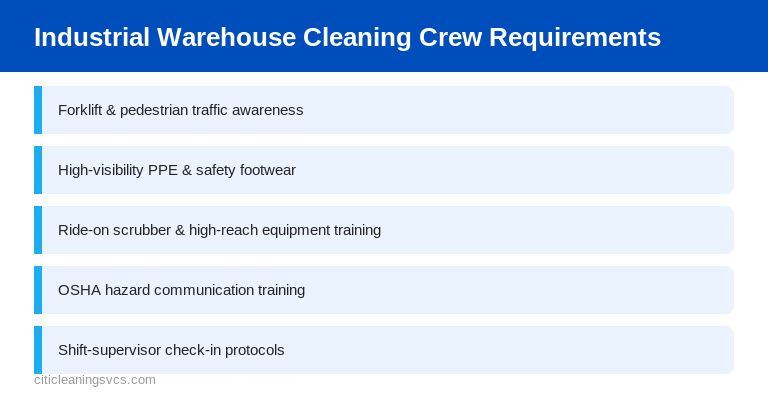
An industrial warehouse cleaning crew needs training and equipment that general office janitorial staff simply don’t carry. Forklift-aware protocols, PPE, and equipment operation are baseline requirements, not add-ons.
Warehouses are active industrial environments. Crews working around forklifts, conveyor systems, and racking need situational awareness that office cleaners never have to develop, and that awareness has to be trained, not assumed.
Look for a partner whose crews are trained on:
Crew stability matters as much as training. A vendor with high turnover sends a rotating cast of unfamiliar faces into a facility with real operational hazards, and every new face is one more person who doesn’t yet know your layout.
New crew members also need time to learn where hazards actually live in your specific facility — which racking aisle floods after heavy rain, which dock door sticks, which corner has poor sightlines for forklift traffic. That institutional knowledge takes months to build and disappears every time a vendor churns through staff.
A company built on long-tenured, trained staff will hold that knowledge over years, not weeks. That stability is exactly what makes a written safety checklist worth using consistently — which brings us to the next section.
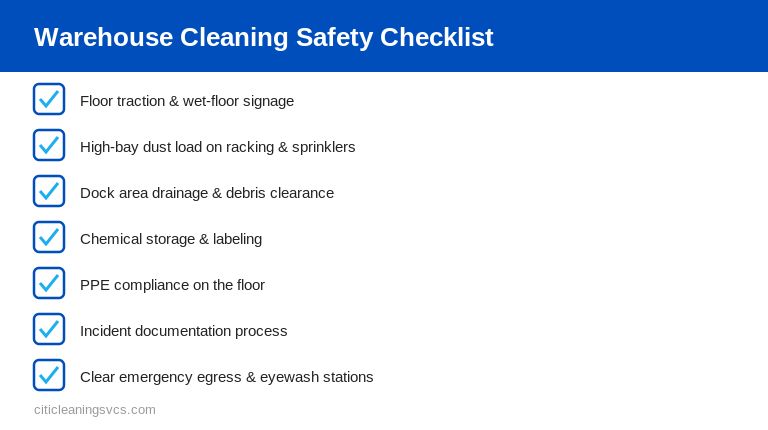
A written safety checklist turns warehouse cleaning from a reactive chore into a documented, auditable program. Facility managers can use this list to evaluate their current cleaning plan or brief a new vendor.
Use it as a baseline and adjust it to your facility’s specific hazards, racking layout, and traffic patterns. Keep a signed copy on file so it doubles as documentation if an incident ever needs to be reviewed.
Run through this list quarterly with whichever vendor services your facility, whether that’s Citi or someone else. A vendor who resists a documented checklist, or treats the request as unusual, is telling you something important about how they operate.
Once safety is documented and repeatable, the next step is knowing how to evaluate the vendor delivering it.
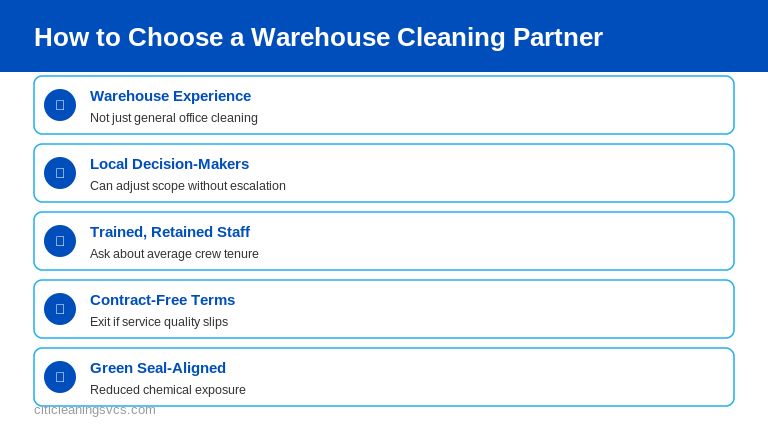
The right warehouse cleaning company combines industrial-grade capability with local responsiveness — not a national brand running your facility through a call center. Capability and communication matter more than a recognizable logo.
Central Florida’s logistics corridor has grown fast, but the cleaning options serving it haven’t kept pace with specialization. Many national vendors treat a warehouse contract the same as an office building contract, just with a bigger square footage number attached.
When evaluating a partner, look for:
A short reference check with another facility manager in a similar industry tells you more than any sales pitch. Ask what breaks down when volume spikes during peak season, and ask specifically how the vendor handled it the last time it happened.
Pay attention to how quickly a vendor’s team returns a call or email during the evaluation process itself. That responsiveness is usually a preview of what you can expect once you’re an active client rather than a prospect.
Once you’ve narrowed your options, compare the full range of commercial cleaning services a vendor offers and review the clauses in the proposed agreement before you sign, then move on to understanding how warehouse cleaning is typically priced so you can compare proposals apples to apples.
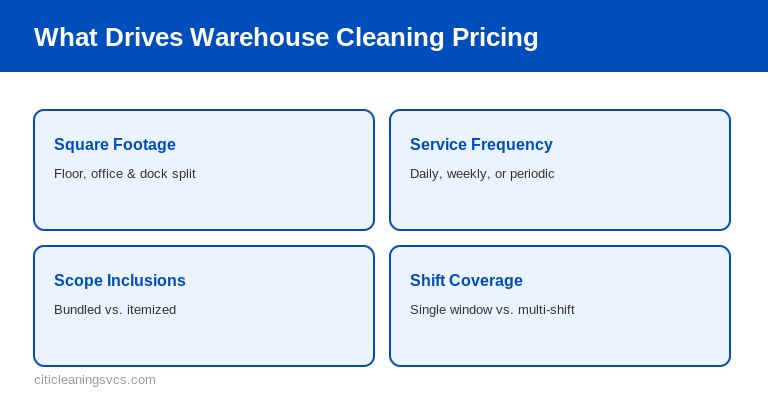
Warehouse cleaning pricing is driven by square footage, service frequency, and scope — not a flat per-visit rate. Facilities with heavier dock traffic or multi-shift schedules typically carry a higher scope than a low-traffic storage warehouse.
Vendors typically price around a handful of core variables. Understanding them helps you compare proposals that otherwise look wildly different on paper, even when they’re quoting the same facility.
Request an itemized proposal that separates routine service from periodic deep cleaning. That structure makes it easy to see exactly what you’re paying for and to adjust scope as your operation changes, and it gives you leverage if a competing bid comes in with a suspiciously low number.
A vague, bundled quote is harder to audit later and harder to renegotiate if your needs shift. For a broader breakdown of how commercial pricing works across facility types, see this guide on commercial cleaning costs. With pricing structure in mind, let’s look at what “local” actually means for facilities along Central Florida’s logistics corridor.
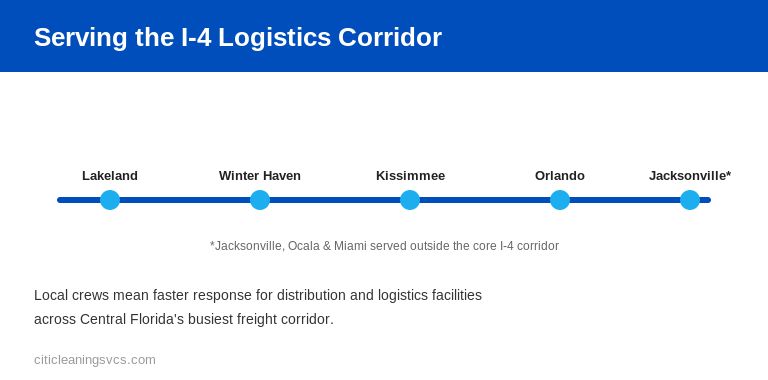
Central Florida’s I-4 corridor has become one of the state’s busiest logistics and distribution hubs, and warehouse cleaning demand has grown right alongside it. Facilities here run tighter shift schedules and higher throughput than most other property types in the region.
Distribution and logistics operators along this stretch — from Orlando and Kissimmee through Lakeland and Winter Haven — need a cleaning partner who understands dock schedules, seasonal freight surges, and multi-shift staffing without a learning curve eating into the first few months of service.
A locally based warehouse cleaning company brings advantages a national vendor structurally can’t match:
Citi Cleaning Services has served Central Florida’s commercial and industrial facilities since 2004, with crews trained specifically for distribution and logistics environments across Orange, Seminole, Lake, and Osceola counties, as well as Jacksonville, Ocala, and Miami. That regional focus is what lets a family-owned, minority/women-owned business compete on responsiveness where national vendors can’t, and it’s part of why average client retention runs well past a decade.
Local presence closes the gap between a cleaning plan on paper and a cleaning plan that actually runs on your floor. Facilities near Lakeland and Jacksonville benefit from the same trained crews and equipment standards as those closer to Orlando, without a separate regional pricing structure. From here, let’s answer the questions facility managers ask most often.
A standard contract typically covers floor care, dock area cleaning, high-bay dust removal, restrooms, break rooms, and trash management. Scope should be itemized in writing, not bundled into a vague flat rate, so you can see exactly what’s covered and what would trigger an extra charge.
Most warehouses need daily attention to high-traffic floor areas and trash, with weekly deep cleaning of dock zones and floors. High-bay dust removal is usually scheduled monthly or quarterly depending on operational volume and how much cardboard or shrink wrap the facility processes.
A locally based partner with trained staff already in the market can typically scale service within days, not weeks. National vendors relying on subcontracted regional labor often take much longer, especially heading into peak shipping seasons when every facility is asking for the same thing at once.
Warehouse cleaning generally focuses on floors, dust, dock areas, and general facility upkeep, while industrial cleaning can extend further into equipment-adjacent surfaces and manufacturing-specific processes. Ask any prospective vendor exactly where their scope stops so there’s no ambiguity once service starts.
Ask about crew training and tenure, OSHA certification, shift-flexible scheduling, and whether the contract is cancelable if service quality drops. A confident vendor answers all four without hesitation and can point to specific examples rather than general reassurances.
Warehouse cleaning often costs more per square foot than office cleaning because of specialized equipment, dust removal, and multi-shift coverage. Get an itemized proposal so you can see exactly what’s driving the difference instead of comparing two unrelated bottom-line numbers.
Yes — zone-based cleaning plans let crews work sections of a facility while other areas stay fully operational. This is standard practice for any vendor experienced with distribution and logistics facilities and shouldn’t require you to pause receiving or shipping.
Slip-and-fall incidents tied to dust, debris, and wet floors near forklift and pedestrian traffic are the most common and most expensive risk. A documented cleaning and signage protocol, reviewed on a regular schedule, is the most effective way to reduce it.
Warehouse cleaning isn’t a cosmetic line item — it’s a safety program that happens to leave your facility looking better too. The facilities that get this right treat scope, safety compliance, scheduling, and crew qualifications as one connected decision, not four separate checkboxes handled by different people.
Here’s a simple four-step action plan to move forward:
Getting these four steps right before you sign anything puts you in a far stronger position than reacting after an incident happens.
Warehouse cleaning done well is quiet, consistent, and rarely makes headlines inside your building. That’s the goal — a program that prevents problems instead of one your team notices only when something goes wrong.
