
Choosing the wrong commercial cleaning company is one of the more expensive procurement mistakes a facility manager can make. It shows up as tenant complaints, missed inspections, insurance headaches, and — six or twelve months later — the cost of running the whole RFP again.
These 10 tips are the framework our operations team at Citi Cleaning Services uses when we help facility managers audit vendors across Central Florida. Citi has served this market for 20+ years (founded in 2004) and supported roughly 100 vendor transitions over the last five years. Every tip below survived contact with a real building.
You will finish with a practical checklist: what to verify, what to ask, what to walk away from, and how to structure the pilot period before you commit to a long-term agreement.
Key Takeaways
- Verify insurance before you look at pricing. COI, workers’ comp, and bond are non-negotiable in 2026.
- Prioritize retention over reviews. A 10-year client roster beats a stack of five-star ratings.
- Insist on a room-level scope of work — not a one-page brochure.
- Prefer contract-free, month-to-month terms so incentives stay aligned.
- Match the crew model to how your building actually operates — day porter, night crew, weekend deep-clean, or hybrid.
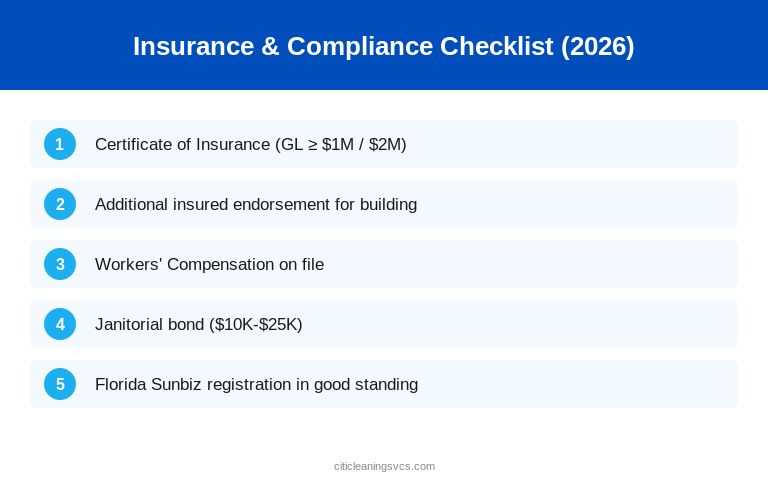
Before you look at a single price quote, ask for four documents. Any vendor who hesitates on any one of them should be dropped from the list.
Certificate of Insurance showing general liability of at least $1M per occurrence and $2M aggregate, with your building or property manager listed as additional insured. Workers’ Compensation coverage on file — verifiable through the Florida Division of Workers’ Compensation. Janitorial bond of $10K–$25K to protect against theft or damage by crews. Florida Sunbiz filing in good standing, easily verified at Sunbiz.org.
These four items eliminate roughly a third of local search results in under 30 minutes. They are also the fastest way to protect yourself from the risk of hiring a fly-by-night operator.
Online reviews measure isolated interactions. Retention measures multi-year relationships. Ask each vendor for their average client tenure and their five longest-running accounts.
A vendor with 10-year clients in your industry has already made the operational trade-offs that keep an account working — training, supervision, communication, response time. A vendor with mixed reviews and short-tenured accounts probably has not.
Retention is a lagging indicator of everything you cannot easily measure on the sales call. Weight it heavily.
Retention averages hide a lot. Ask for two specific numbers: the vendor’s overall renewal rate (accounts that stay past their initial contract term) and their average contract length across their book.
A vendor with a 90%+ renewal rate and an average contract length of 5+ years is running a real business. A vendor with a 60% renewal rate is bleeding accounts and probably trading price for churn — you will be next.
Also ask what happens when an account leaves. Most vendors will only tell you about wins; the story of a loss is more revealing. A vendor who can honestly describe how they lost a recent account is telling you they have processes for post-mortem, and processes for post-mortem are what prevent the same problem repeating on your building.
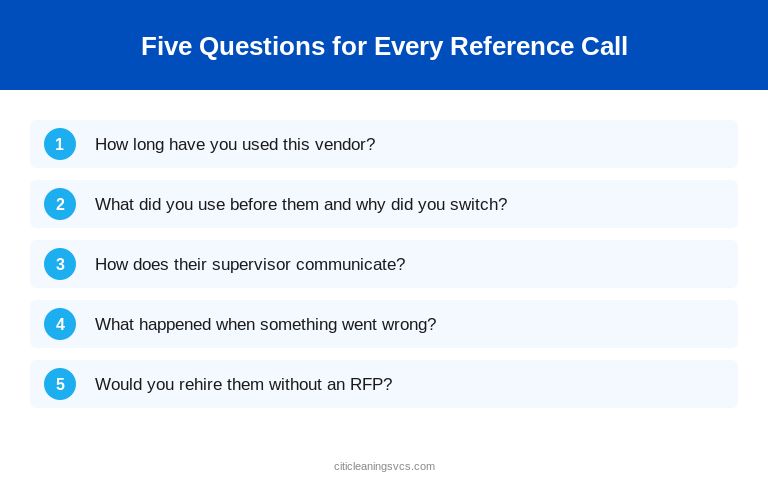
Every vendor will give you a reference list. Fewer than 15% of prospects actually call. Do the calls.
Ask each reference the same five questions: how long have they used the vendor, what did they use before, how does the supervisor communicate, what happened when something went wrong, and would they rehire without an RFP.
The last question is the tell. Hesitation is a warning; a confident yes with a specific reason is worth more than any star rating. Also ask for one former client — a vendor unable to name any recent departure is either brand new or hiding something.
The scope of work is the contract’s heart. Vague scopes cause 80% of disputes; specific scopes prevent them.
A real scope specifies frequency per area (offices vs. restrooms vs. common areas), tasks per visit at the room level, explicit exclusions (window washing over 6 ft., biohazard cleanup, carpet extraction), consumables responsibility, special-service pricing, and emergency response commitments.
If what you receive is a one-page brochure with a monthly price and no room-level detail, the vendor is guessing. Ask for it to be redone at the room level, and score the vendor on how quickly the revised document lands and how complete it is.
A well-written scope also documents inspection frequency and what happens when a task is missed. Look for language that specifies a written re-clean by the next business day, credited back on the invoice if service falls below the agreed threshold.
See our clause-by-clause contract guide for the full spec.
The person walking your building should be the person who will manage your account after you sign. Watch for four behaviors during the walk.
They take notes on paper or a tablet. They ask what has gone wrong with previous vendors. They point out issues you did not mention — grease buildup, hard water, filter age. They ask about access, alarm, and after-hours protocols.
Salespeople sell the pitch. Operators diagnose the building. You want the operator on the walk.
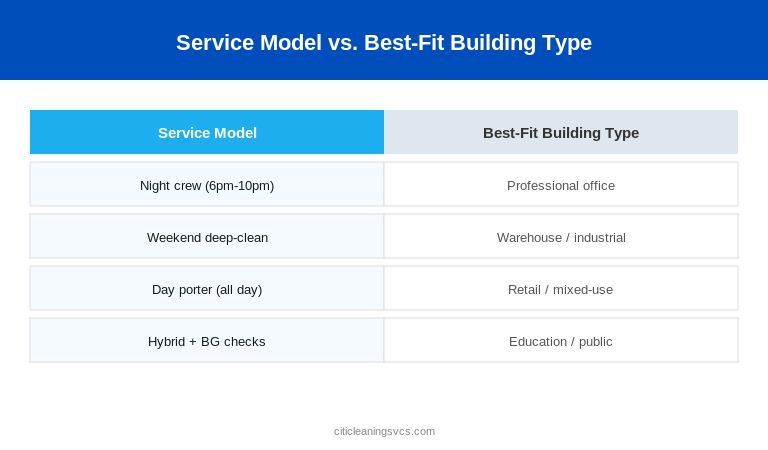
A daytime professional office and a 24/7 distribution warehouse do not need the same crew structure. The vendor should describe the model that fits your building, not push the model they staff by default.
Professional offices: night crews between 6 p.m. and 10 p.m., weekly supervisor walks, low crew turnover. Warehouses: weekend deep cleans plus a day porter for restrooms and break areas. Retail centers: dedicated day porter separate from the overnight deep-clean crew. Educational: background-checked crews and district-compliance paperwork.
See how these models play out at warehouse cleaning, office building cleaning, large retail cleaning, and education facility cleaning in the Central Florida market.
Local means local accountability — for people and products alike. Ask for documentation on three specific areas.
OSHA training: every crew member should complete OSHA 10-Hour General Industry within their first 60 days. Bloodborne pathogen certification is separate and matters for restrooms, gyms, and schools.
Green Seal: confirm cleaning chemistries carry Green Seal GS-37 certification or equivalent. SDS binder: Safety Data Sheets for every chemical on the cart should be available on request — this is a federal requirement, not a nice-to-have.
Providers who cannot produce SDS documentation are operating outside the rules. Providers who invest in OSHA and Green Seal are investing in longevity.
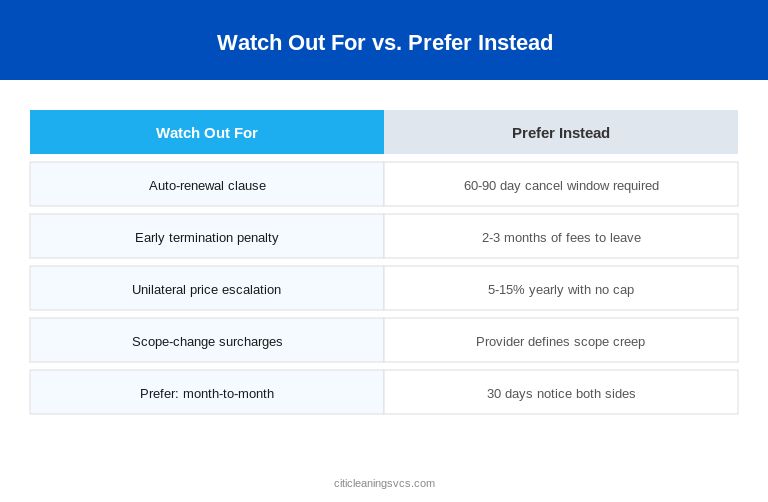
Cleaning contracts frequently bury three traps that only surface when you try to leave. Auto-renewal clauses that lock you in for another year unless you cancel 60–90 days early. Early-termination penalties of two to three months of service fees. Unilateral price escalations of 5–15% annually with no cap.
The cleanest structure is contract-free — month-to-month with 30 days’ notice on either side. Incentives stay aligned: the provider earns your business monthly, and you stay because service is good.
Citi has run contract-free since 2004; see our contracts guide for the reasoning and structure.
Vendors quote monthly totals to obscure comparison. Normalize every bid to the same denominator before you look at price.
Convert every bid to price per square foot per visit. Divide the annual total by (square footage × visits per year). Now every vendor is on the same axis and you can see who is padding versus who is bidding to win.
The middle-lowest bidder is often not the best choice — underbidders cut insurance, training, and supervision to hit price. Use our bid comparison template to score bids consistently and Central Florida pricing benchmarks to sanity-check totals.
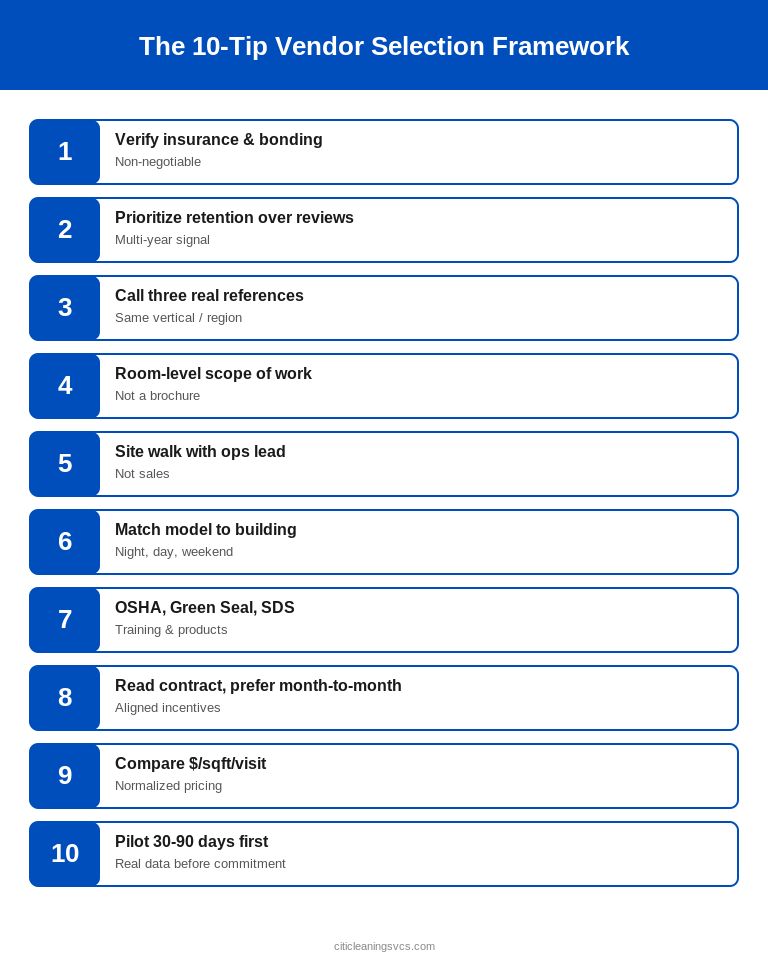
Before signing a 12- or 24-month agreement, run a pilot with your top-scoring vendor. Use a defined scope, weekly QA walk-throughs, and an exit clause that lets you extend or terminate at the end of the pilot.
Track four things every week during the pilot: supervisor visits, task completion against the written scope, response time on requests, and consumables plus chemical usage. Reputable providers welcome pilots because they close well; underprepared vendors resist them for the same reason.
A pilot costs nothing extra and gives you real data before you commit budget for a year. It is the last, cheapest defense against a bad multi-year commitment.
For the deep-dive on any of the tips above, see our complete evaluation checklist, 10 red flags your current vendor is failing you, the and our complete guide to commercial cleaning. For an overview of all the services we run across Central Florida, see the services page or start at the homepage.
Verify insurance, workers’ comp, and bonding before you look at pricing. Everything downstream — training, supervision, contract terms — matters less if a claim ever arises without proper coverage.
Standard scopes for nightly office cleaning range roughly from $0.08 to $0.16 per square foot per visit. See our pricing guide for detailed benchmarks by facility type.
Three to four weeks from RFP to signed pilot. That includes shortlisting, documentation review, site walks, reference checks, and contract negotiation.
OSHA 10-Hour General Industry training, Green Seal-aligned chemistries, active general liability and workers’ comp insurance, a janitorial bond, and Florida Sunbiz registration in good standing.
Month-to-month, contract-free arrangements are safer for the buyer. They align incentives so the vendor earns your business monthly. Multi-year contracts benefit the vendor more than the client.
Underbid vendors typically win year one by cutting insurance, training, or supervision — then service degrades in year two. Price should carry maybe 15% of your evaluation weight, not 60%.
Under 25% annual turnover is best-in-class. Between 25% and 60% is average and manageable. Over 60% predicts service problems within six months.
Overlap the incumbent and the new vendor by 5–10 business days. Do a joint walk-through. Confirm the new crew has access, alarm codes, and consumables before the incumbent’s last shift.
Choosing the right commercial cleaning company is a decision you will live with for a year or more. Use these ten tips as a checklist and follow the compressed action plan below.
