
A minority owned cleaning company can strengthen your supplier-diversity numbers, but only if the ownership claim holds up on paper. This guide explains what MBE, WBE, DBE, and M/WBE certifications mean, how they show up in RFP scoring, and how to verify a janitorial vendor before you award.
Citi Cleaning Services has bid on Central Florida contracts since 2004. As a family-owned, minority- and women-owned (M/WBE) company, we see both sides of the procurement table: what evaluators ask for and what vendors tend to get wrong.
You will learn the difference between self-declared and certified status, where certification carries weight in a solicitation, and a five-point check that takes under an hour. Let’s start with the definitions, because most RFP confusion starts there.
Key Takeaways
- Certified is not the same as self-declared. A third-party certificate is the document most RFPs accept.
- MBE and WBE are ownership designations. They describe who owns and controls the company, not how well it cleans.
- Certification shows up in four places in a typical RFP: scoring, participation goals, Tier 2 reporting, and tie-breakers.
- Tier 2 spend matters. A prime contractor can often count a certified janitorial subcontractor toward its diversity reporting.
- Verify every certificate. Check the issuer, the expiration date, and the scope before you award.
- Judge performance separately. Ownership status never replaces scope, training, insurance, and references.
A minority-owned cleaning company is a business that is at least 51 percent owned, operated, and controlled by one or more members of a recognized minority group. The word that matters is “controlled”: the owner must run the company day to day, not just hold shares.
Plenty of vendors describe themselves as minority-owned in a brochure. Far fewer hold a certificate from an organization that audited the ownership papers, tax returns, and management structure.
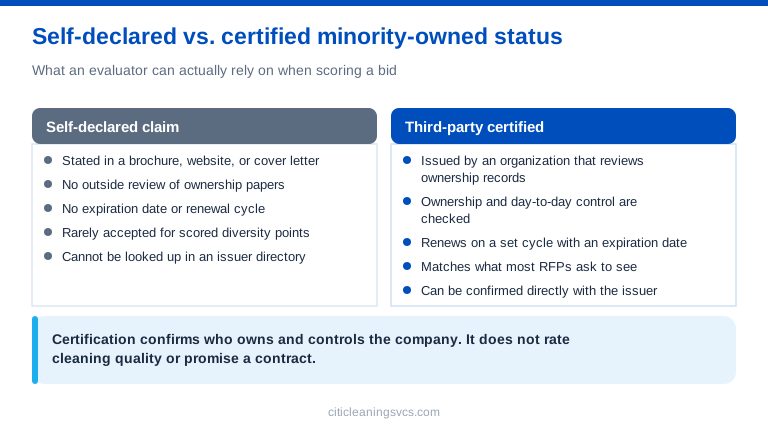
That gap is why procurement teams ask for the certificate, not the claim. A certificate tells your compliance team that someone independent already checked.
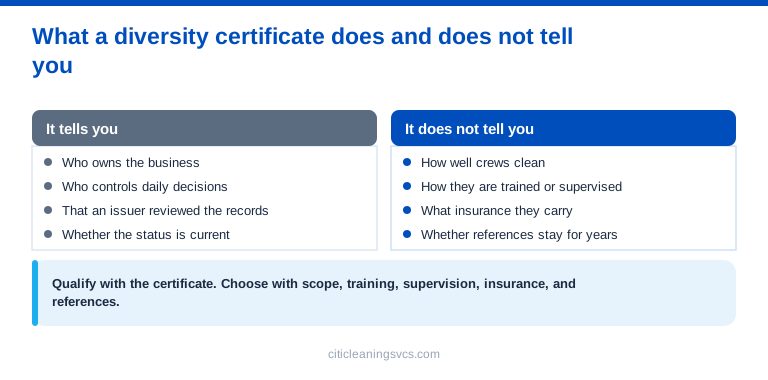
Keep one limit in mind: certification confirms ownership and control. It does not rate cleaning quality, and it does not promise a contract.
MBE means minority business enterprise, WBE means women’s business enterprise, and DBE means disadvantaged business enterprise. M/WBE is the shorthand some agencies use when they treat the first two together.
Each label sits on a different rulebook, so the same company can hold one, several, or none. The table below separates them.
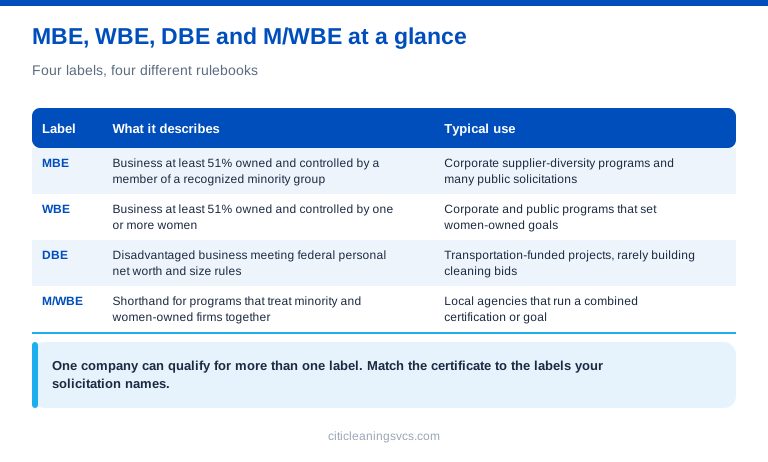
DBE is the one that trips people up. It belongs to transportation-funded projects and carries its own federal eligibility rules, including personal net worth and business size limits.
Most office-building and warehouse janitorial bids never mention it.
A company can be both minority-owned and women-owned. When one owner qualifies under both definitions, the company can pursue both certificates, and some agencies count either one toward a goal.
Three issuers show up most often in Florida solicitations: the National Minority Supplier Development Council, the Women’s Business Enterprise National Council, and the state’s Office of Supplier Diversity. Local governments and some large institutions run their own programs too.
The NMSDC certification process applies a 51 percent ownership, operation, and control standard for minority-owned businesses. NMSDC also states plainly that certification is an ownership-based designation and does not secure contracts on its own.
The WBENC certification standard applies the same 51 percent test to women-owned firms and adds a citizenship or lawful permanent residency requirement for the majority owner. WBENC delivers certification through regional partner organizations, so applicants apply locally.
Florida’s Office of Supplier Diversity sits inside the Department of Management Services and certifies minority business enterprises for state purposes. Private buyers usually accept NMSDC and WBENC; public buyers often name the state or a local program.
The takeaway is simple. Read the solicitation to see which issuers it names, then match the vendor’s certificate to that list.
Certification can influence an RFP in four ways: a scored supplier-diversity section, a participation goal, a subcontractor reporting requirement, or a tie-breaker. No universal weighting exists, so every solicitation sets its own.
Some agencies award points when a bidder is certified. Others ask prime contractors to commit a percentage of the work to certified subcontractors, then verify it during the term.
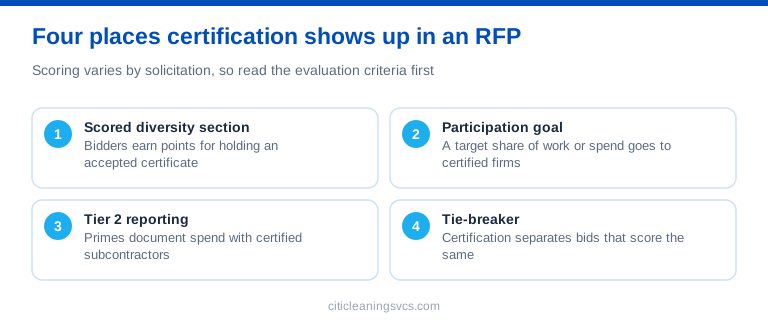
Because the rules vary, treat the evaluation criteria as the authority. If the RFP assigns points for diversity, document the certificate in the proposal exactly as the instructions require.
For a facility manager running an informal vendor selection, certification still helps. It gives your procurement or finance team a clean, auditable reason to include a vendor on the shortlist.
Tier 1 spend is money you pay directly to a certified vendor. Tier 2 spend is money your prime contractor pays to certified subcontractors on your behalf.
Janitorial work is a natural Tier 2 category. A property management firm or general facility-services contractor can subcontract nightly cleaning to a certified vendor and report that spend upward.
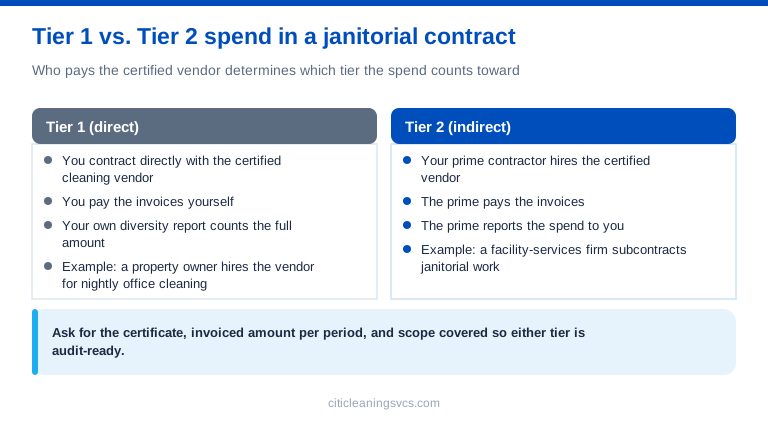
If your organization tracks Tier 2 numbers, ask the cleaning vendor for a clean reporting package. At minimum it should show the certificate, the invoiced amount per period, and the contract scope it covers.
Good reporting protects both sides. The prime gets documentation for its own audits, and the subcontractor gets credit for the work it performs.
Reporting works best when the service arrangement is simple to document, which is one reason many buyers value contract-free commercial cleaning with clear monthly invoices.
Public-sector rules are not static. Some local governments have restructured programs that once used minority and women-owned goals into race- and gender-neutral small business programs.
Private-sector supplier-diversity programs run on their own policies. Many corporate buyers, hospitals, universities, and property managers still ask for NMSDC or WBENC certificates.
That split means a vendor’s certificate can carry different weight depending on who is buying. Confirm the current rules for the agency or company that issued your solicitation before you build a scoring plan around them.
If you buy for a public entity, ask your procurement office how it treats small-business and diversity credentials today. That one email prevents a bid protest later.
Verification takes about an hour and uses only public information. Ask for the certificate, read it, then confirm it with the issuer.
Run these five checks on every vendor that claims minority-owned or women-owned status.
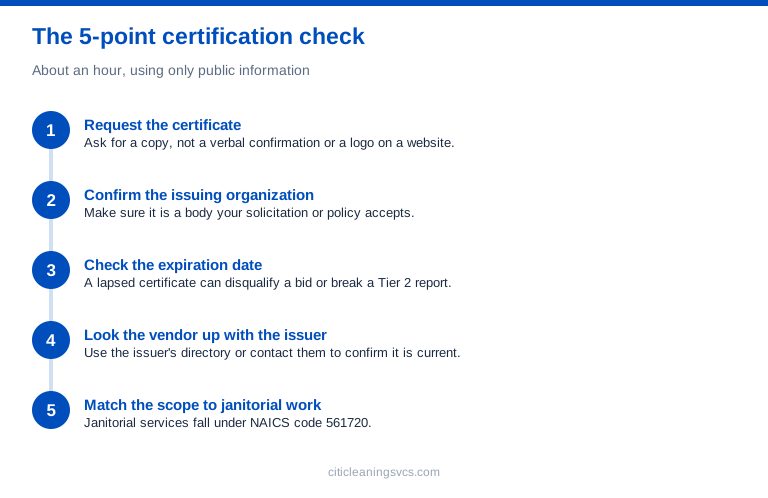
The scope check deserves extra attention. Janitorial services fall under NAICS code 561720, and a certificate that lists a different line of work may not support a cleaning contract.
Also check the expiration date. Certificates renew on a cycle, and a lapsed certificate can disqualify a bid or break a Tier 2 report.
If a vendor’s paperwork checks out but your instincts still say something is off, our guide to the warning signs of the wrong cleaning vendor covers the operational red flags.
No. Ownership status says nothing about price or performance, so evaluate a certified cleaning vendor on the same criteria you apply to everyone else.
A fair comparison looks at the scope of work, crew training, supervision, insurance, and references. Our guides on how to compare commercial cleaning bids and how to read a cleaning proposal give you the side-by-side format.
Here is the standard we hold ourselves to at Citi Cleaning Services. We are independently owned, founded in 2004, staffed by more than 70 trained professionals, and our clients stay with us for more than ten years on average.
Our crews are OSHA-certified and our practices are Green Seal-aligned. We work without long-term contracts, we serve facilities around the clock, and we focus on Central Florida.
Those facts belong in the same scorecard as any other vendor’s. Certification opens the door to the comparison; performance wins the award.
A practical way to enforce that discipline is to score two questions separately.
First ask whether the vendor qualifies, meaning the certificate is valid and the scope matches. Then ask whether the vendor performs, meaning the operation behind the paperwork can deliver month after month.
Separating the questions also protects the buyer in a protest. If a losing bidder challenges the award, your file shows a documented qualification check and a documented performance score.
Ask questions that test the operation, not just the paperwork. A vendor who is proud of its crews will answer them quickly and in detail.
For more on the questions that separate strong bidders from weak ones, start with our 10 tips for choosing a commercial cleaning company and read our guide to selecting a janitorial service provider. If you manage several property types, our pages on janitorial services and office building cleaning show the scope we typically see.
MBE certifies a business that is majority owned and controlled by a member of a recognized minority group. WBE certifies a business that is majority owned and controlled by one or more women.
No, because certification confirms ownership and control and nothing more. The vendor still has to win on scope, price, and past performance.
Tier 2 spend is money a prime contractor pays to certified subcontractors. The prime reports it to show diversity participation in its own supply chain.
Request the certificate, confirm the issuer, check the expiration date, and look the company up with the issuer. Then confirm the certificate’s scope covers janitorial work.
A self-declaration is a claim, while a certificate means an independent organization reviewed the ownership documents. Most RFPs that score diversity ask for the certificate.
Ownership does not set price. Compare bids by scope, staffing, and service levels, the same way you would for any vendor.
Yes. A company whose majority owner qualifies under both definitions can hold both certificates, and some buyers accept either one toward a goal.
It varies by issuer and by how complete the application is. Expect to gather ownership records, financial statements, and proof of control, then wait through a review that can include a site visit.
Certification is a verification tool. It tells you who owns and controls a business, it gives your procurement team a clean audit trail, and it can satisfy participation goals in the right solicitation.
It does not replace an evaluation of the work itself. Use the certificate to qualify a vendor, then use scope, training, supervision, and references to choose one.
