
Commercial floor stripping and waxing typically runs $0.30 to $1.25 per square foot in 2026, with most Central Florida facilities landing between $0.45 and $0.75. The final number swings by floor condition, wax coats, facility access hours, and volume.
This 2026 pricing guide breaks down the real cost of stripping and waxing commercial VCT floors, tile, and terrazzo — with per-square-foot rates by facility type, volume discount thresholds, hidden line items to watch, and a side-by-side comparison of insured commercial specialists versus handyman crews. You will also get a Florida-specific pricing worksheet and a printable checklist of questions to ask before signing.
By the end you will know exactly what a fair quote looks like for your building, why 4 to 5 wax coats matter more than the hourly rate, and how multi-location portfolios can cut per-square-foot pricing by 20 to 35 percent.
Key Takeaways
- Baseline range: $0.30–$1.25 per sq ft for a full strip and 4–5 coats of wax in 2026.
- Central Florida average: $0.45–$0.75 per sq ft for VCT in normal condition.
- Floor condition — not square footage — is the single biggest cost driver.
- Volume discounts begin at ~25,000 sq ft per visit and scale to 20–35% off single-location rates.
- 4–5 wax coats extend the service life from 6 months to 18–24 months and lower annual cost per sq ft.
- Uninsured handymen quote 40–60% less but expose you to workers comp and property damage claims.
Stripping and waxing is a full removal of every layer of old finish, followed by re-sealing and applying multiple fresh coats of commercial floor wax. It is not the same as a burnish, scrub-and-recoat, or a maintenance mop.
A complete service covers six steps: furniture move, stripping solution dwell, floor stripping with a low-speed machine, neutralize and rinse, seal application, then 4 to 5 wax coats with dry time between each. Cutting any step to save money shortens the finish life and shows up as haze, streaks, and yellow buildup within weeks.
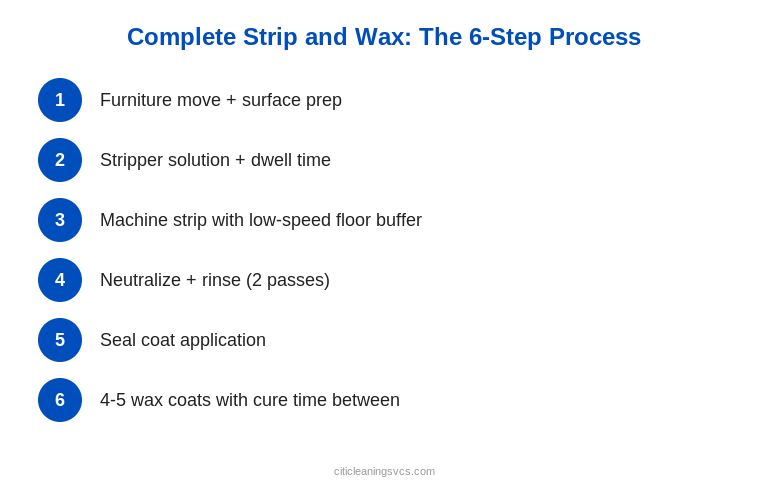
A single-coat wax job costs less up front and fails inside 90 days. Four to five coats give the floor a sacrificial wear layer that takes daily foot traffic without cutting into the finish itself.
Independent flooring manufacturers such as the Resilient Floor Covering Institute recommend a minimum of four coats on new VCT installations and any full-strip service. Anything less is not a full service — it is a top coat.
You just learned what a real service includes. Next, the per-square-foot numbers you should expect to see on a Florida quote.
Commercial rates in 2026 fall inside a predictable band. The table below shows Central Florida averages for single-visit projects — one location, standard access, one shift of after-hours labor.
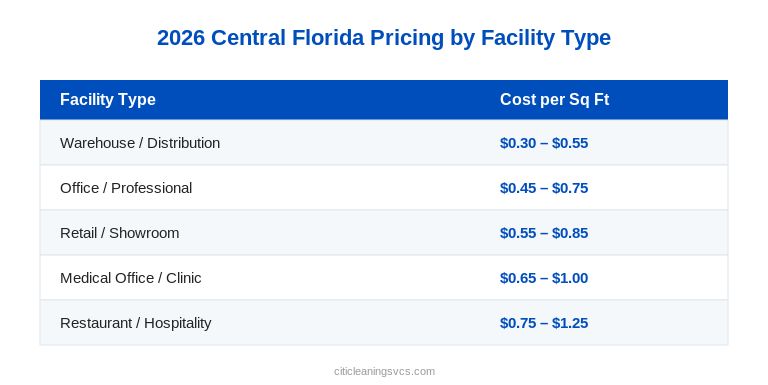
Different floor plans burn different labor hours per square foot. A wide-open warehouse strips fast. A cubicle-heavy office floor moves 20–30 percent slower because of furniture navigation.
These are cash prices with 4 to 5 coats of a commercial acrylic wax finish, insured labor, and OSHA-certified crew members. Numbers rise if the floor requires two visits, deep grease cutting, or emergency next-day scheduling.
Facility managers assume square footage sets the price. It is actually the floor’s starting condition that swings the quote by 40 percent or more.
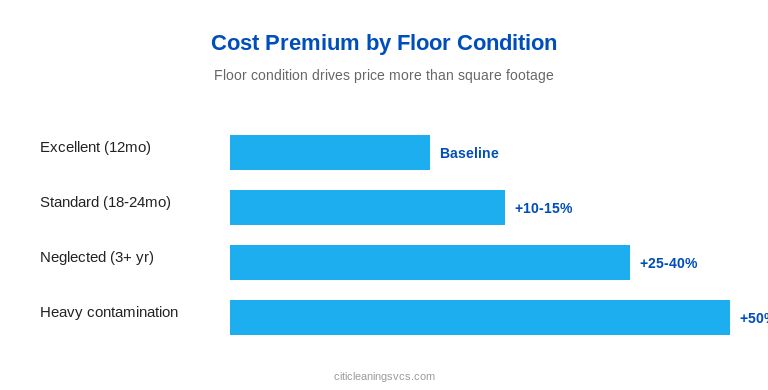
A neglected 20,000 sq ft warehouse can cost the same as a 30,000 sq ft warehouse in standard condition. Regular annual stripping is cheaper than deferred stripping every four years — the math on that is later in this guide.
You now have real per-square-foot numbers by facility type and condition. Next, the volume thresholds where multi-location portfolios save the most.
Portfolio buyers are the most under-priced segment of the commercial cleaning market. Vendors would rather run one crew across three sites in a week than juggle three one-off quotes. That efficiency shows up as real discounts once you cross the 25,000 sq ft per visit line.
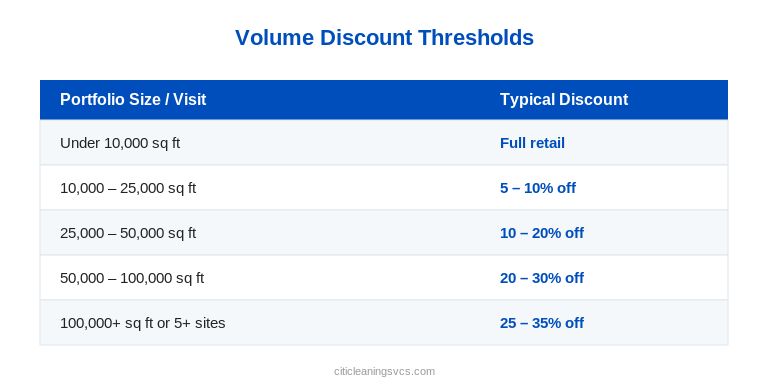
Two things must be true to hit these numbers. First, the vendor has to own its equipment and payroll — subcontracted crews cannot offer the same margin. Second, the visits have to fit inside a route the vendor can staff efficiently.
If you manage 3 retail locations at 8,000 sq ft each, do not order three separate visits at three separate rates. Ask for a portfolio quote where the vendor strips all three inside a single week using the same crew and equipment mobilization. Expect 15–20% off the sum of individual visit rates.
Portfolio pricing is one of the biggest advantages of working with an established Central Florida specialist over a national broker. Local vendors keep the discount instead of skimming it for referral margin. See the tradeoffs in our guide on how to compare commercial cleaning bids across vendors.
You now know when volume tips the price. Next, the pricing model that costs more up front but wins on annual cost.
The cheapest strip-and-wax cycle over five years is not the one with the lowest per-visit price. It is the one that keeps the finish healthy so the floor never needs an emergency full strip.
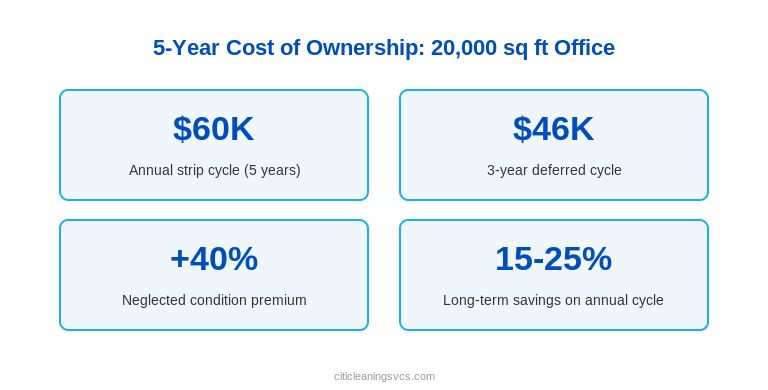
Take a 20,000 sq ft office at $0.60 per sq ft for a standard strip and wax. That is $12,000 per full service. Two annual scenarios:
Scenario B looks cheaper — until you add the reputational cost of yellowed floors in front of tenants, plus the near-certain need for a fourth event in year five. When you model years six through ten, annual maintenance always wins.
Facility managers who track floor age and schedule proactively spend 15–25% less over a 10-year window than facilities that wait until floors “look bad.” See our companion piece on how often to strip and wax VCT floors for the cycle timing details.
You now have the 5-year math. Next, the vendor comparison that decides who actually earns your business.
A handyman quote will come in 40–60% under an insured commercial specialist. That gap is not markup — it is the cost of general liability insurance, workers comp, OSHA-certified training, commercial-grade equipment, and the wax itself.

The Occupational Safety and Health Administration requires slip-resistant finish application, spill protocols, and PPE that untrained crews rarely follow. Facility managers who understand liability price the difference into their budget rather than trying to eliminate it.
Citi Cleaning Services is a family-owned, minority/women-owned (M/WBE) Central Florida provider that has stripped and waxed commercial floors since 2004, with 70+ trained pros and 10+ year average client retention. All crews are OSHA-certified and Green Seal-aligned. Services run contract-free, 24/7, across Orange, Seminole, Lake, and Osceola counties.
You now see what the price gap really buys. Next, the questions that separate serious vendors from the rest.
Every quote should answer these questions before you accept it. If a vendor cannot answer clearly, keep shopping.
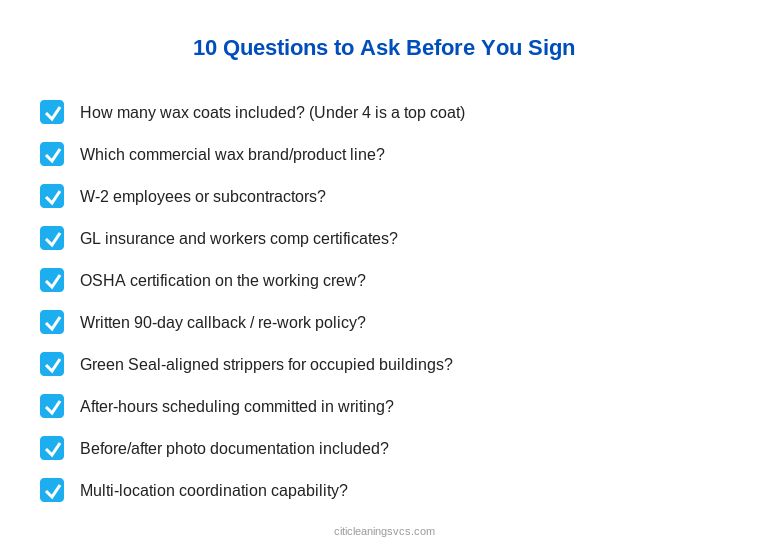
A vendor that answers all ten in writing has already earned above-average trust. For a full framework, our team maintains a companion guide on how to read a cleaning proposal line by line.
You now have the checklist. Next, the answers to the questions Google says facility managers ask most.
Central Florida pricing runs 5–10% lower than South Florida and roughly on par with North Florida markets like Jacksonville. Two market factors matter.
First, humidity extends dry time. Every wax coat needs an extra 15–20 minutes to cure in Orlando’s summer humidity versus a dry western climate. Some vendors absorb that. Others charge a small humidity premium in July and August.
Second, sand and grit from parking-lot foot traffic wears wax finish 20–30% faster than average. Central Florida facilities benefit from more frequent burnishing between full strip cycles. Related reading: our complete VCT floor care guide and signs your floors need a strip and wax.
Downtown Orlando class-A buildings quote at the higher end of the range because of after-hours access restrictions and elevator scheduling. Suburban office parks in Lake Mary and Maitland run 10–15% below downtown rates for the same square footage.
Kissimmee and Osceola County light-industrial buildings, where night shifts are common, often get the lowest per-square-foot rates in the region because crews can work daytime hours without occupied-space constraints. Retail plazas in tourist corridors near International Drive pay a premium because of frequent scheduling around events. Facility managers who know their submarket price band avoid overpaying by 15–25%.
For a broader view of related floor services, our commercial floor cleaning services guide covers pricing for daily maintenance in addition to periodic strip cycles, and the Citi Cleaning Services homepage lists every Central Florida service area. If you also outsource general janitorial, see our commercial janitorial services pricing guide.
Central Florida averages $0.45 to $0.75 per square foot for VCT in standard condition with 4 to 5 wax coats. Warehouses run lower at $0.30 to $0.55. Restaurants and medical spaces run higher at $0.65 to $1.25.
Expect $4,500 to $7,500 for a full strip and 4–5 coat wax in Central Florida, insured. A 10,000 sq ft neglected floor with heavy yellowing can push $9,000+.
They exclude insurance, workers comp, OSHA training, and commercial-grade wax. They also typically apply 1–2 coats instead of 4–5. The floor fails in 6–9 months, and you pay again.
Every 12 to 18 months for most facilities. Neglecting past 3 years triggers premium neglected-condition pricing and shortens tile life. Interim burnishing every 60–90 days extends the strip cycle.
Yes — meaningful ones. Portfolios of 25,000+ sq ft per visit or 5+ locations typically save 20–35% versus one-off pricing, if the vendor is local and owns its crew.
Furniture move, base cove edging, extra coats above 3, emergency scheduling, and humidity premiums are the common line items. Get every one of them itemized before signing.
Stripping removes all wax down to the tile. Scrubbing cleans the top layers without removing them. Burnishing high-speed polishes the top coat for shine. Different frequencies, different costs.
Yes over a 10-year window. Neglected-condition premiums, emergency callbacks, and premature tile replacement add up. Annual stripping runs 15–25% less over a decade even at higher per-year outlay.
