
Commercial VCT floors do not fail overnight. They fail in the two years you spent pretending the shadows in the hallway were normal.
This guide shows you the five signs that commercial floor stripping and waxing services should already be on your calendar. You get a diagnostic you can walk with today, the DIY-to-professional line most in-house teams cross without knowing it, and the real cost of waiting until the floor tells you it is done.
We pull from 20+ years serving Central Florida facility managers across warehouses, offices, retail, and education campuses. Every sign below is one we see repeatedly right before a facility calls in a strip and re-wax.
Here is the one thing worth reading twice: the sign most managers dismiss (Sign 2) is the one that quietly doubles the cost of restoring the floor.
Key Takeaways
- Wear patterns in walking paths mean your finish is already thinning — do not wait for tile damage.
- Yellow buildup is not dirt. It is oxidized finish that cannot be mopped away.
- In-house teams top out at deep scrub. Full stripping needs professional equipment, chemistry, and airflow.
- Delayed strip and wax costs 6–10× more than a scheduled service — sometimes crossing into full tile replacement.
- Slip complaints are the last warning. They also come with liability tied to your name.
If you can see the walking path from ten feet away, the finish is gone in that zone.
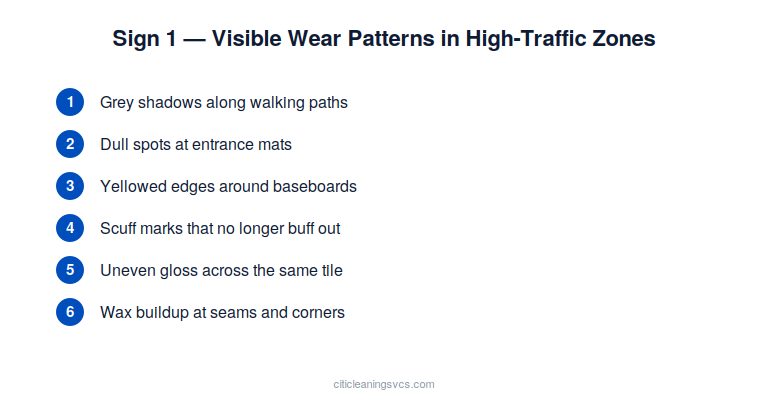
VCT is a hard-wearing floor, but the shine is 100% finish. Once foot traffic wears through the top coat, the tile itself starts absorbing scuffs, spills, and shoe rubber. That damage is permanent.
What to walk for: shadowed paths from entrances to elevators, dull patches around desks and workstations, scuffing at door swings, and grey rings around trash-can placements.
These are not cosmetic. They tell you the sacrificial layer has done its job and needs a full strip and wax before the tile itself starts to fail.
Catch this sign and you are still in maintenance territory. Miss it and you slip into repair.
Yellowing is not a dirt problem. It is a chemistry problem.
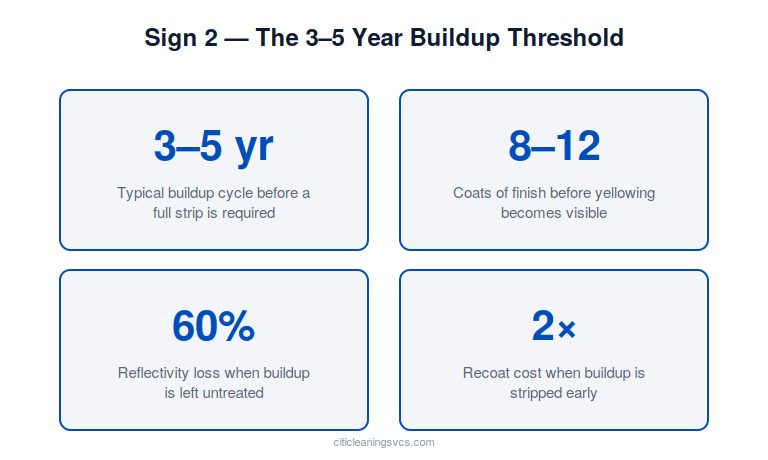
Every recoat adds a layer of acrylic finish on top of the last one. Over 3–5 years, those layers oxidize, trap dirt at the interface, and turn from clear to amber. Once the color shift is visible under normal lighting, no amount of mopping brings it back.
Where to look: corners, edges under baseboards, seams between tiles, and the perimeter where auto-scrubbers cannot reach.
A full strip removes every coat back to bare tile. A recoat over yellow buildup traps the yellow and sets it there for the next cycle. That is why teams that skip the strip end up paying twice.
Sign 2 is the quiet one. Handle it on schedule and your floors read as new — even on 20-year-old tile.
In-house cleaners are excellent at daily and weekly work. Full stripping is a different job.
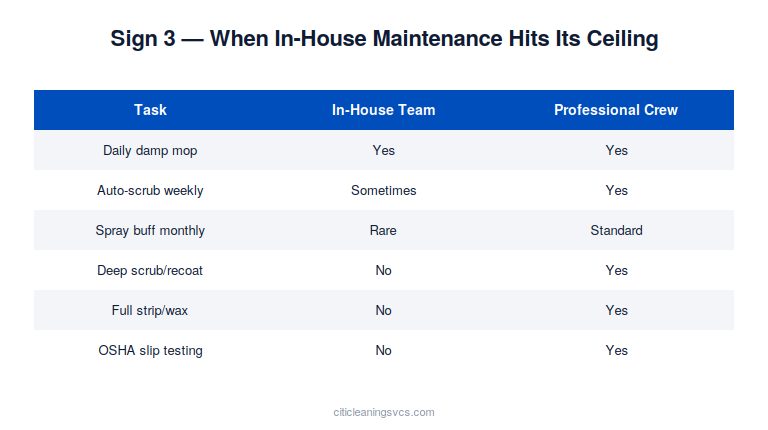
A proper strip requires stripping chemistry (aggressive alkaline), a low-speed swing machine with stripping pads, wet vacuum recovery, neutralization, and 2–5 fresh finish coats with correct dry times between. It also requires closing the area for 4–8 hours per zone.
The honest test: ask your in-house team what pad grit they use for stripping, what neutralizer they follow with, and how long each finish coat takes to cure. If the answers are vague, that is not a failure — it is a scope boundary.
Family-owned providers like Citi Cleaning Services bring OSHA-certified crews, Green Seal-aligned chemistry, and off-hours scheduling. That protects your team from doing a job they were not equipped for, and it protects the floor from the wrong technique.
The point of Sign 3 is not blame. It is recognizing the line.
Delayed strip and wax is one of the most expensive line items a facility manager quietly signs off on.
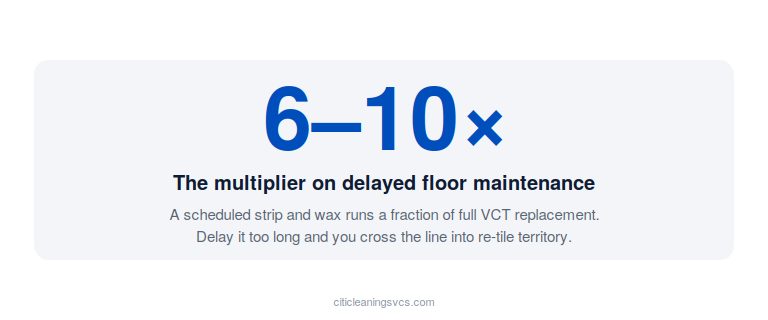
The math is straightforward. A scheduled strip and re-wax every 3–5 years keeps the tile substrate protected. Skip two cycles and you are looking at deep scoring in the tile, permanent color shift, and adhesive failure at high-moisture zones.
Where the cost jumps:
According to OSHA guidance on walking-working surfaces, a maintained floor is a safety asset. A degraded one is a liability.
Sign 4 is where the budget conversation shifts from “nice to have” to “already overdue.”
The last sign is the one you never want to reach. It is also the one insurance carriers care about.
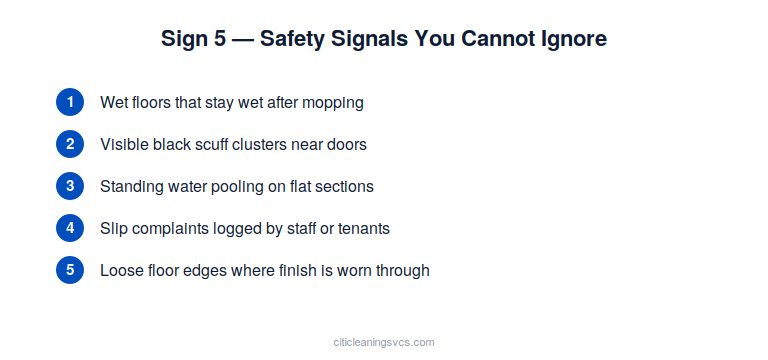
When finish wears through, the floor’s coefficient of friction drops in exactly the zones with the highest traffic — entrances, corridors, break rooms. That is where slip incidents cluster.
What triggers a same-week response: a slip complaint of any kind, wet floors that dry unevenly, visible black rubber scuff clusters, and any zone where an auto-scrubber leaves a stripe behind.
Contract-free arrangements matter here. When a slip signal shows up, you want a provider that can be on site this week — not one waiting for the annual PO cycle.
If you saw yourself in any of the four earlier signs and this one appears, do not wait for the fifth. Book a walk-through.
You do not need to strip and wax often. You need to do it on the right cadence and stop skipping the layers in between.
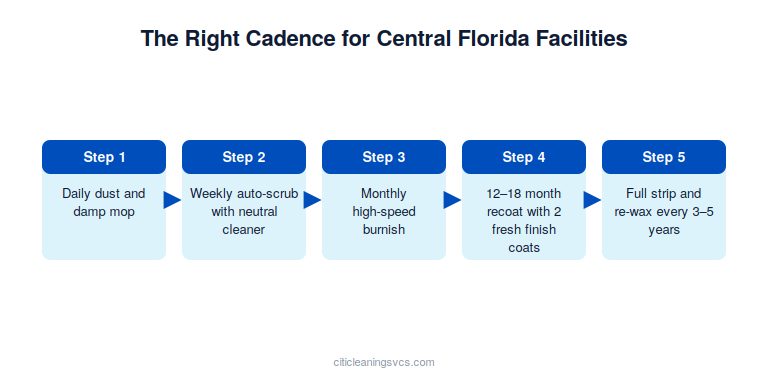
For most Central Florida facilities (warehouse, retail, office, education), the cadence looks like this:
See our full VCT maintenance guide for the pad grit chart and neutralization protocols. If you are unsure where you are in the cycle, that is exactly what a walk-through solves.
A full strip and wax every 3–5 years, with 12–18 month deep scrub and recoat cycles in between. High-traffic warehouses or 24/7 facilities may need faster cycles.
A recoat adds 2 fresh finish coats over a cleaned surface. A full strip removes every coat of finish back to bare tile, then rebuilds with 4–5 coats. Skipping the full strip traps buildup underneath new finish.
Daily and weekly work — yes. Full stripping requires professional equipment, chemistry, wet vacuum recovery, and off-hours scheduling. Most in-house teams top out at deep scrub and recoat.
No. Professional providers schedule stripping in evenings, weekends, or overnight windows. Central Florida facilities typically stage stripping by zone so operations continue.
Look for OSHA training on hazardous chemicals and walking-working surfaces, plus Green Seal-aligned chemistry when the facility has sustainability commitments. ISSA CIMS credentialing is a strong signal.
Square footage, number of coats, condition of existing finish, furniture moves, and scheduling window. Contract-free providers price per project so you are not locked into an annual commitment.
For active safety signals, most professional Central Florida providers can be on site within the same week. Standard scheduling runs 1–3 weeks out.
Walk-off mats at every entrance, daily dust mopping, weekly auto-scrub, monthly burnish, and a 12–18 month recoat. That cadence is what keeps you off the emergency-strip track.
