
Your floors take more daily abuse than almost any other surface in your facility. Commercial floor cleaning services protect that investment, but only when the method matches the material.
Use the wrong method and you get faster wear, dull finishes, or a slip hazard. Use the right one and your floors last years longer.
This guide breaks down the methods, the real cost drivers, and how to choose between a maintenance program and reactive restoration. You’ll also get a floor-type decision matrix you can hand to your facilities team today.
Key Takeaways
- No single method works for every floor. VCT, tile, concrete, and stone each need a different cleaning and restoration approach.
- Cost per square foot depends more on floor condition than square footage. Neglected floors cost far more to restore than to maintain.
- Scheduled maintenance programs cost less over time than emergency floor restoration triggered by visible damage.
- Frequency matters as much as method. A great method on the wrong schedule still fails the floor.
- Specialist floor care experience reduces the risk of using the wrong chemistry or equipment on a sensitive surface.
- A written floor care plan tied to your specific floor types prevents most emergency restoration calls.
Commercial floor cleaning services cover routine maintenance, deep cleaning, and periodic restoration for hard-surface and resilient flooring in business facilities. It is not the same as running a mop over a floor once a week.
Facility managers searching for commercial floor cleaning companies are usually solving one of two problems: floors that look worn despite regular cleaning, or a lack of clarity on what method their floor type actually needs. Both problems trace back to the same root cause.
Most in-house janitorial staff are trained on general surface cleaning, not floor-specific chemistry and equipment. A vinyl composite tile (VCT) floor needs a completely different care cycle than polished concrete or ceramic tile.
Using the wrong pH cleaner, the wrong pad grit, or the wrong equipment pressure can strip a protective finish or etch a stone surface permanently. That is why commercial floor cleaning is treated as its own discipline inside professional janitorial operations, not a generic add-on.
Get the routine right and you rarely need restoration. Skip it, and restoration becomes inevitable.
Facility managers across Central Florida rely on Citi Cleaning Services for exactly this kind of floor-specific expertise, delivered through professional floor care services built around each surface type rather than a one-size-fits-all routine.
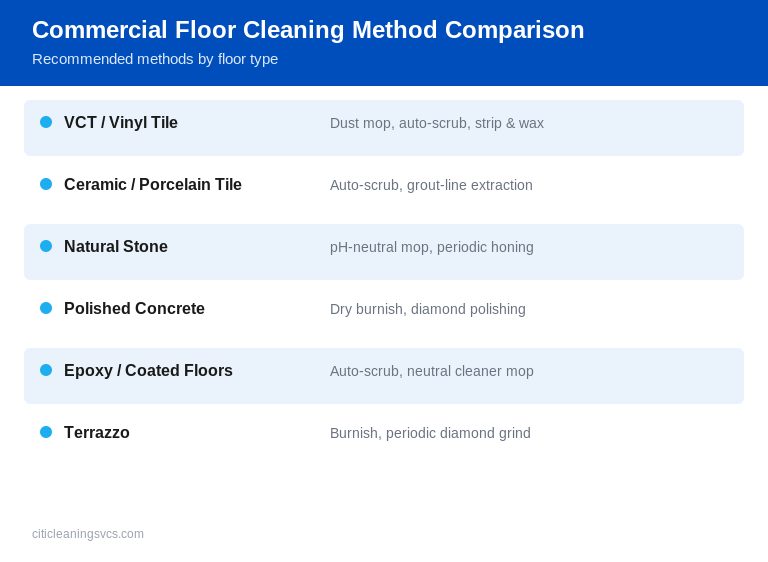
The right commercial floor cleaning method depends entirely on what the floor is made of. Matching method to material is the single biggest factor in floor longevity.
Facility managers overseeing mixed-use buildings often have three or four floor types under one roof — a lobby in polished concrete, offices in VCT, and restrooms in ceramic tile. Each needs its own plan.
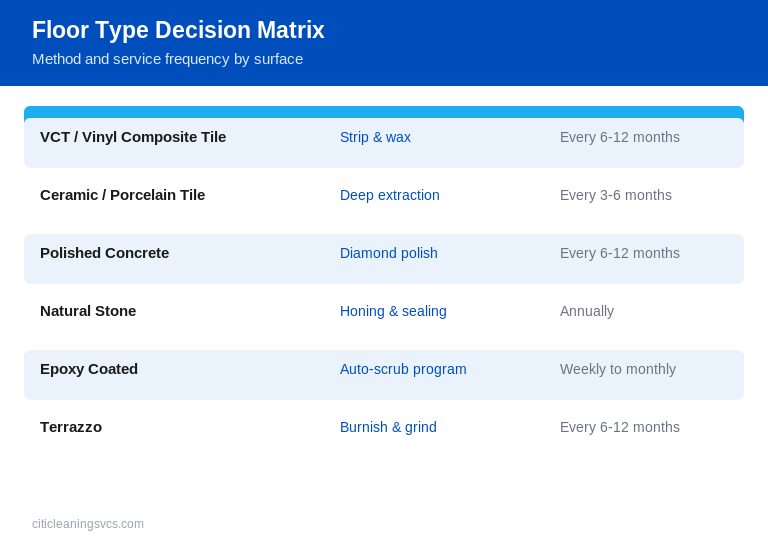
| Floor Type | Recommended Method | Typical Frequency |
|---|---|---|
| VCT / Vinyl Composite Tile | Dust mop, auto-scrub, strip and wax | Strip and wax every 6-12 months |
| Ceramic / Porcelain Tile | Auto-scrub, grout-line extraction | Deep extraction every 3-6 months |
| Natural Stone (marble, terrazzo blends) | pH-neutral mop, periodic honing | Honing and sealing annually |
| Polished Concrete | Dry burnish, diamond polishing | Diamond polish every 6-12 months |
| Epoxy / Coated Floors | Auto-scrub, neutral cleaner mop | Weekly to monthly, condition-dependent |
| Terrazzo | Burnish, periodic diamond grind | Grind and reseal every 6-12 months |
Notice the pattern: resilient floors like VCT respond well to strip and wax cycles, while hard, porous surfaces like natural stone need gentler pH-neutral products and periodic honing instead. Using a stripper formulated for VCT on natural stone can etch or dull the surface permanently.
Our VCT floor care guide and tile and grout cleaning methods and costs breakdown go deeper on the two most common commercial floor types in Central Florida.
Once you know the right method for each surface, the next question is what it costs to keep that method running consistently.
Central Florida’s humidity accelerates certain floor problems that facility managers in drier climates rarely see. Moisture trapped under VCT can cause bubbling, and high ambient humidity slows dry times between coats during a strip-and-wax job.
Grout lines in tile floors also absorb more moisture in humid conditions, which speeds up soil buildup between deep-cleaning cycles. Facilities in Orange, Seminole, Lake, and Osceola counties often need shorter intervals between scheduled services than the same floor type would require in a drier region.
A provider familiar with commercial floor cleaning in Orlando and the surrounding region builds humidity into the maintenance schedule from the start, rather than treating every facility with a generic national average.
The method only works if the equipment behind it is calibrated for the surface. Auto-scrubbers need the correct pad grit for the floor material, and burnishers need the correct speed setting to avoid overheating a finish.
Diamond-impregnated pads used for polished concrete are a different tool entirely from the soft pads used on VCT, and using the wrong one can cause visible swirl marks or premature wear. Extraction equipment for tile and grout needs enough suction and heat to lift soil without oversaturating the grout lines.
This is where a generalist janitorial crew and a floor-care specialist diverge most. A specialist keeps a dedicated equipment inventory matched to each floor type in a facility’s portfolio, rather than running one machine across every surface.
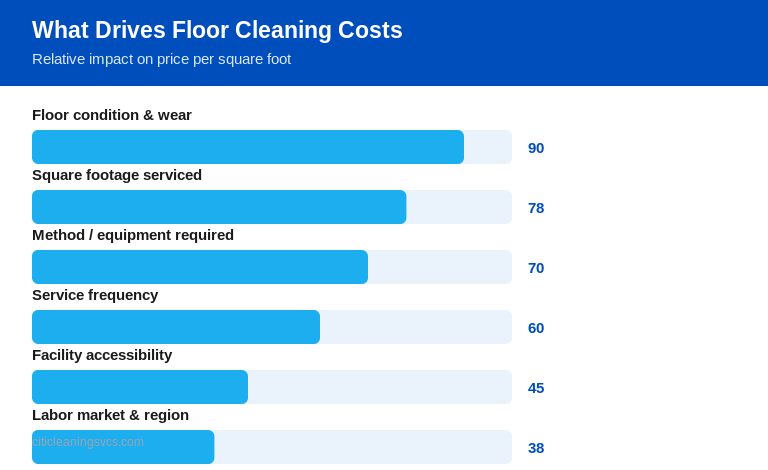
Floor condition drives cost more than square footage does. A well-maintained 20,000-square-foot floor can cost less to service than a neglected 5,000-square-foot floor.
Public industry sources generally cite commercial floor cleaning falling in a wide range per square foot, with steep variation based on method and floor condition. Routine maintenance sits at the low end of that range, while restoration work — grinding, deep stripping, or stone honing — sits at the high end because of labor time and specialized equipment.
Facility managers comparing quotes should ask for a breakdown by these factors rather than a single blended number. That transparency makes it possible to compare bids apples-to-apples — a process we cover step by step in our guide on comparing commercial cleaning bids.
Floor care costs also connect to your broader janitorial budget. If you’re building out a full facility budget rather than pricing floor care in isolation, our commercial cleaning cost guide breaks down how floor care typically fits alongside daily janitorial and facility maintenance line items.
Understanding cost factors is only half the picture. The bigger financial decision is whether to budget for ongoing maintenance or wait until a floor needs emergency restoration.
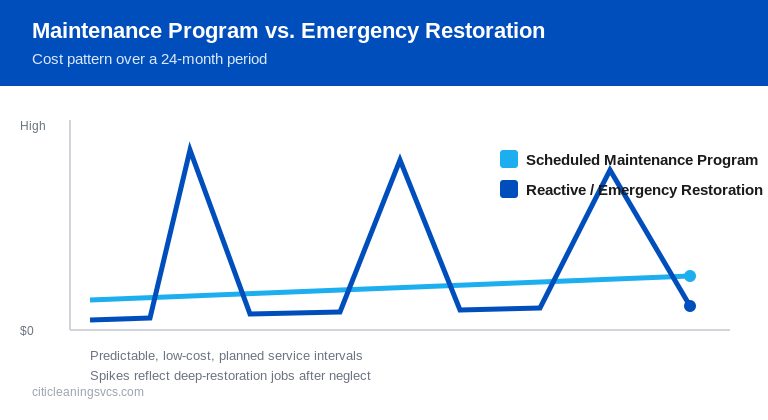
Scheduled maintenance programs cost less over the life of a floor than reactive, emergency restoration. The tradeoff is patience versus a bigger one-time bill.
A maintenance program spreads cost across predictable, planned visits — dust mopping, auto-scrubbing, and periodic recoating on a fixed calendar. Emergency restoration happens after damage is already visible: deep scuffing, yellowed wax buildup, or grout that has absorbed years of soil.
By the time a floor needs emergency restoration, the damage usually requires more aggressive methods. That means more labor hours, more equipment time, and in some cases full stripping or grinding instead of a lighter refresh.
Neglected floors also carry a hidden safety cost. According to OSHA, slips, trips, and falls are a leading cause of workplace injury, and worn or improperly maintained floor surfaces are a documented contributing factor.
That risk translates directly into liability exposure for facility managers.
Our post on the signs your floors need strip and wax service walks through the visible warning signs that indicate a floor is heading toward emergency territory. Catching those signs early keeps the job in maintenance-program territory instead of restoration territory.
Choosing between the two comes down to one question: is this floor still on a schedule, or has it already fallen off one?
The right provider treats floor care as a specialty, not an afterthought bundled into general janitorial pricing. That distinction matters more than the quoted rate.
Many commercial floor cleaning companies advertise floor services but subcontract the specialized work or assign it to generalist staff without floor-specific training. Ask direct questions before signing anything.
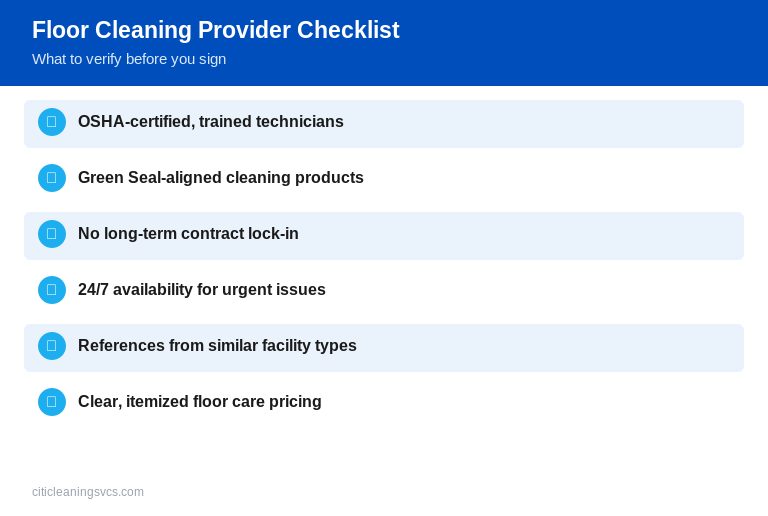
Providers that are OSHA-certified and Green Seal-aligned bring a documented safety and sustainability standard to the work, which matters for facilities managing liability and compliance. Contract-free arrangements also give facility managers leverage to adjust service without renegotiating a long-term agreement.
Industry associations like ISSA, the worldwide cleaning industry association, publish guidance on floor safety standards that reputable providers should be familiar with. A provider who references these standards during a walkthrough is a good sign they take floor care seriously.
For a deeper look at what belongs in a service agreement before you sign, see our guide on what should be in a cleaning contract.
Vetting a provider properly up front prevents most of the maintenance-versus-restoration problems covered earlier in this guide.
It also helps to understand where floor care fits within your overall service scope. Our explainer on what commercial cleaning includes and our comparison of day porter vs night porter services both clarify how specialized floor care relates to daily janitorial staffing decisions.
There is no single best method. VCT responds well to strip and wax cycles, tile needs regular grout-line extraction, and polished concrete needs dry burnishing and periodic diamond polishing.
The right method always starts with identifying the floor material first.
Cost varies widely based on floor condition, method, and square footage, and public industry sources report a broad range depending on those factors. Routine maintenance sits at the lower end, while restoration work like stripping or grinding sits higher because of labor time and specialized equipment.
Request an itemized quote broken out by these factors so you can compare providers accurately, rather than accepting a single blended price per square foot.
Routine dust mopping and spot cleaning should happen daily to weekly. Deep cleaning like auto-scrubbing or extraction typically runs monthly to quarterly, and restoration work like strip and wax usually happens every six to twelve months.
Foot traffic volume and floor type both affect the ideal schedule for your facility.
Routine cleaning maintains an already-healthy floor surface through regular mopping and scrubbing. Restoration rebuilds a damaged or heavily worn surface through stripping, grinding, or resealing.
A floor that stays on a routine schedule rarely needs restoration.
A provider with dedicated floor care training and equipment typically delivers better long-term results than a generalist team handling floors as one task among many. Ask specifically about floor-specific certifications and experience with your floor type.
Many janitorial companies offer floor care as a specialized add-on rather than a core competency, so it pays to ask direct questions.
Yes, in almost every case. Scheduled maintenance spreads cost predictably, while emergency restoration requires more aggressive methods and more labor once damage has set in.
Waiting until a floor visibly fails almost always costs more than staying on a maintenance schedule.
VCT floors typically need dust mopping, regular auto-scrubbing, and a strip-and-wax cycle every six to twelve months. Tile floors need regular auto-scrubbing plus periodic grout-line extraction to remove soil trapped in porous grout lines.
Both floor types benefit from a consistent maintenance schedule rather than reactive deep cleaning.
If your floors show wear patterns, dull spots, yellowing, or visible grime in high-traffic areas despite regular cleaning, it’s time for a documented floor care plan. A plan matched to your specific floor types, traffic patterns, and service frequency prevents small issues from becoming expensive restoration jobs down the line.
A facility walkthrough with a floor care specialist is the fastest way to identify what your building actually needs, and it typically costs nothing to schedule.
Commercial floor cleaning is not one service — it’s a set of methods matched to specific floor materials, backed by a consistent schedule. Get the method and frequency right, and restoration becomes the exception instead of the rule.
Cost per square foot depends far more on floor condition than raw square footage, which is why a maintenance program almost always beats reactive restoration on total cost. The floor-type decision matrix in this guide gives you a starting point for building that plan.
Here’s how to put it into action:
Floors that stay on a schedule rarely need emergency intervention. The facilities that struggle are almost always the ones without a plan at all.
