
Type “commercial cleaning near me” into Google and you get a list of pins on a map. What you don’t get is any signal about which of those companies will actually show up at 10 p.m. on a Sunday when a pipe bursts in your break room.
This guide is built for facility managers, office administrators, and property owners across Orlando, Kissimmee, Sanford, and the broader Central Florida corridor. Citi Cleaning Services has spent 20+ years (since 2004) walking buildings, writing scopes, and cleaning up after storms in this exact region — the questions below are the ones our team gets asked most often by procurement teams who have been burned before.
You will learn the seven evaluation criteria that separate a real local partner from a cleaning outfit that just paid for a Google Business Profile pin. Start here.
Key Takeaways
- Proximity matters, but reputation matters more. A crew based 40 minutes away with 10-year clients outperforms a 5-minute crew with turnover problems.
- Verify insurance, W-9, and OSHA training before signing anything. Ask for certificate of insurance naming your building as additional insured.
- Do a site walk with the account manager, not a salesperson. The person who runs the account should see your facility before quoting.
- Contract-free arrangements protect you. Month-to-month terms let you switch if service slips without penalty.
- Check for M/WBE certification, Green Seal alignment, and industry membership (ISSA, BOMI, IFMA) as trust signals.
- Response time under two hours for emergency spills, floods, or after-hours callbacks is the Central Florida standard.
Proximity feels like it should matter. Fewer miles equals faster response, less fuel cost, more local accountability — that is the intuition.
The reality: a crew 35 minutes away with a 10-year client roster beats a crew five minutes away with 40% annual turnover. Local searches surface both. Reviews barely tell them apart.
Start by treating “near me” as the beginning of a shortlist, not the end. A provider serving your ZIP code from a base within a one-hour drive is close enough to run day porter shifts, respond to emergencies, and hold quarterly walk-throughs. Anything closer is a bonus, not a requirement.
In Central Florida the practical service radius runs from downtown Orlando out to Sanford, Kissimmee, Winter Park, Lake Mary, Apopka, and Clermont. Providers that operate here full-time understand summer humidity swings, hurricane-season debris, and the traffic patterns that determine whether a crew arrives at 5 a.m. or 6:30 a.m.
Once your shortlist is drawn, the actual evaluation begins.
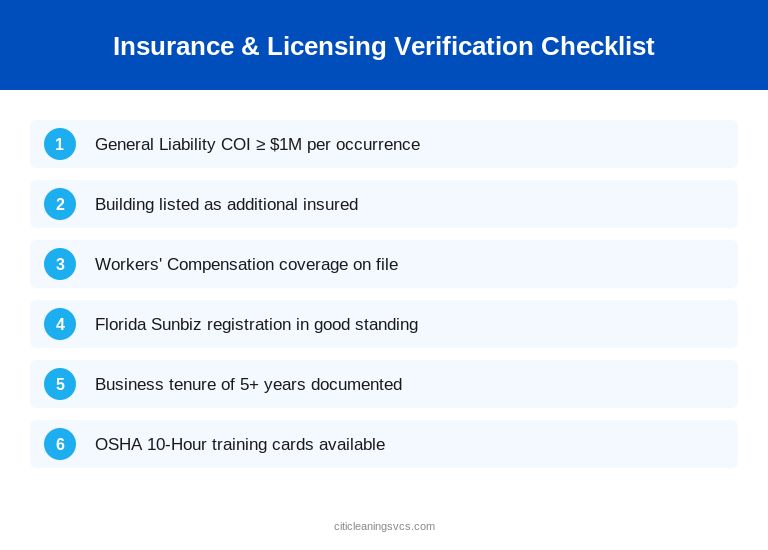
Before you look at pricing, ask for three documents. A provider that hesitates on any of these should be crossed off the list immediately.
Certificate of Insurance (COI). Request a current COI showing general liability coverage of at least $1 million per occurrence and $2 million aggregate. Ask that your building or property management company be listed as additional insured. Legitimate providers can email a COI within 24 hours.
Workers’ Compensation coverage. Florida requires workers’ comp for cleaning contractors with four or more employees, per the Florida Division of Workers’ Compensation. If a cleaner is injured on your property and their employer has no coverage, your building’s insurance is the fallback.
Active Florida business registration. Search the Florida Department of State’s Sunbiz registry to confirm the company is in good standing and identify who owns it. Fly-by-night operators surface here fast — look for consistent filings and long tenure.
The Citi Cleaning Services office keeps COIs updated with each renewal so procurement teams can request one and receive it the same business day. That responsiveness is what verification looks like in practice.
Insurance verification is a five-minute step that eliminates roughly a third of local search results before you ever see a price.
Every provider will hand you a reference list. Fewer than one in ten prospects ever calls the numbers. Do the calls.
Ask for three references from clients in your industry vertical and within a 30-mile radius of your building. For an office in Maitland, ask for other Maitland or Winter Park references. For a warehouse in Ocoee, ask for other logistics or distribution references.
When you call, ask five specific questions:
The last question is the tell. A hesitation of more than two seconds is a warning sign. A confident “yes” — paired with a specific reason — is worth more than any online review.
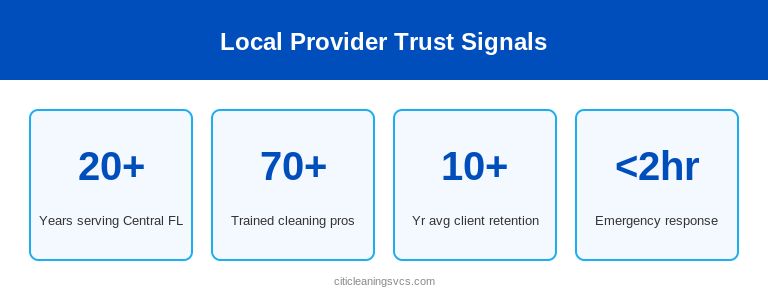
For context, Citi maintains a 10+ year average client retention rate. That number exists because references get called and the crews behind those references get treated like career professionals, not gig labor.
References verify that the provider can hold a long-term account. That is a different signal than “they cleaned my lobby once.”

The person walking your building should be the person who will manage your account after you sign. Not a business development rep. Not a franchise owner. The operations lead.
During the walk, watch for four behaviors that separate real operators from pitch artists.
They take notes on paper or a tablet, not their memory. Real scopes come from measured square footage, restroom counts, and observed floor types — not vibes.
They ask what has gone wrong with previous vendors. This tells you they are diagnosing your actual pain point, not selling a template.
They point out things you did not mention. Grease buildup on kitchen tile, hard water spots on glass, a HVAC filter that hasn’t been changed in a while — these tells prove the walker knows facilities work.
They ask about your access, alarm, and after-hours protocols. Anyone who does not ask how their crew will get in the building is not planning to run the account seriously.
After the walk, expect a written scope of work within five business days. It should specify frequency (nightly, three times a week, weekly), tasks per visit, exclusions, and any additional services with pricing broken out separately.
If the “scope” you receive is a one-page brochure with a monthly price and nothing else, keep shopping. Real providers write real scopes.
A daytime medical office and a 24/7 distribution warehouse do not need the same service model. Local providers who understand your industry will match their crew structure to your operational reality.
For professional offices (accounting, law, engineering, insurance), night cleaning between 6 p.m. and 10 p.m. is standard. Verify the crew size, the supervisor cadence (at least weekly on-site), and whether the same crew returns each shift. Turnover destroys quality; consistency preserves it.
For warehouses and light industrial facilities, weekend deep cleans and a day porter for high-traffic areas often work better than nightly crews. A local provider should be able to describe both models and tell you which fits your dock schedule.
For retail centers, look for providers who staff the porter role separately from the deep-clean crew. Porters keep restrooms and entrances presentable during business hours; deep cleaners rotate through floors, glass, and back-of-house on off-hours.
For educational facilities, ask about background-checked crews and comfort with district-level compliance paperwork.
Citi runs all four of these models across our Central Florida book, plus additional deployments in Jacksonville, Ocala, and Miami. If a local provider cannot cleanly describe two or three of these staffing models on a call, they probably work from a single template.
The right service model is worth more than the lowest bid. A cheaper scope that does not match how your building runs will cost you more in complaints, tenant calls, and re-cleans.
Local means local accountability. That includes accountability for the people cleaning your building and the products they use.
OSHA training. Ask if crews complete OSHA 10-Hour General Industry training and can produce cards. Bloodborne pathogen training is a separate certification and matters for restroom, medical, and gym environments.
Ask how the provider handles slip-and-fall risk. Wet-floor sign protocol, spill response, and shift-change checklists should be documented, not verbal.
Green Seal alignment. Sustainable cleaning is no longer a premium feature — it is table stakes for facility managers who report to tenants, investors, or LEED certifiers. Confirm the provider uses products certified under Green Seal GS-37 or equivalent standards.
SDS binders on site. Safety Data Sheets for every chemical the crew brings into your building should be available on request. This is a regulatory requirement, not a nice-to-have. Providers who cannot produce SDS documentation are operating outside the rules.
Citi’s crews are OSHA-certified, Green Seal-aligned, and carry SDS documentation for every product on the cart. These are not marketing lines; they are the reason clients renew year after year.
Cleaning contracts often bury three traps that only reveal themselves after you try to leave.
Automatic renewal clauses. Many multi-year contracts renew automatically for another year unless you send written cancellation 60 or 90 days before the anniversary. Miss that window and you are locked in.
Early termination penalties. Some contracts charge two or three months’ fees to cancel early. That penalty exists because the provider knows you will want to leave when service slips.
Scope-change surcharges. Look for language that lets the provider raise pricing unilaterally when they claim scope has changed. Some use this to increase rates 8–15% mid-contract without much justification.
The cleanest local arrangement is contract-free — month-to-month service where either party can end the relationship with 30 days’ notice. This structure aligns incentives: the provider earns your business every month, and you stay because service is good, not because leaving is expensive.
Citi has run contract-free since day one. Our clients renew because we perform, not because paperwork traps them. If a local provider will not offer contract-free terms, ask why — and get their answer in writing.
Contract terms decide what happens on your worst day, not your best. Read them carefully.
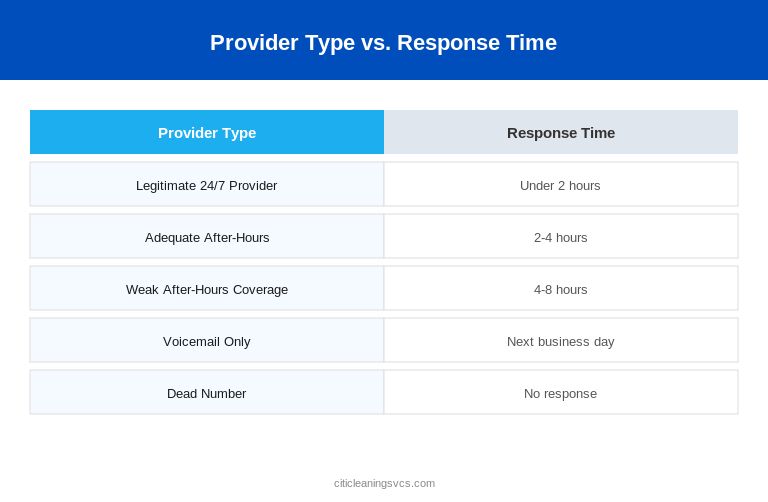
The final test is emergency responsiveness. Every local provider claims 24/7 availability. Far fewer can prove it.
During the evaluation period, place two test calls: one during business hours and one at 9 p.m. on a Sunday. Ask a simple question — “how quickly could you respond to a floor flood?” — and time the call-back.
Two-hour response is the Central Florida standard for legitimate 24/7 providers. Six-hour response means “we will get to it tomorrow.” No response means the number rolls to a dead voicemail and the provider is not actually staffed for after-hours calls.
Emergencies happen. Pipe breaks. Storm cleanup. A vendor spill in a manufacturing bay. A biohazard incident in a bathroom. When they do, response time is worth more than every other line item combined.
Citi answers at (407) 540-1850 around the clock. That number rolls to an on-call operations lead, not a call center. During Hurricane Ian, Milton, and Idalia we mobilized crews to client buildings before the storm cleared — because our people live in the same counties we serve.
Test response time before you commit. It is the one variable that predicts whether the relationship will still work in year three.
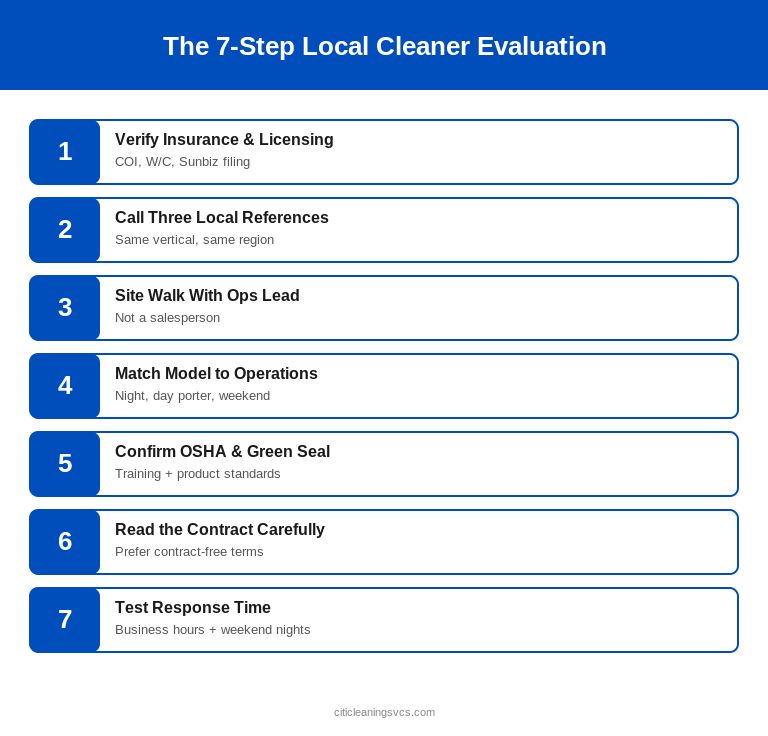
The seven steps above form a repeatable framework. Any provider that clears all seven belongs on your final list; any provider that stumbles on more than two should be dropped without a second call.
Total evaluation time: roughly three to four hours across two weeks. That investment saves months of complaint tickets, tenant emails, and vendor turnover down the road.
The best local provider for your building is the one that treats the sales process the way they will treat the account after it starts — with documentation, follow-through, and a real person who answers the phone. Everything else is packaging.
If you are comparing providers in Orlando, Winter Park, Sanford, Kissimmee, Lake Mary, Apopka, Clermont, or anywhere in the four-county Central Florida corridor, use this framework and stop trusting star ratings alone. See how janitorial services in Orlando, office building cleaning, and warehouse cleaning are structured in practice, or start with our full services overview.
Related reading: how to compare commercial cleaning bids, how to read a cleaning proposal, what should be in a cleaning contract, and 10 red flags your commercial cleaning company is failing you.
Check the address on Google, then cross-reference with Sunbiz.org for a Florida registration filed at that same address. National franchises often list a local pin but route calls to an out-of-state call center. Local operators answer with a real person and can describe your neighborhood.
Pricing depends on square footage, frequency, and scope. Nightly office cleaning ranges roughly from $0.08 to $0.16 per square foot per visit for standard scopes. For detail, see our Central Florida pricing guide. Any provider that quotes without a site walk is guessing.
Same business day for the first callback. A written scope within five business days of the site walk. Providers who take longer are either understaffed or under-interested in the account.
No. A base within a one-hour drive is close enough to run day porter shifts, respond to emergencies, and hold quarterly walk-throughs. Prioritize operational fit and reputation over pin location.
OSHA 10-Hour training for all crew, Green Seal-aligned product programs, active general liability and workers’ comp insurance, and Florida Sunbiz registration in good standing. M/WBE certification is a bonus and often opens supplier diversity programs for tenants.
Month-to-month, contract-free arrangements are safer for the buyer. They align incentives: the provider earns your business monthly. Multi-year contracts benefit the vendor more than the client and often hide auto-renewal or termination penalty clauses.
Request a Certificate of Insurance (COI) listing your building or property manager as additional insured. Confirm general liability of at least $1 million per occurrence and workers’ comp on file. Legitimate providers email a COI within 24 hours.
Training, insurance, supervision, retention, and documentation. The cheaper crew often cuts every corner listed above; the pricier crew invests in the pieces that make the account sustainable at year five. Match your provider to your risk tolerance, not just your budget line.
Local commercial cleaning is a long-term decision. Skip the star-rating shortcut and run a real evaluation.
