
Restrooms are the single fastest way for a commercial property to lose tenant goodwill. A dirty stall, a sticky floor, or an empty paper dispenser gets reported to building management before any other service failure. This guide gives Central Florida facility managers the standards, protocols, and checklists that keep commercial restrooms audit-ready every day.
You’ll see the ISSA and OSHA benchmarks that frame compliant restroom cleaning, the seven cleaning zones every professional crew works through, a daily task sheet you can hand to a porter, touch-point disinfection protocols that reduce illness transmission, and a 10-point inspection scoring system you can use on the next walkthrough. Every protocol below is pulled from standards Citi Cleaning Services has used across 20+ years and 70+ trained cleaning professionals servicing office, warehouse, medical office, and distribution facilities across Orange, Seminole, Lake, and Osceola counties.
Let’s start with why the restroom carries more weight than any other space you oversee.
- Restroom condition is the #1 tenant-complaint trigger across commercial properties — ahead of HVAC, lighting, and parking.
- Professional restroom cleaning uses a seven-zone protocol that moves top-down, back-to-front, and dirty-last to prevent cross-contamination.
- Touch-point disinfection is a separate step from general cleaning and must happen 2–4 times per day in high-traffic restrooms.
- A 10-point inspection score lets facility managers hold vendors accountable with objective numbers, not vibes.
- ISSA CIMS and OSHA bloodborne pathogen rules set the floor for compliant restroom cleaning — anything below those standards is a liability risk.
- Supply par levels prevent 90% of restroom complaints when restocking is tied to a time-of-day schedule, not a once-daily sweep.
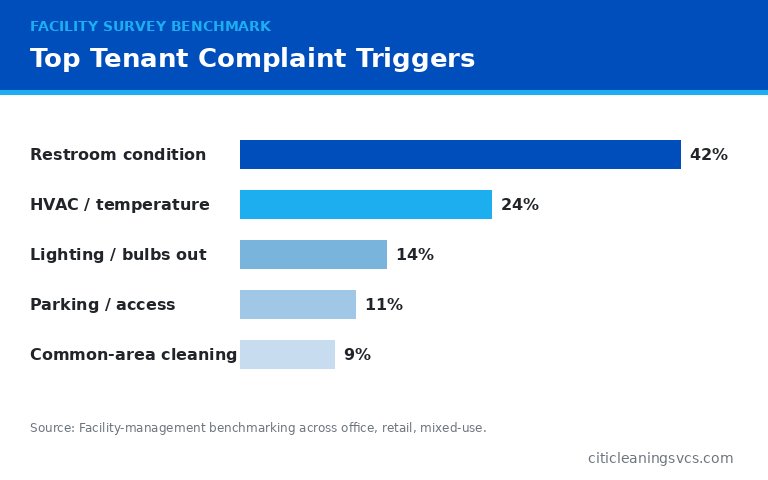
Restrooms generate more tenant complaints than every other building system combined. Industry benchmarking data from facility management associations puts restroom condition at the top of tenant satisfaction scorecards in office, retail, and mixed-use properties. If you’ve seen the same complaint pattern across your portfolio, our walkthrough of 10 red flags your cleaning company is failing you covers how restroom condition shows up early in a declining vendor relationship.
Here is why the stakes are so high. A tenant who walks into a restroom with an overflowing bin, a sticky floor, or an empty paper roll forms an immediate impression of the entire building — not just the restroom. That impression carries into lease-renewal conversations, Google reviews, and informal word-of-mouth among facility peers.
The reverse is also true. A clean, well-stocked, odor-free restroom reinforces the message that the building operator cares about details tenants actually touch. That is why we treat restrooms as a daily priority rather than a weekly service line.
Three business outcomes track directly to restroom cleaning quality: tenant retention, employee productivity (particularly in office and medical-office tenants), and property reputation on review sites and tenant forums. Treat the restroom like the lobby and the complaint rate drops.
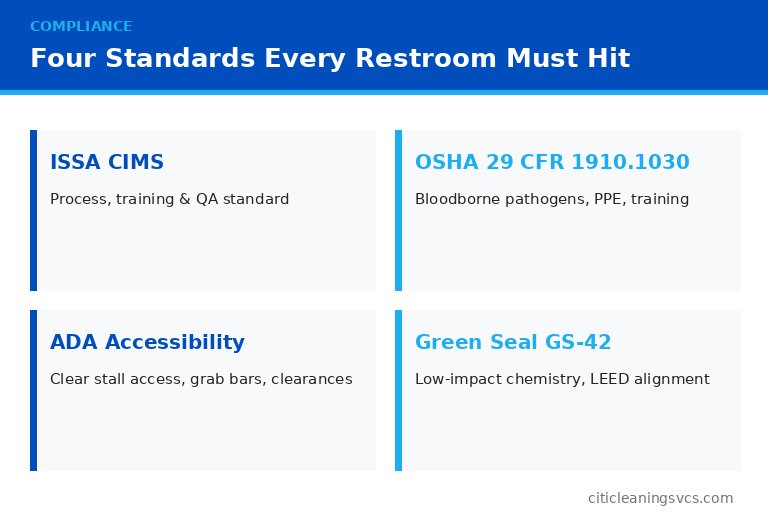
Compliant commercial restroom cleaning follows four published standards. Hit all four and you are protected on tenant disputes, worker-safety claims, and ADA complaints.
The ISSA Cleaning Industry Management Standard sets process requirements for professional cleaning operations. It covers staff training, quality assurance, documentation, and health-and-safety practices. Ask any vendor whether their restroom protocols map to CIMS. If they don’t know what CIMS is, that’s a signal — one of several covered in our broader guide to selecting a janitorial service provider.
Commercial restrooms are one of the few spaces where cleaning staff can encounter biohazards. OSHA 29 CFR 1910.1030 requires an exposure control plan, PPE, labeled biohazard waste disposal, and documented training for anyone whose job can expose them to blood or other potentially infectious materials. Every restroom-cleaning technician on a Citi crew is OSHA-trained before they touch a restroom.
Keep accessible stalls, grab bars, and sink clearances free of obstructions at all times. A rolling supply cart left in an ADA stall is a compliance issue the moment a visitor needs it.
Many Class A office portfolios and higher-education campuses require Green-Seal-aligned cleaning chemistry and documented sustainability practices. Citi’s protocols are Green-Seal-aligned and support LEED Operations and Maintenance credits where tenants pursue them. Our overview of what commercial cleaning actually covers walks through where restroom work sits in a full facility scope.
Hit these four standards and the restroom cleaning program is compliant by default.
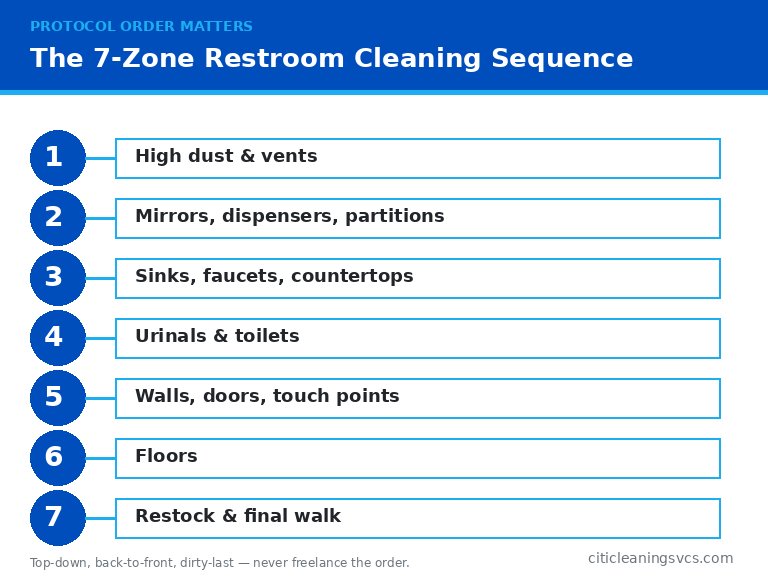
Professional restroom cleaning moves through seven zones in a fixed order. The order matters as much as the chemistry — working out of sequence cross-contaminates clean surfaces with soils from dirty ones.
Air returns, light fixtures, exhaust vents, and the tops of partition walls collect dust that falls when disturbed. Clean high surfaces first so falling debris lands on surfaces still waiting to be cleaned.
Wipe mirrors with glass cleaner and a flat-weave microfiber. Clean dispensers (soap, paper towel, toilet paper, seat covers) inside and out. Wipe partitions top-to-bottom including the inside of stall doors where hands push.
Apply a bathroom cleaner, dwell per label, agitate, then rinse. Pay attention to faucet aerators and the base where the fixture meets the counter — this is where biofilm forms.
Apply a bowl cleaner inside, let it dwell, then scrub under the rim with a dedicated bowl brush. Clean the exterior top-down: tank, handle, hinge, seat (both sides), base, and the floor flange where the fixture meets the floor.
Spot-clean walls around urinals and toilets. Fully wipe door handles, push plates, light switches, and the hands-on side of entry doors with a disinfectant that meets the required dwell time.
Sweep or dust-mop first. Mop with a fresh bucket solution — never reuse yesterday’s mop water. Pay extra attention to the baseboards and corners behind toilets where urine salts collect and generate odor.
Restock paper, soap, seat covers, and feminine-hygiene supplies to par. Empty bins, replace liners, and walk the room once with a nose check — if it doesn’t smell clean, it isn’t clean yet.
Train your vendor to follow this exact sequence. Freelancing the order is where odor and cross-contamination enter the picture.
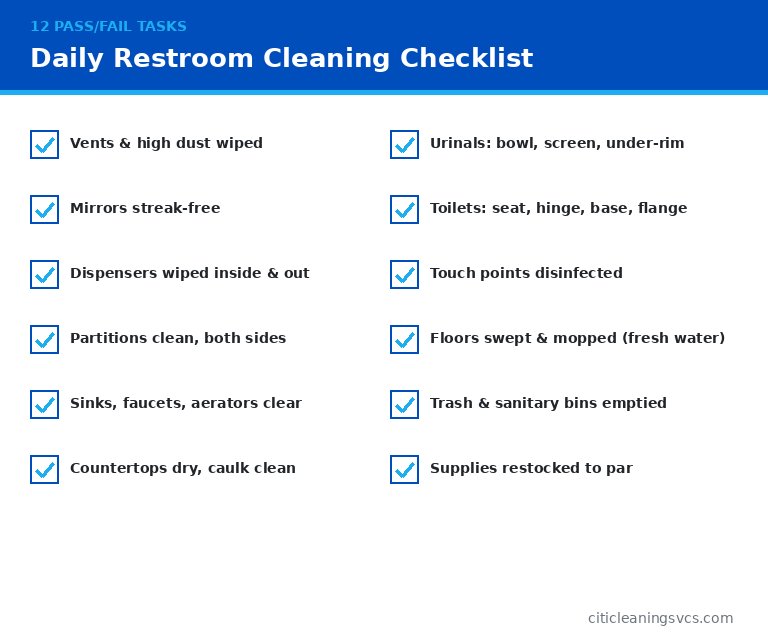
Hand this checklist to the porter or night-shift crew. Every item is a pass/fail observation that a facility manager can verify on a walkthrough.
Twelve items, every day, no exceptions. The checklist is also the audit trail if a tenant complaint reaches your inbox — a documented, dated, initialed sheet shows exactly what was done and when. The same pass/fail discipline shows up in our broader framework for comparing commercial cleaning bids: vendors who document their work are the ones who deliver it consistently.
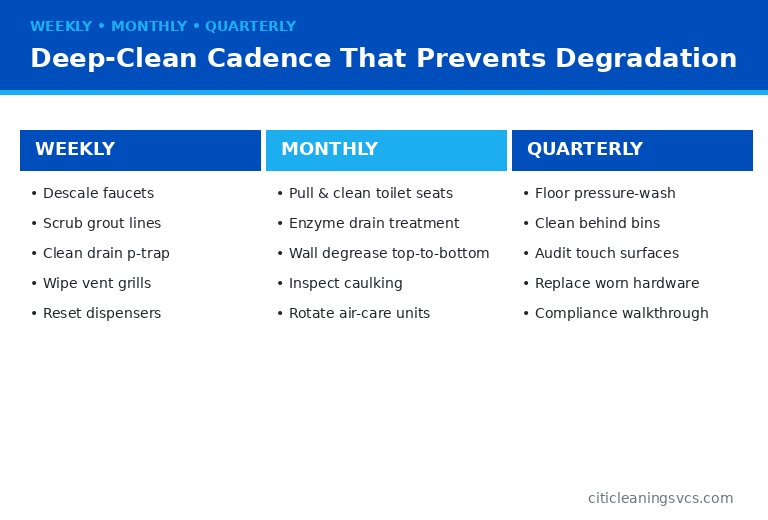
Daily cleaning keeps a restroom presentable. Weekly and monthly deep-clean tasks keep it from degrading over time. The daily sheet handles surface soil; the weekly and monthly cycles reach soils that build up where daily cleaning doesn’t fully address them.
A restroom on a weekly plus monthly plus quarterly cadence stays in the same condition in year three as it did on day one. A restroom on daily cleaning alone slowly degrades until a one-time deep-clean becomes an expensive project rather than a routine step.
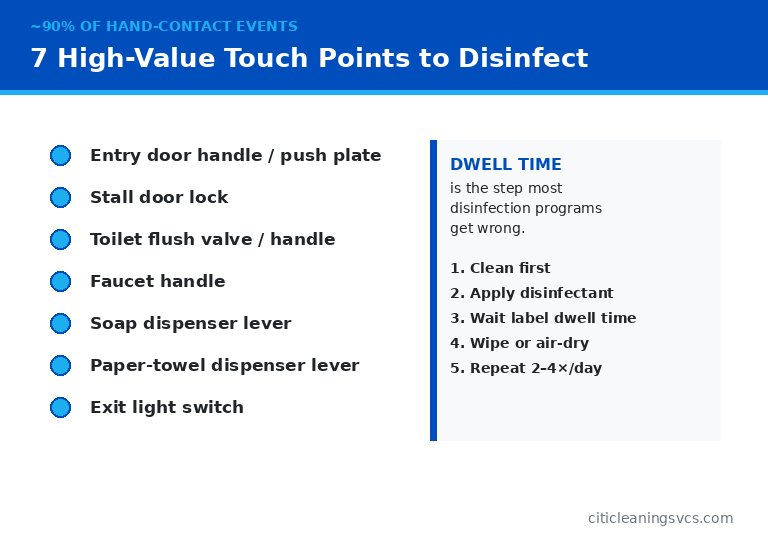
Cleaning and disinfection are two different tasks. Cleaning removes soil so a surface looks clean. Disinfection kills pathogens on surfaces that are already clean. Both are needed — but they are not the same step, and treating them as the same step is why some vendors claim to disinfect without actually reducing pathogen load.
The seven highest-value touch points in a commercial restroom are the entry door handle (or push plate), the lock on each stall, the flush valve or handle on each toilet, the faucet handle on each sink, the soap dispenser lever, the paper-towel dispenser lever (or motion sensor housing), and the light switch at exit. These account for roughly 90% of hand-contact events in a typical commercial restroom.
Dwell time is where most restroom disinfection fails. A disinfectant that needs 5 minutes of wet contact time to kill a pathogen does nothing meaningful in a 10-second spray-and-wipe. Train the crew on dwell times or ask your vendor to document theirs. For a chemistry-side primer, our breakdown of high-level vs. low-level disinfectants covers which products are appropriate for which restroom surfaces.
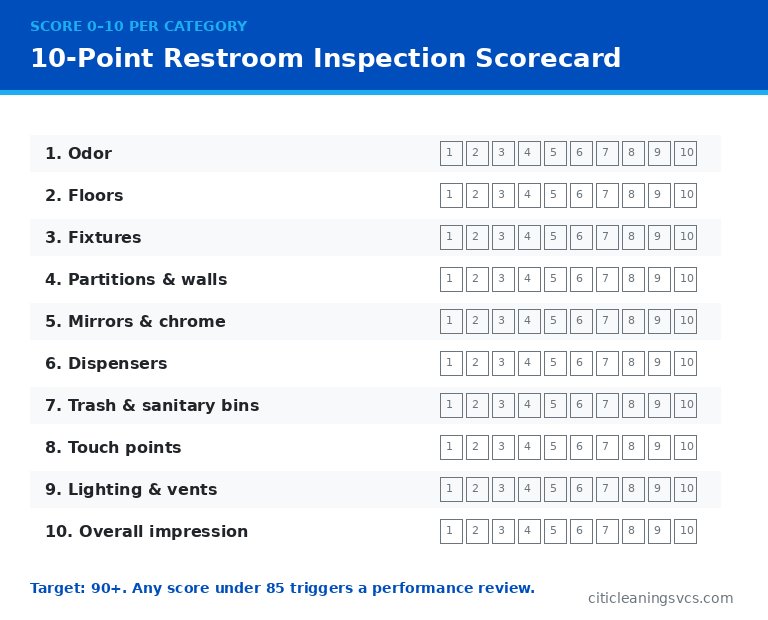
Subjective inspections (“the restroom looks fine”) don’t hold a vendor accountable. Numeric inspections do. Use this 10-point scoring system on every walkthrough. Each category scores 0 to 10. A total under 85 is a performance conversation.
Scores track over time. Three consecutive inspections at 85+ earns a vendor the benefit of the doubt. Three consecutive scores under 85 is grounds for a formal review — see our note on reading a cleaning proposal for how to put inspection standards into the scope before the vendor starts work.
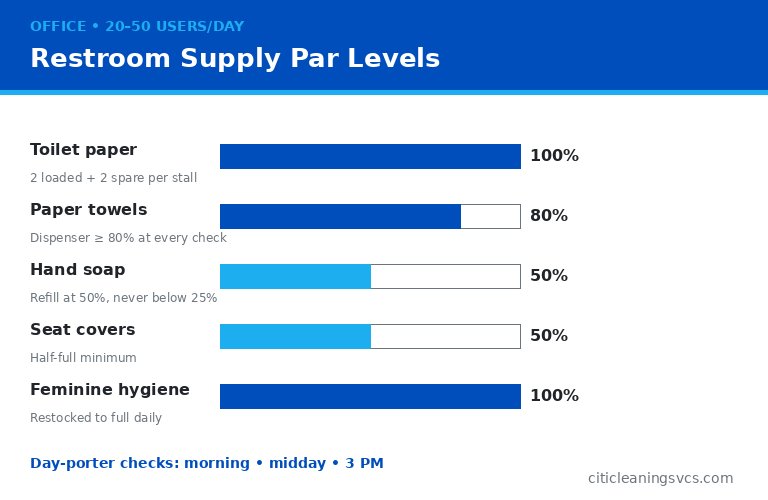
Empty dispensers generate roughly 40% of restroom complaints. Set par levels and refill on a time-of-day schedule rather than a daily sweep and you prevent most of them.
In a facility with 40+ restroom users per day, the day-porter checks supplies three times: morning (open), midday (post-lunch), and afternoon (3 PM). In lower-traffic restrooms, once mid-morning is sufficient.
Build the par levels and the schedule into the cleaning scope so there’s no ambiguity about what “stocked” means. A dispenser at 15% capacity is not stocked, even if it technically has paper in it.
A restroom cleaning program improves only when it is measured. Track four metrics each month and the conversation with your vendor becomes concrete:
Share the dashboard with the vendor each month. When the numbers get worse, the vendor should bring you a corrective action plan before you ask. When the numbers get better, say so — vendors who feel the win work harder on the next month.
Citi uses this exact structure in client QBRs across Central Florida — including Orange, Seminole, Lake, and Osceola counties — and we publish a restroom scorecard against every account we hold. Measured programs stay clean. Unmeasured programs regress. Facility teams that run professional janitorial services treat restrooms as the leading indicator for the whole program.
At a minimum, daily. In high-traffic facilities — 100+ users per day — a day-porter model with checks every 2–3 hours is standard. Restrooms in medical offices, food-service tenants, and distribution centers may need two full cleanings per day.
Cleaning removes visible soil with a general-purpose cleaner. Disinfection kills pathogens on an already-clean surface using an EPA-registered disinfectant with a specific dwell time. Both are needed. A spray-and-wipe without dwell time is cleaning, not disinfection.
Urine salts in grout and under toilet flanges, biofilm in drains, and overflowing sanitary bins. Daily mopping alone does not reach any of these. Weekly grout scrubbing and monthly enzyme drain treatment handle the root causes.
As a rule of thumb, 100+ users per day across the restroom cluster justifies a day porter. Below that, a mid-day refresh check is usually enough. Office buildings with floor-level restrooms per tenant may need per-floor coverage even at lower volume.
Use the 10-point inspection score in this guide. Walk a sample of restrooms weekly, score every category, log the result, and review the trend monthly with the vendor. Scores backed by dates and initials are the only accountability tool that holds up in a dispute.
It varies. Some vendors include consumables (paper, soap, liners) in the monthly rate; others charge separately. Clarify in the scope and lock in par levels so there is no ambiguity when a dispenser runs empty.
Never mix bleach with ammonia-based cleaners — the reaction produces toxic chloramine gas. Never mix acid-based descalers with chlorine. Always let one chemical fully rinse before the next is applied. OSHA requires the vendor’s Safety Data Sheets on-site for every product used.
Yes. Citi provides commercial restroom cleaning on contract-free, month-to-month arrangements across Central Florida — Orange, Seminole, Lake, Osceola counties, with additional coverage in Jacksonville, Ocala, and Miami. Service levels and inspection scoring stay the same regardless of contract length.
Restroom cleaning is the fastest, highest-leverage improvement a facility manager can make. The standards exist (ISSA CIMS, OSHA bloodborne pathogens, ADA, Green Seal), the protocols exist (seven zones, daily checklist, 10-point score), and the metrics exist (score, complaints, stockouts, response time). The question is whether your vendor is executing against them — or improvising.
Here is the four-step action plan.
Citi Cleaning Services has been running this exact protocol for Central Florida facility managers since 2004 — family-owned, M/WBE-certified, 70+ trained cleaning professionals, 10+ year average client retention, OSHA-certified, Green-Seal-aligned, contract-free, 24/7. (407) 540-1850.
