
Most commercial floor waxing jobs fail before the first coat goes down. This guide walks through the specific expertise, coat-count standards, and process discipline that separate specialist floor waxing companies from generalist cleaners who add “floor care” to their brochure. It’s based on 20+ years of experience maintaining vinyl composition tile (VCT) floors across Florida, from single-site offices in Orlando to multi-location contracts stretching to Miami and Jacksonville.
Here’s what you’ll learn: the coat-count number that predicts whether your floor lasts 6 months or 18, the five red flags that reveal a generalist selling waxing services, and the specific questions to ask before signing any commercial floor waxing contract.
Key Takeaways
- 4 to 5 wax coats is the professional standard. Generalist crews often apply 2 to 3, which is why floors dull twice as fast.
- Specialist VCT companies use dedicated crews, calibrated equipment, and floor-specific training — not the same team that empties trash cans on Monday.
- Statewide coverage matters for multi-location facilities. A specialist with Florida-wide reach delivers consistent results across every site.
- Stripping and waxing are not the same service. Confusing them is the fastest way to overpay or under-restore your floors.
- The real cost of a bad wax job isn’t the invoice — it’s the accelerated stripping cycle that follows six months later.
Commercial floor waxing is the process of applying multiple layers of floor finish to a cleaned or stripped VCT, vinyl, or hard-surface floor. Each layer protects the underlying tile from foot traffic, chemicals, moisture, and abrasion.
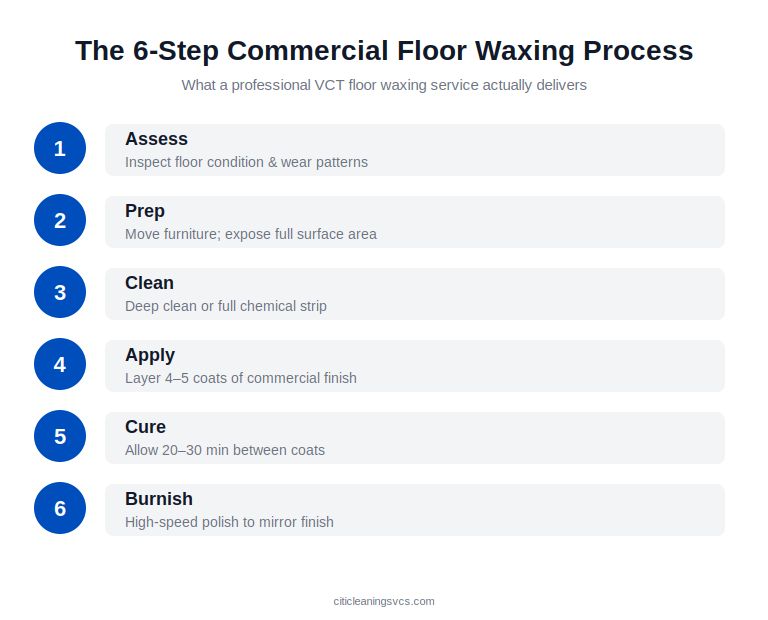
The service is not a single task. It’s a sequence: dust mop, deep clean, apply finish in layers, allow proper cure time between coats, then burnish to lock in the shine. Cutting any step short shows up within weeks.
A full commercial floor waxing service typically includes:
Miss any of these and the floor either wears prematurely or looks uneven under the lights. A facility manager walking into a job on Monday morning can spot corner-cutting in under 30 seconds.
Specialist commercial floor waxing companies deliver better results because floor care is what they do every week — not an add-on service they upsell during quarterly reviews. That focus shows up in three specific places: crew training, equipment quality, and process discipline.
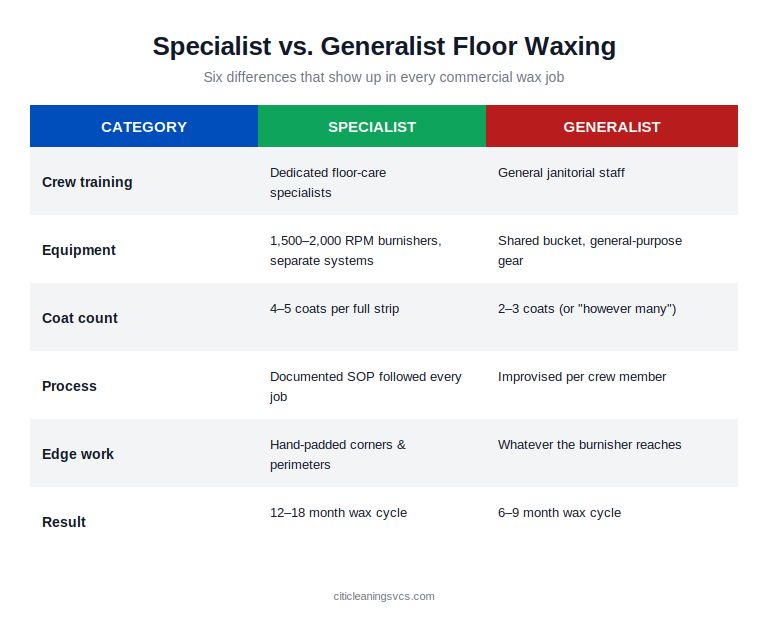
Generalist commercial cleaners typically train their staff on general janitorial duties — restrooms, trash, dust, vacuum. Floor stripping and waxing is treated as an occasional project handled by whoever’s available. That’s why generalist wax jobs often show streak patterns, missed edges, and uneven coat thickness.
A specialist runs a different playbook. Dedicated floor-care technicians train specifically on VCT restoration. They know how to read wear patterns, adjust chemical dilution for your floor’s age, and calibrate their burnishers to your specific finish product.
The equipment difference is just as significant. Specialist companies maintain commercial-grade auto-scrubbers, high-speed burnishers rated for 1,500 to 2,000 RPM, and separate mop systems for stripping versus applying finish. Generalists often share one mop bucket between three services — a shortcut that contaminates the finish coats and shortens floor life.
Process discipline is the third differentiator. Specialists follow the same sequence on every job because they’ve refined it across thousands of square feet. Generalists improvise, which leads to inconsistent results across sites and shift changes.
The takeaway: when you contract with a specialist, you’re paying for the accumulated expertise of a team that does this every day. When you contract with a generalist, you’re paying for whichever crew member drew the short straw that week.
The number of wax coats a company applies is the single strongest predictor of how long your floor stays glossy. Professional standards call for 4 to 5 coats of finish on a fully stripped VCT floor. Most generalist crews apply 2 to 3.
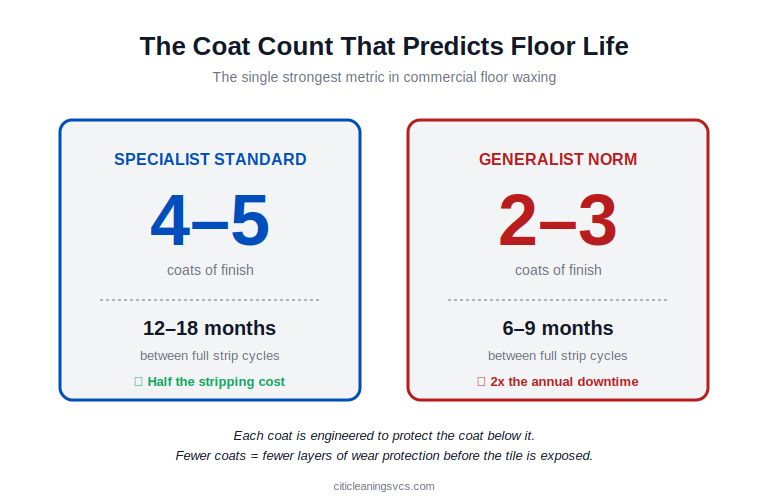
Here’s why the difference matters. Each coat of commercial floor finish is engineered to protect the coat below it. Foot traffic, wheeled carts, dropped supplies, and daily damp-mopping all abrade the top coat first. A floor with 5 coats has 5 chances to wear before the tile itself is exposed. A floor with 2 coats has 2.
The numbers translate directly to your maintenance calendar:
Stripping is the expensive part of the maintenance cycle. It requires more labor hours, more chemicals, more furniture relocation, and more downtime for your facility. Cutting corners on coat count today doubles your stripping frequency tomorrow.
Ask any commercial floor waxing service how many coats they apply. If the answer is “two or three” or “however many looks good,” you’re talking to a generalist. If the answer is “4 to 5 depending on floor condition and traffic volume,” you’re talking to a specialist.
Real VCT expertise is visible in the small choices a crew makes on every job. It’s not about who has the fanciest brochure — it’s about who reads the floor before they touch it.
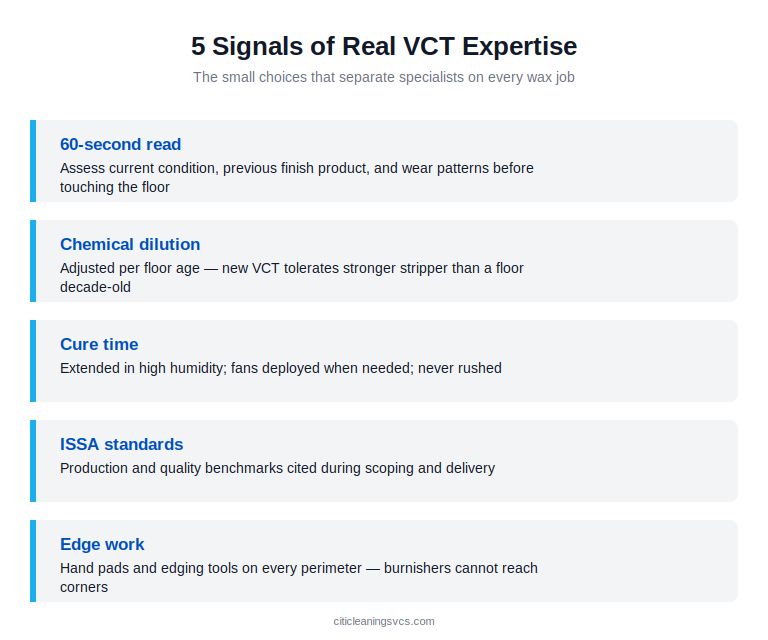
A specialist walks into a job and immediately identifies three things: the floor’s current condition, the finish product previously used, and the wear patterns that reveal how the space is actually used. That 60-second read determines every subsequent decision.
Chemical dilution is one of those decisions. New VCT tolerates a stronger stripper than a floor that’s been chemically abused for a decade. A generalist mixes the same solution every time. A specialist adjusts based on what the floor can handle without cupping or dye-lifting.
Cure time is another. Commercial floor finish needs 20 to 30 minutes between coats in ideal humidity. A specialist checks conditions and either extends the cure time or runs a fan to pull moisture out of the air. A generalist starts the next coat when the previous one “looks dry.”
The International Sanitary Supply Association (ISSA) publishes production and quality standards for commercial floor care work. Specialists cite those standards during scoping. Generalists have never heard of them.
Finally, edges and corners separate the two. Specialists work the perimeter of the floor with hand pads and edging tools because a burnisher can’t reach a corner. Generalists let the burnisher run the pattern it can reach and leave the rest.
Most facility managers can’t watch a wax job in progress — they’re managing five other vendors that day. The red flags below help you screen out generalists before they touch your floor.
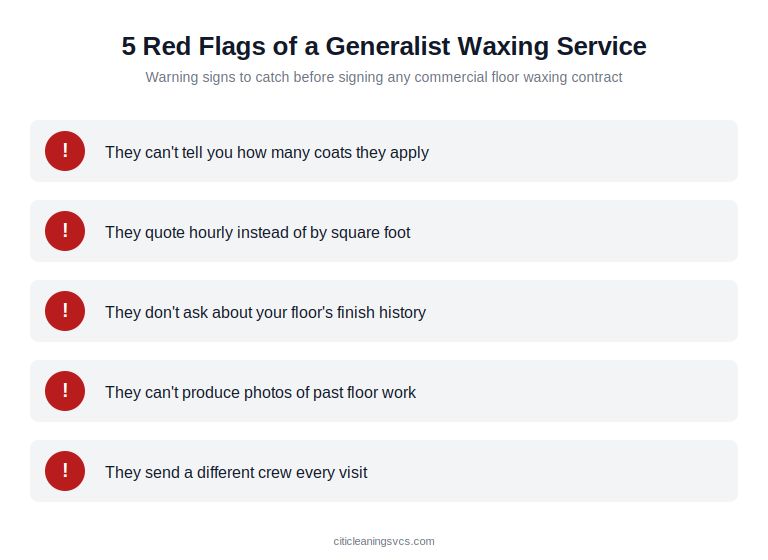
Watch for these five warning signs when evaluating any commercial floor waxing service:
Any one of these is a caution flag. Two or more means you’re about to buy a maintenance problem instead of a wax job.
Multi-location facility managers — from office buildings and warehouses to expanding regional footprints — face a specific challenge: getting consistent floor care quality across sites that may be hundreds of miles apart. Statewide-capable commercial floor waxing services solve this by running a single trained team across all locations rather than sub-contracting to local one-off crews.
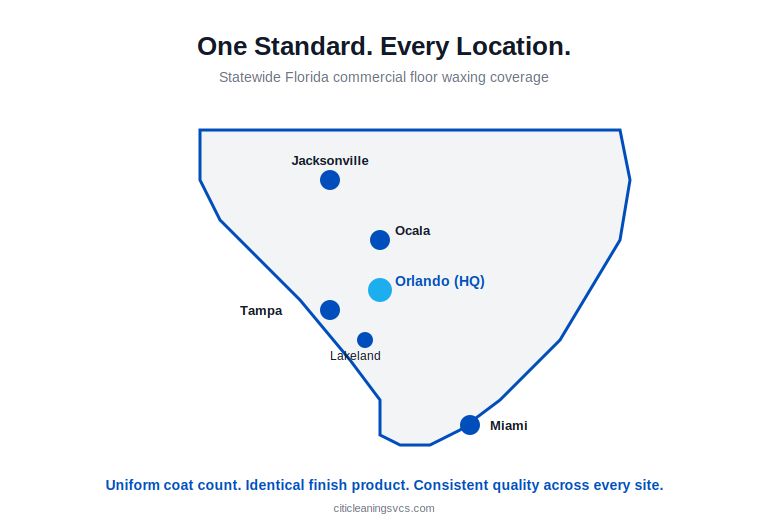
Consider a retail chain with locations in Orlando, Tampa, Jacksonville, and Miami. If four separate local vendors each service one site, you get four different coat-count standards, four different chemical dilutions, and four different quality reports. The Orlando floor looks great; the Miami floor is dull by month four. That’s not because Miami is harder to clean — it’s because the vendor there is running a different playbook.
A specialist with statewide coverage delivers uniformity. The same team travels between sites, or crews are trained on the same standard operating procedure. Coat count is identical. Finish product is identical. Quality inspection is identical. Every location looks the same because every location was serviced the same way.
This matters especially for property management firms, regional retailers, education systems, and transportation facility operators who report to corporate leadership on facility appearance. Consistency across sites is the whole point of hiring a professional service.
The right commercial floor waxing service for your facility depends on three factors: how many locations you manage, what condition your current floors are in, and how much floor downtime your operation can absorb.
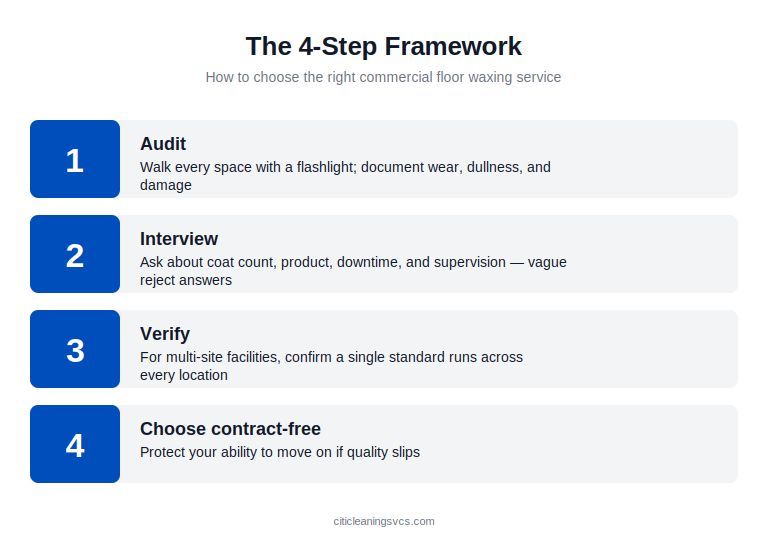
Use this 4-step framework to evaluate any commercial floor waxing service before signing.
Step 1: Audit your current floor condition. Walk the floor with a flashlight. Note wear patterns, dull spots, streak marks, and edge damage. This baseline tells you whether you need a full strip and re-wax or just a maintenance coat.
The Occupational Safety and Health Administration lists slip-and-fall incidents among the most frequent commercial injury causes — well-maintained floor finish reduces that risk. Note anywhere the current finish has thinned to bare tile.
Step 2: Request specifics, not summaries. Ask each candidate: how many coats will you apply, what product will you use, how long will the floor be down, and who will supervise the job. Vague answers are disqualifying.
Step 3: Verify multi-site capacity. If you manage more than one location, confirm the service can run a single standard across every site. Ask specifically whether crews travel or whether local sub-contractors handle each region.
Step 4: Check the exit terms. A specialist earns your business every cycle rather than locking you into a long contract. Contract-free arrangements let you move on if quality slips — and give the vendor an incentive to protect the relationship every time.
Most commercial VCT floors need a full strip and re-wax every 12 to 18 months when 4 to 5 coats are applied correctly. High-traffic facilities may need it every 9 to 12 months. Maintenance buffing between full re-waxes extends the cycle.
Waxing applies new layers of finish to the floor. Buffing polishes the existing top coat to restore shine without adding new product. Buffing is a maintenance step; waxing is a restoration step.
A full strip and re-wax on a 5,000 square foot space typically takes 8 to 12 hours from setup to sign-off. Most crews work overnight or weekends to avoid business disruption. Larger facilities are broken into zones and completed over multiple visits.
No. A full strip is only needed when the existing finish is damaged, discolored, or built up to the point of yellowing. Between full strips, a scrub-and-recoat maintains the finish with less labor and downtime.
Technically yes, but the results vary dramatically. Specialists with dedicated floor-care crews, commercial-grade equipment, and process discipline consistently outperform generalist cleaners who treat waxing as an add-on service.
4 to 5 coats is the professional standard for a fully stripped VCT floor. Fewer coats mean shorter finish life; more coats risk buildup that yellows over time. Traffic volume and floor condition determine the exact number within that range.
Look for four indicators of a full strip: yellowing under the finish, uneven coat buildup at edges, dark scuff marks that don’t buff out, and dull spots that resist re-polishing. If any of these are present, a maintenance re-wax won’t restore appearance — a strip is required.
Pricing depends on square footage, floor condition, coat count, and access hours (overnight/weekend jobs cost more). Reputable services quote by square foot rather than by hour so you can compare accurately across vendors.
Commercial floor waxing done right protects your facility’s appearance, extends floor life, and reduces long-term maintenance costs. Done wrong, it accelerates every problem it was supposed to solve.
Here’s the 4-step action plan for choosing the right commercial floor waxing service:
Apply this framework and you’ll avoid the most expensive mistake in commercial floor care: paying for a wax job that fails within six months. For more guidance on evaluating cleaning vendors, see our post on how to choose the right commercial cleaning company.
