
Most facility managers pick a commercial cleaning company the same way they pick a lunch spot: a quick referral, a short meeting, and a signed scope that mostly matches what the last vendor was doing. That approach is exactly why 60–70% of commercial cleaning accounts fail within 18 months. A data-driven comparison framework fixes it. This guide gives Central Florida facility managers a weighted evaluation model, insurance verification standards, reference-check scripts, and a scoring matrix you can run across any set of commercial cleaning companies before you sign.
You’ll see the 10 criteria that actually predict long-term vendor performance, the exact weights to apply to each one, the questions to ask on a reference call, and the red flags that disqualify a bidder before you waste another hour. Everything below is pulled from how Citi Cleaning Services evaluates partners and competitors across 20+ years, 70+ trained cleaning professionals, 10+ year average client retention, and the Central Florida facility-manager cohort we serve across Orange, Seminole, Lake, and Osceola counties.
Let’s start with why the standard RFP approach keeps failing.
- Standard RFP evaluation weights are wrong — most frameworks over-weight price (40%+) and under-weight supervision, training, and quality assurance.
- Ten criteria with calibrated weights accurately predict 12-month performance when scored against a documented rubric.
- Insurance verification is three documents, not one — general liability, workers’ comp, and janitorial bond must all be certified from each bidder.
- Reference checks need a scripted question set — four questions per reference, three references minimum, with answers logged side-by-side.
- Four red flags disqualify a bidder before you sign — no supervisor on-site, no written training program, no quality-assurance protocol, no insurance certified in your facility’s name.
- A weighted scoring matrix turns subjective “they seemed professional” into a numeric decision you can defend to procurement, finance, or ownership.
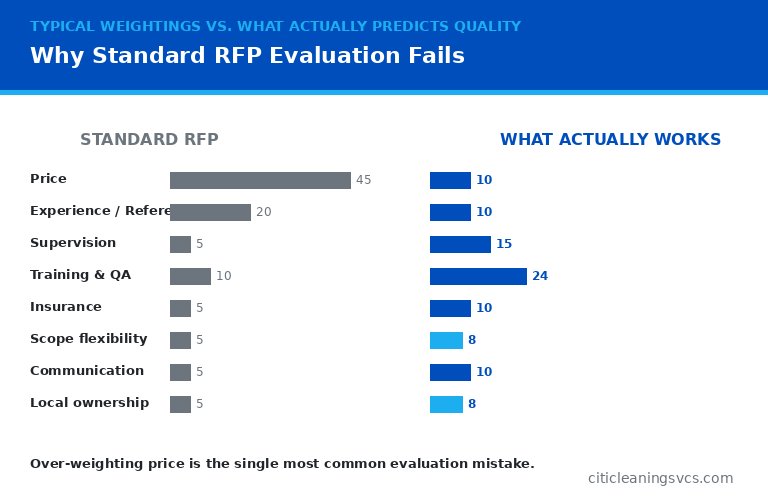
Most facility RFPs score commercial cleaning companies on a 100-point scale where price accounts for 40–50 points, references and experience split another 30, and a vague “operational capability” bucket covers whatever’s left. The vendor with the lowest number wins. Twelve months later, the same facility is on a different vendor.
The failure pattern is consistent. Cheapest bidder underprices labor to win. Service degrades within three months as the crew burns out or turns over. The facility manager tries to fix it through escalations, then eventually re-RFPs. The second-cheapest vendor wins the second RFP. Same pattern repeats.
The fix is a weighted framework that scores for operational capability and quality-system discipline — the things that actually determine whether a cleaning program holds up. Price still matters, but it’s one input among ten, not half the decision. Our broader walkthrough on comparing commercial cleaning bids expands on the mechanics; this guide focuses on the full evaluation framework.
If the last time you ran this evaluation you ended up with the wrong vendor, the framework is the thing to change — not the vendor pool.
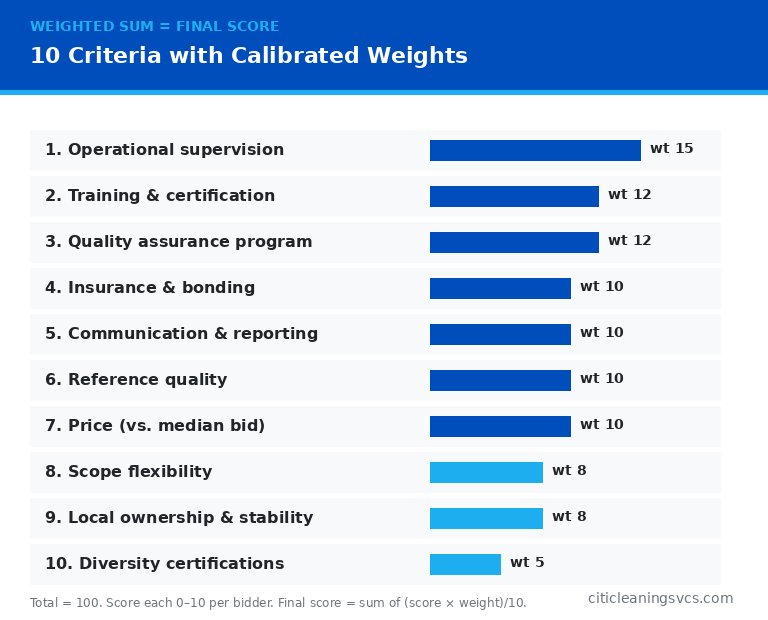
Ten criteria, calibrated weights. Every bidder scores 0–10 per criterion. Final score is the weighted sum. The spread between the highest and lowest final scorer in a typical evaluation of five bidders is 20–35 points — more than enough to drive a defensible decision.
Here are the criteria and the weights that reliably predict 12-month vendor performance.
Note what’s missing from the top of this list: price. Price matters, but under-weighting operational capability is what turns a cheap bidder into an 18-month expensive mistake. Our breakdown of commercial cleaning costs explains why the lowest-bid trap is particularly common in this category.
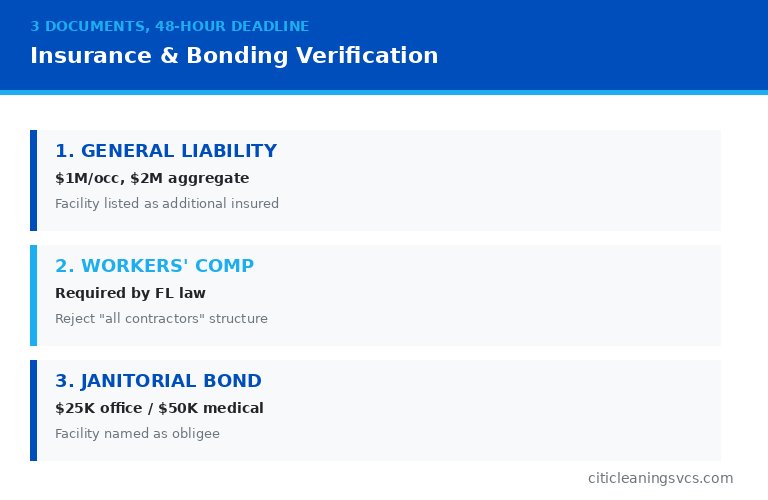
Three documents, three verification steps. If a bidder cannot produce all three in a facility manager’s name within 48 hours, they are not a serious vendor.
Minimum $1M per occurrence, $2M aggregate. Must list your facility as an additional insured. Verify by calling the insurance broker on the certificate — not just reading the document.
Required by Florida law for any commercial cleaning company with employees. If the bidder claims “we’re all independent contractors,” that’s a liability transfer to you — a trip-and-fall by an uninsured contractor on your property becomes your general-liability claim. Reject that structure.
Covers theft or dishonesty by cleaning staff while in your facility. $25K minimum for most office buildings; $50K+ for medical office, high-value equipment environments, or any facility with sensitive documents. Verify the bond is active and names your facility as the obligee.
Request all three on the first evaluation call. Any bidder that cannot produce them within 48 hours is non-responsive. Any bidder that produces them but refuses to add your facility as additional insured is non-serious. Our note on what should be in a cleaning contract covers how to bake these requirements into the signed scope.
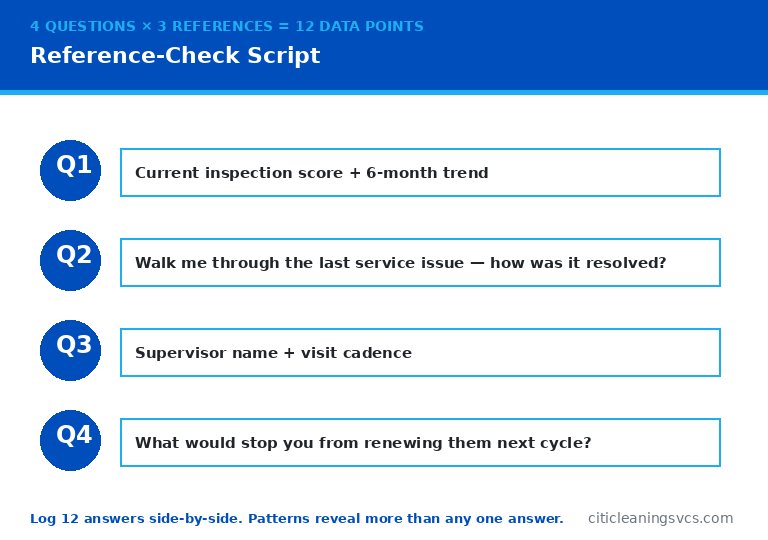
Three references, four questions each. The questions matter more than the number — most reference calls fail because the facility manager asks “would you recommend them?” and ends the call. Instead, ask these four questions and log the answers side-by-side across all three references.
Numbers reveal more than impressions. A vendor averaging 92 that has trended from 95 → 93 → 92 → 91 is in a slow slide. A vendor averaging 85 that has trended from 78 → 81 → 83 → 85 → 87 is improving. Both pieces of information matter.
Every account has a service issue at some point. What matters is how the vendor handled it. A reference who takes 20 seconds to answer this question is either covering or hasn’t thought about it carefully — follow up.
Supervision is the single highest-correlation input to long-term quality. If the reference can name the supervisor and quote the visit cadence, the vendor runs a real operational structure. If the reference says “I’m not sure, I just talk to the account manager,” the supervision tier is probably thin.
This is the honesty question. Nobody says “nothing” — every account has some friction. A reference who can name the specific friction has thought about it, which means they’re giving you useful information. A reference who says “we’re happy” without a follow-up detail is probably reciting rather than reflecting.
Log all 12 answers (3 references × 4 questions) in a side-by-side matrix. Patterns across references matter more than individual answers.
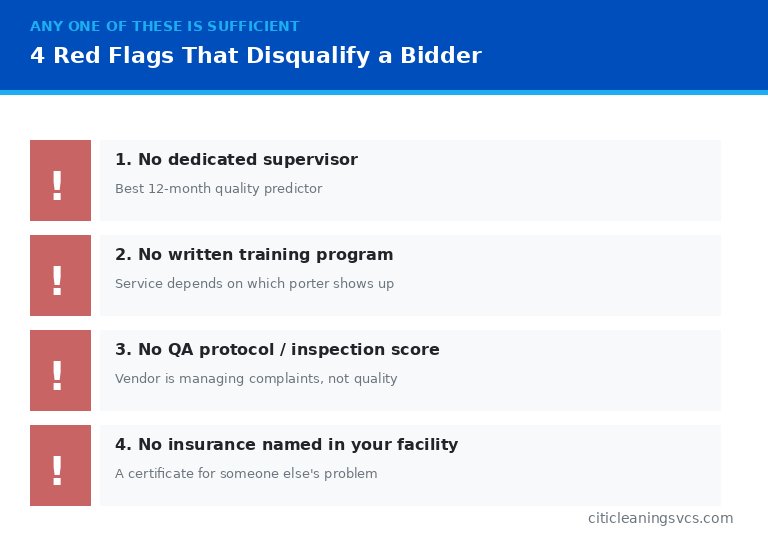
Four red flags end the evaluation. Any one of them is sufficient grounds to disqualify the bidder regardless of how the rest of the score looks.
If the bidder says “our account manager handles everything,” translate that as “the people cleaning your facility report to nobody on-site.” Dedicated supervision is the single best predictor of 12-month quality. Our review of red flags your cleaning company is failing you covers the operational signs this gap produces.
Ask to see the written onboarding curriculum for new cleaning staff. If the answer is “we train on the job” or “our supervisors handle it informally,” training is not systematic. Service quality in that structure is a function of which porter happens to be assigned to your account that week.
Ask: “How does your supervisor know, this week, whether my restrooms are at spec?” A real answer is a scored inspection document, a cadence, and a corrective action protocol. A hand-wave answer means the vendor is managing complaints, not quality.
Covered above. A certificate that doesn’t name your facility as additional insured is a certificate for someone else’s problem.
Any one of these four is a disqualifier. Combinations are especially common at the low end of the bid pool — if a vendor shows two or more red flags, the price difference is not a savings. It is deferred cost.
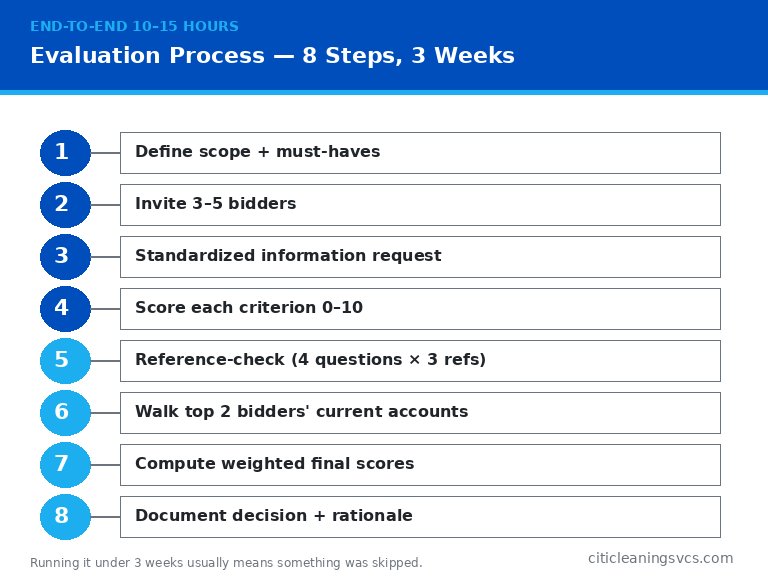
Eight steps to run a defensible evaluation. End-to-end this takes 10–15 hours spread across three weeks. Set that budget before you start — the shortcut is where most framework attempts collapse.
Our take on selecting a janitorial service provider covers the proposal-review side in more detail. The scoring matrix is where it all comes together.
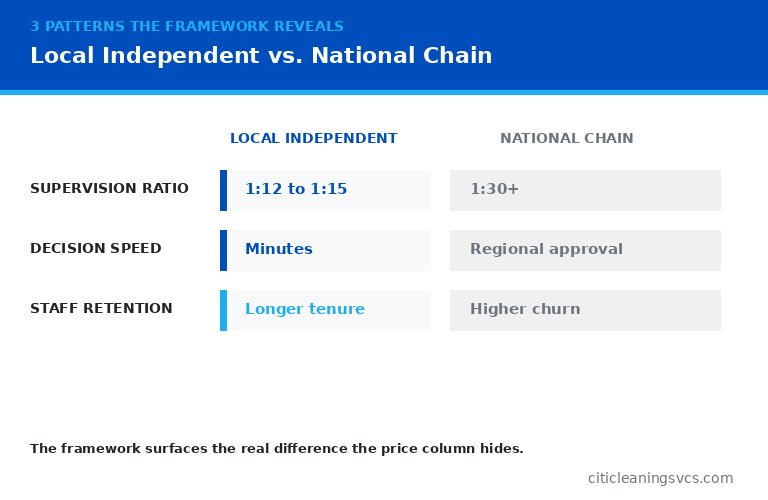
The framework above applies to any bidder regardless of ownership structure. That said, three patterns consistently separate independent local commercial cleaning companies from national or franchise chains, and the framework exposes all three.
Local independents typically operate at a 1:12 to 1:15 supervisor-to-cleaner ratio. National chains frequently run 1:30+ with the “supervisor” role largely administrative. The framework’s weight on supervision captures this difference.
When something goes wrong — equipment failure, staffing gap, scope change — local owners decide in minutes. Chain locations wait for regional approval. The framework’s communication-and-reporting weight captures this.
Local independents retain cleaning staff longer because the owner is the one assigning accounts. National chains churn through staff because the local location is one of many for the staff and the account. The framework’s training-and-certification weight captures this indirectly through consistency.
None of this is to say “always pick a local independent.” It is to say the framework reveals the real difference, which the standard RFP evaluation hides behind a price column. Citi has been an independent, family-owned, minority- and women-owned (M/WBE) commercial cleaning company in Central Florida since 2004, with a 10+ year average client retention — stats the framework surfaces when evaluated honestly.
Procurement departments want numbers. Finance teams want totals. Ownership wants risk reduction. The weighted scoring matrix gives all three. Present it as a one-page summary with four elements:
That one page beats a 40-page RFP response binder. Procurement signs faster when the numbers tell the story. Finance signs faster when the risk-reduction logic is explicit. Our overview of what commercial cleaning actually covers is useful context when you need to explain scope to a stakeholder who doesn’t live in facilities.
Three to five. More than five dilutes attention and the scoring loses meaning. Fewer than three removes the comparison discipline. If you only have two bidders, add a third from your market even if you don’t expect them to win — they anchor the comparison.
About 10 points out of 100. Over-weighting price is the single most common evaluation mistake. Scoring price against the median bid (not the lowest) prevents the cheap-outlier trap and keeps the operational-capability weights where they drive the decision.
Three weeks. Week 1: define scope, invite bidders, send information requests. Week 2: receive responses, reference-check, score. Week 3: site walks, final scoring, decision. Running it faster than three weeks usually means something was skipped.
Yes, if they’ll participate. The incumbent typically scores higher on reference-check and operational-knowledge criteria, which is useful context. If they refuse to re-bid, that’s an operational signal in itself.
Ask for a current client at your facility type and size. Visit on a routine cleaning day, not a scheduled visit. Walk restrooms, floors, and common areas with the facility’s own property manager — not with the vendor’s rep. Thirty minutes reveals more than two hours of proposal review.
Document the delta in both score and operational risk. “Bidder A scored 15 points higher on supervision and quality-assurance weighted criteria that correlate with 12-month vendor retention; the $4,200/year price delta represents 2.1% of total program cost.” That’s the sentence procurement needs.
The 10 criteria stay the same. The weights shift slightly — warehouse facilities put more weight on floor-care specialization; medical offices put more weight on compliance training; multi-tenant office buildings put more weight on day-porter coverage. Our guide to choosing a warehouse cleaning partner covers the warehouse-specific weighting shifts.
Yes. The weights don’t change with scale. A single-location office with 25 employees uses the same 10 criteria as a 10-building portfolio — the scoring just takes less time because the bidders’ responses are shorter. Our take on local Central Florida commercial cleaning companies is in commercial cleaning services near you.
Commercial cleaning companies are not a commodity. The spread between a well-run vendor and a cheap vendor is the difference between a facility program that stays clean for a decade and one that re-RFPs every 18 months. A weighted evaluation framework exposes that spread before you sign. The ISSA Cleaning Industry Management Standard documents the operational discipline most of these criteria map to, if you want an external reference while building your rubric.
Here is the four-step action plan.
Citi Cleaning Services has been evaluated against this exact framework by Central Florida facility managers for over two decades — family-owned, M/WBE-certified, 70+ trained cleaning professionals, 10+ year average client retention, OSHA-certified, Green-Seal-aligned, contract-free, 24/7, serving Orange, Seminole, Lake, Osceola, Jacksonville, Ocala, and Miami. (407) 540-1850.
