
Facility maintenance is not janitorial. It is not repair-and-replace. It is the coordinated program that keeps every building system, surface, and safety element running so your operation never has to pause. Get it right, and you buy back staff hours, cut emergency spend, and extend the life of every asset in the building.
This guide covers the full scope of commercial facility maintenance services, how to decide between a single-source partner and a stack of specialty vendors, what to require in a scope of work, and how to calibrate a program to your building type. It is written for facility managers, property managers, and operations leads who are tired of guessing what “facility maintenance” is supposed to include.
By the end, you will know exactly what to ask for, what to pay for, and what to stop paying for.
Key Takeaways
- Facility maintenance covers 10 core service categories, from janitorial and floor care to HVAC checks, lighting, and preventive rounds — organized around preventive, corrective, and predictive work.
- Single-source partners cut vendor management time by 40 to 60% versus a multi-vendor stack, and eliminate the finger-pointing that inflates emergency spend.
- Preventive maintenance costs 3 to 9 times less than reactive maintenance, per Federal Facilities Council benchmarks — the ROI is in shifting the ratio.
- The right partner has a documented service scope matrix, a defined SLA per service line, and monthly reporting you can read in under 10 minutes.
Facility maintenance is the umbrella program that keeps a commercial building operational, safe, and presentable. It spans janitorial, floor care, restroom and consumables management, minor building repairs, preventive rounds on mechanical and electrical systems, lighting, exterior upkeep, and safety compliance.
The confusion in the market comes from vendors using “facility maintenance” as a synonym for whichever service line they happen to sell. A janitorial-only company calls nightly cleaning “facility maintenance.” A repair contractor calls break-fix work “facility maintenance.” A property management firm bundles all of it under one line item.
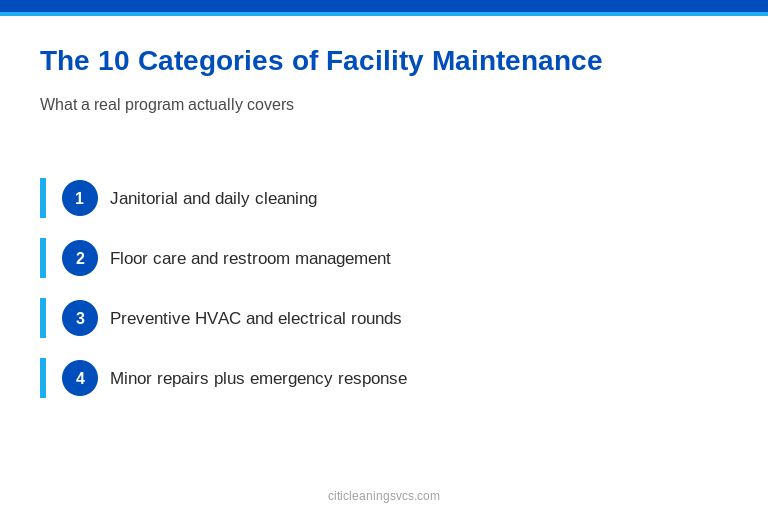
A true facility maintenance program covers 10 categories:
A facility maintenance partner should own the first six categories in-house and coordinate the rest through a vetted trade network. If a vendor tells you they do “everything” without explaining which trades they subcontract, keep asking.
The single biggest reason to hire a facility maintenance partner is not cost — it is time. Every hour your operations team spends coordinating vendors, chasing invoices, or reacting to breakdowns is an hour that is not going toward the actual business.
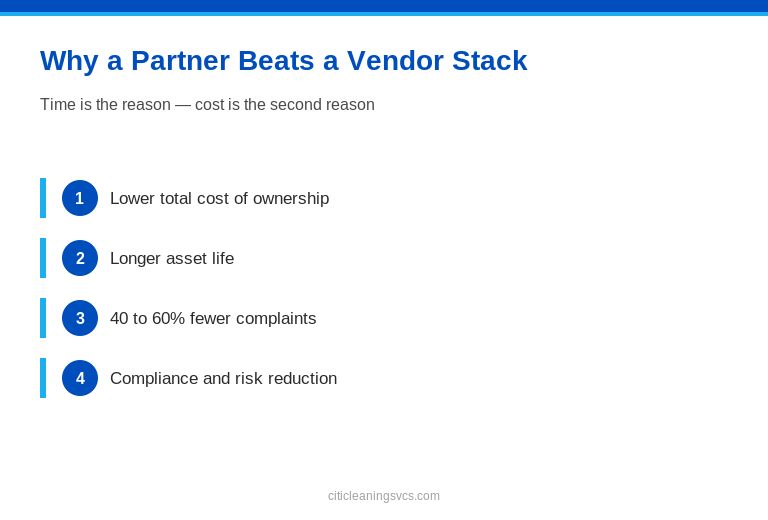
Well-run facility maintenance programs consistently deliver four measurable outcomes:
Preventive maintenance costs 3 to 9 times less than reactive maintenance, according to Federal Facilities Council data cited by the U.S. Department of Energy. A building that runs 80% preventive and 20% reactive spends dramatically less over a 5-year window than a building that runs 30/70 the other way.
HVAC units, floors, roofs, and lighting systems all last longer when maintained on manufacturer-recommended cycles. Skipping a $200 quarterly HVAC check to save budget often costs $8,000 in premature compressor replacement two years later.
Buildings with proactive facility maintenance programs generate 40 to 60% fewer tenant complaints in the first year. Complaint volume is the leading indicator of tenant renewal — every reduced complaint compounds into lease renewals downstream.
OSHA-aligned procedures, documented safety training, and a paper trail of preventive work drop your general-liability exposure. When something does go wrong, the vendor’s insurance and documentation carry the load — not yours.
Every facility management team faces the same decision: hire one facility maintenance partner to run the whole program, or manage a stack of specialty vendors (janitorial + HVAC + electrical + landscaping + pest, etc.).
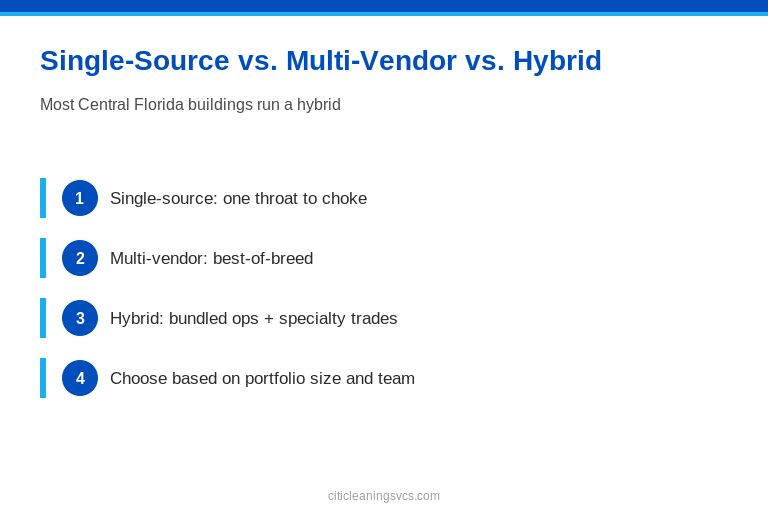
One contract, one invoice, one point of accountability. The partner owns the outcome — if the restroom is dirty and the light is out, one call fixes both. Vendor-management overhead drops 40 to 60% because you stop chasing four calendars.
Fits best when: your operations team is lean, your building portfolio is 1 to 25 sites, or you need a single throat to choke on tenant complaints.
Best-of-breed specialists per category. You control every relationship and can swap any vendor without disrupting the others. Total service cost can be lower at scale, but management overhead is high.
Fits best when: you have a dedicated in-house facility engineering team, your portfolio is 50+ sites with regional specialists, or you have negotiated master service agreements that beat any bundled rate.
In practice, most Central Florida property managers land on a hybrid: one facility maintenance partner owns janitorial, floor care, restroom management, preventive rounds, and minor repairs — while HVAC, roofing, and specialty life-safety systems stay with dedicated trades. That model captures 80% of the single-source efficiency without giving up specialty expertise.
Every facility maintenance program is a mix of three modes. Understanding the mix is how you set expectations and how you calibrate the budget.
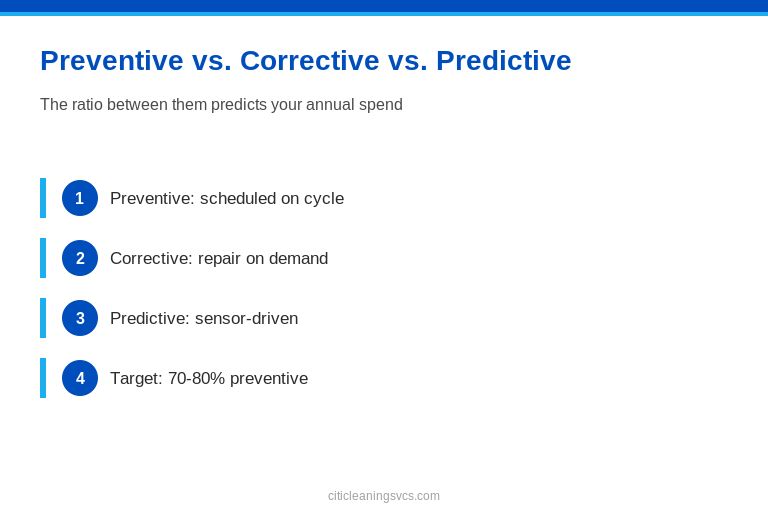
Scheduled work performed on a time or usage cycle: quarterly HVAC filter changes, annual strip-and-wax on VCT floors, weekly pressure-washing entryways, monthly emergency-lighting checks. The goal is to catch a problem before it becomes a work order.
Repair work generated by a fault: a broken door handle, a leaking faucet, a burned-out ballast. Corrective is unavoidable in any building — the goal is to minimize how much of your total work is corrective.
Data-driven work triggered by sensor readings or usage patterns: replacing a bearing when vibration exceeds a threshold, servicing a compressor when energy draw creeps up. Predictive requires monitoring and shows up mostly on larger commercial and industrial sites.
Facilities running 70 to 80% preventive, 20 to 25% corrective, and up to 10% predictive tend to spend the least per square foot per year. Facilities running under 50% preventive are almost always over-spending on emergencies.
Not every building needs the same scope. A 20,000-square-foot office building needs a different mix than a 200,000-square-foot warehouse or a multi-tenant medical office building.
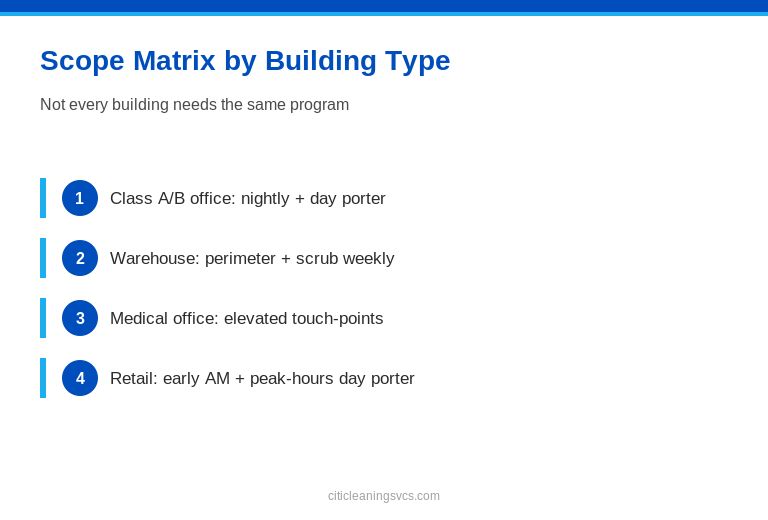
Nightly janitorial with day-porter coverage, VCT and carpet on quarterly cycles, restroom deep-clean monthly, preventive HVAC filter changes quarterly, exterior glass twice a year, minor repairs on a same-week SLA. Reporting cadence: monthly.
Perimeter cleaning nightly, dock-area pressure wash monthly, floor scrubbing (concrete or epoxy) weekly, restroom and breakroom deep-clean weekly, preventive checks on loading-dock equipment, high-bay lighting quarterly. Reporting cadence: bi-weekly given the volume.
Elevated restroom and touch-point disinfection cycles, common-area janitorial nightly, floor care aligned to tenant traffic patterns, HVAC and IAQ checks on a documented cadence. (Tenant-suite disinfection specific to clinical spaces is out of scope for commercial janitorial and belongs with a specialty vendor.)
Early-morning janitorial before opening, day porter through peak hours, restroom hourly touch-ups, exterior sidewalk sweep daily, quarterly deep-clean on floors and glass. Reporting cadence: weekly during peak season.
A blended scope with different task lists for the office footprint (nightly janitorial + quarterly floor care) and the warehouse footprint (weekly scrub + monthly pressure wash + high-bay lighting). One partner running both cuts hand-off issues at the interior door.
A qualified partner will pass the following checklist. If any answer is soft, ask for the underlying document.
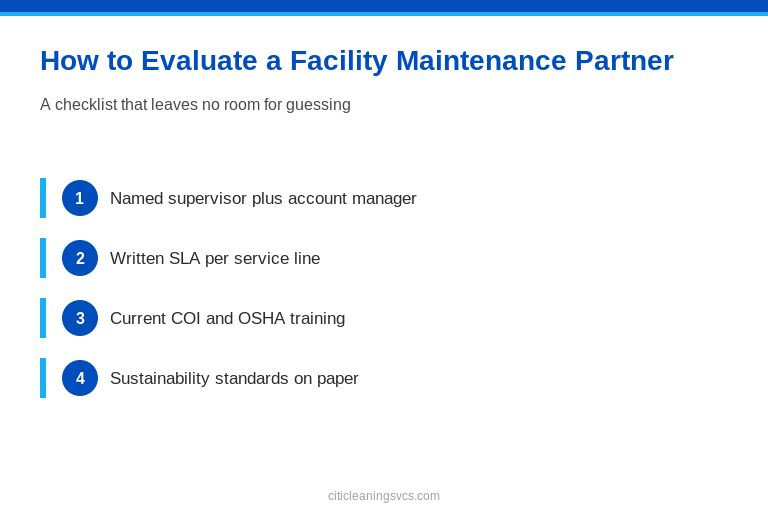
Citi Cleaning Services meets every item on that list. We are family-owned, M/WBE-certified, and have served Central Florida facility managers since 2004 with 70+ trained professionals, a 10+ year average client retention rate, OSHA-certified crews, Green Seal-aligned chemistry, and a contract-free monthly model that puts the burden on us to earn the business every month.
The honest answer: it depends. A 20,000-square-foot office running a light scope will cost a fraction of what a 200,000-square-foot mixed-use property runs. Rather than post a number that will not fit your building, here is the framework a qualified partner uses to build a rate.
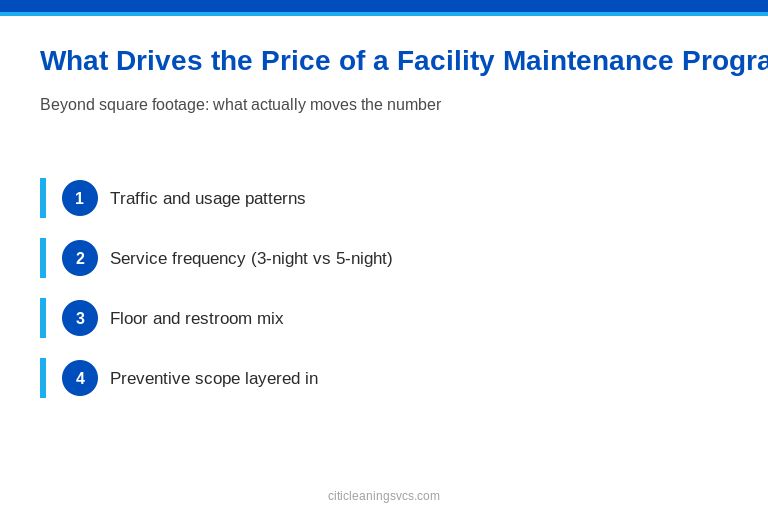
A qualified partner will show you the labor hours per shift, the supply cost per month, the periodic-work amortization (strip and wax, extraction, pressure wash), and the management overhead. If a vendor bids only a single monthly rate with no breakdown, you cannot audit the value.
See our commercial cleaning cost breakdown for the underlying math on labor, supplies, and periodic work.
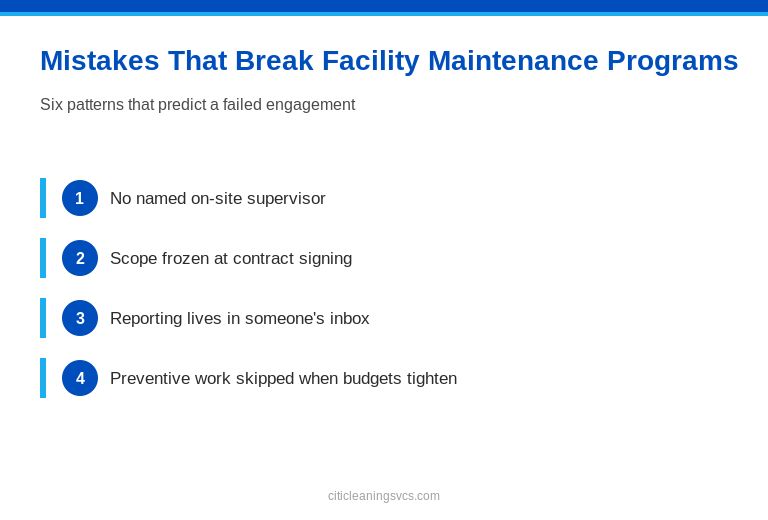
Even well-scoped programs fail when a handful of predictable mistakes creep in. Watch for these.
Facility management is the strategic function — budgets, capital planning, tenant experience, space planning. Facility maintenance is the operational execution layer that keeps the building running day-to-day. Most buildings need both; the maintenance layer is what an outsourced partner typically owns.
Quarterly at the tactical level (task-by-task) and annually at the strategic level (what to add, retire, or re-cycle). Buildings that never revisit the PM calendar drift into either over-servicing or under-servicing within 18 months.
One vendor can own janitorial, floor care, restroom management, preventive rounds, and minor repairs. Specialty mechanical trades (major HVAC repair, roofing, elevator maintenance, life-safety) belong with licensed specialty contractors — a good facility maintenance partner coordinates with them, does not replace them.
The base building scope (common areas, restrooms, exterior, mechanical) belongs to the property manager and gets bundled into CAM. In-suite work is either tenant-responsibility or an opt-in service the property manager brokers.
General liability at a minimum of $1M/$2M, workers’ comp per state law, auto liability if vehicles are used on site, and property damage coverage. Most commercial leases require the vendor to name the building and owner as additional insured.
Move from reactive to preventive on high-cost systems (HVAC, floors, roofing). Consolidate vendors to eliminate coordination overhead. Renegotiate on a corrected scope every 24 months. Track KPIs monthly so you know what you actually pay for.
A well-run cutover takes 21 to 30 days: 10 days of scope-and-contract, 10 days of onboarding and joint walk-through, and a first-week audit. Emergency transitions can compress to 7 to 10 days if the incumbent is in breach.
Complaint volume and complaint response time, preventive-work completion rate, corrective work-order backlog, supply cost per square foot, and safety incidents. Monthly reporting is standard; weekly reporting is common on larger sites.
Facility maintenance done right is one of the highest-ROI programs a building operator can run. Here is the sequence to get from where you are to a program that pays back inside 12 months.
Facility managers across Orange, Seminole, Lake, and Osceola counties who follow this sequence report 40 to 60% lower complaint volume and measurable savings on emergency spend inside the first year. Our homepage covers our full facility maintenance scope, and our what-is-facility-maintenance guide goes deeper on the operational side. See the Florida market overview for context on how the local partner landscape has evolved.
