
A commercial restroom cleaning checklist is only useful if it covers every surface, happens on the right cadence, and gets signed off by a human. This guide gives Central Florida facility managers a complete, printable commercial restroom cleaning checklist — daily tasks, weekly scrubs, monthly deep-cleans, inspection scoring, and ADA-compliance checks — plus a free PDF you can hand to a porter or vendor tomorrow morning.
You’ll see the exact daily task list a professional porter runs, the weekly and monthly tasks that stop a restroom from degrading, and an inspection scoring template that holds a vendor accountable with real numbers. Everything below is pulled from protocols Citi Cleaning Services has used across 20+ years, 70+ trained cleaning professionals, and OSHA-certified crews servicing office, warehouse, and distribution facilities across Orange, Seminole, Lake, and Osceola counties.
Let’s start with why a checklist beats a general scope every time.
- A documented commercial restroom cleaning checklist cuts tenant complaints by 60–80% compared to an unwritten scope.
- Daily, weekly, and monthly cadences each catch different soils — daily cleaning alone leaves urine salts, grout buildup, and drain biofilm untouched.
- Twelve daily tasks, five weekly tasks, five monthly tasks, and three quarterly tasks cover a compliant commercial restroom in full.
- ADA compliance adds four line items most generic checklists miss — stall clearances, grab bars, dispenser heights, floor traction.
- A 10-point inspection score turns subjective complaints into trackable vendor-accountability numbers.
- Supply par levels and time-of-day restock checks prevent 40% of restroom complaints that start with “the dispenser was empty.”
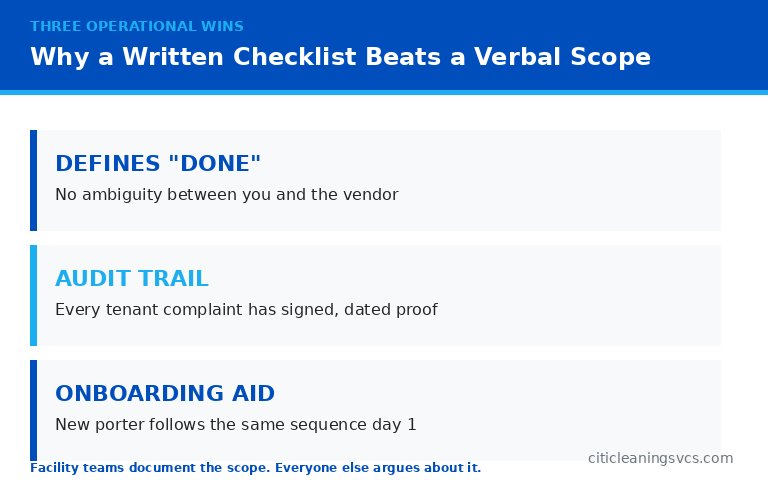
A written checklist does three things an unwritten scope cannot. It defines “done” so there is no ambiguity between you and the vendor. It creates an audit trail every time a tenant complaint hits your inbox. And it gives the porter a job aid when turnover happens — which it will.
Think about where restroom cleaning actually fails. A new porter joins the account and nobody shows them the exact sequence. The regular porter is out and the backup never saw the task list. A tenant complains about an overflowing bin and nobody can prove whether the bin was emptied yesterday. In every case, a written, signed, dated checklist is the fix.
Facility teams that run professional janitorial programs treat the checklist as a contractual deliverable. The porter signs each shift’s sheet. The site manager counter-signs weekly. The facility manager reviews monthly. That one habit prevents most of the vendor-performance conversations that otherwise consume an entire quarter.
If your current cleaning program runs on verbal expectations, writing it down is the fastest, cheapest quality upgrade available.
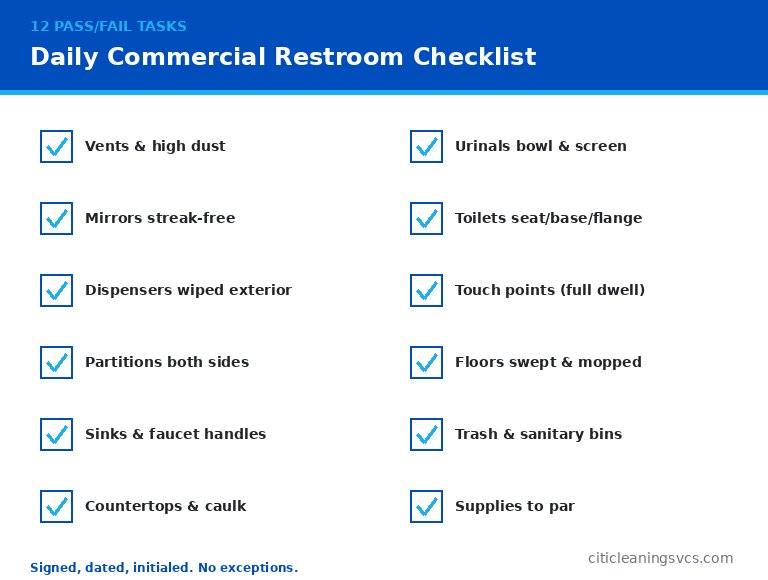
Twelve items run every day, every restroom, no exceptions. Each is a pass/fail observation — either the task was completed to spec or it was not. Hand this list to the porter and ask for an initialed, dated copy at the end of every shift.
Twelve items. Print it, laminate it, hand it to the porter. The checklist is also what you point to when a tenant complains — the signed, dated sheet shows exactly what was done and when.
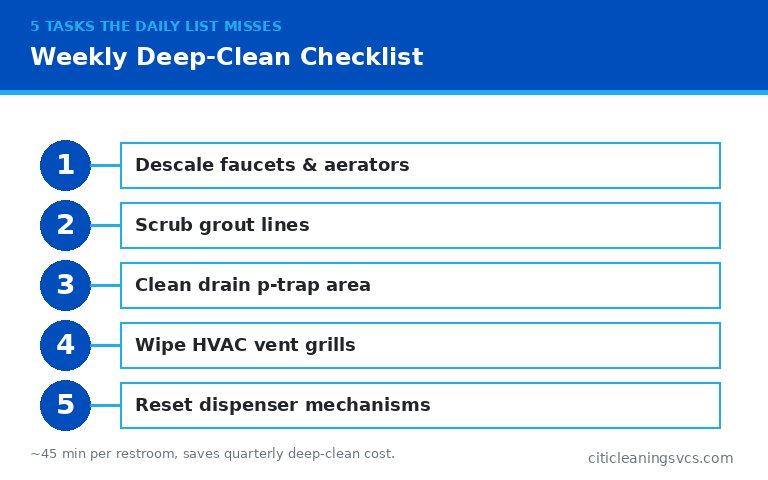
Daily cleaning keeps a restroom presentable. Weekly tasks keep it from degrading. These five items run on a schedule — same day each week, logged on the master calendar.
These five weekly tasks take a trained porter about 45 minutes per restroom. Skipping them accelerates the next full deep-clean from a quarterly cost into an annual rebuild — which is far more expensive than 45 minutes of consistent weekly work.
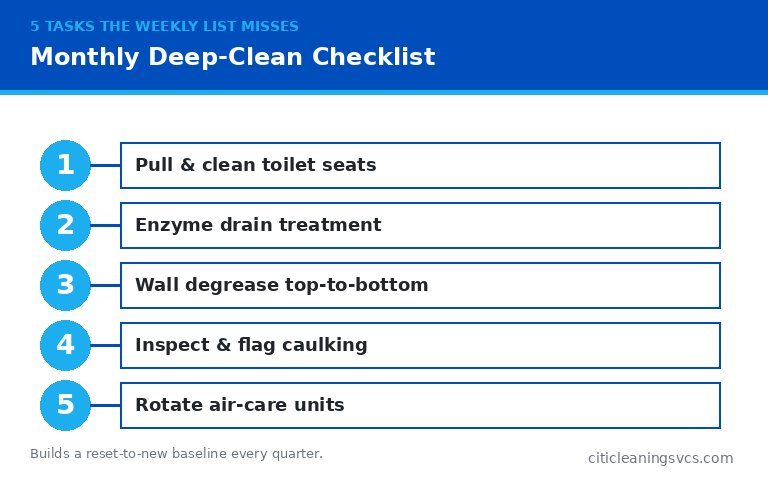
Monthly tasks reach soils and wear that weekly cleaning doesn’t fully address. Build these into the cleaning scope so they happen on a predictable date — not when someone finally notices the problem.
Our deeper breakdown of what commercial cleaning actually covers walks through where monthly tasks sit in a full facility scope, and the ISSA Cleaning Industry Management Standard documents the process rigor behind each cadence. These five items separate professional restroom care from the “wipe and mop” default most generic programs stop at.
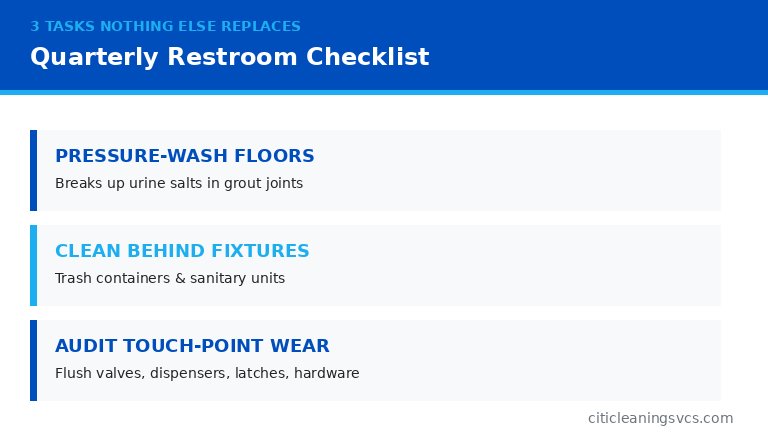
Three quarterly tasks that no daily, weekly, or monthly task fully replaces.
A restroom running daily, weekly, monthly, and quarterly cadences stays in the same condition in year three as it did on day one. A restroom on daily-only cleaning degrades slowly — and the eventual rebuild is expensive. Our overview of commercial floor cleaning methods and costs covers the pressure-wash side in more detail.
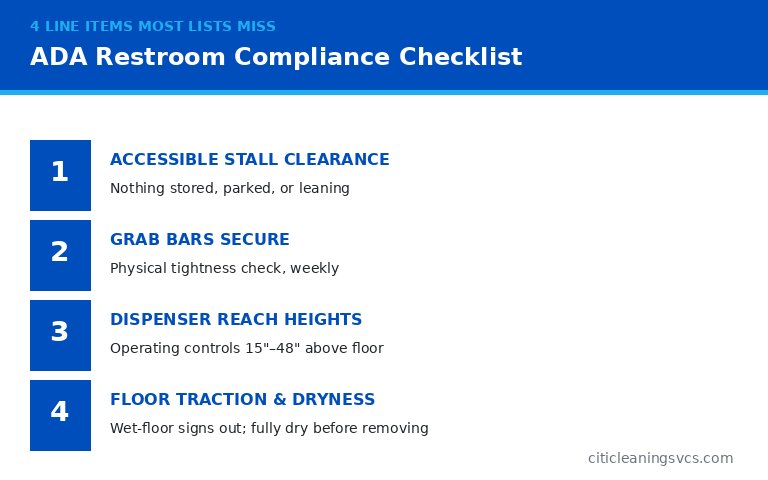
Four line items most generic restroom checklists miss — all of them ADA compliance issues the moment a visitor needs them. Check these weekly at minimum.
ADA is not a once-a-year compliance exercise. It is a weekly habit baked into the restroom cleaning program. The ADA Standards for Accessible Design publish the operating-control height ranges referenced above. The porter who checks grab bars at the same time they wipe them catches a loose fastener before a visitor does.
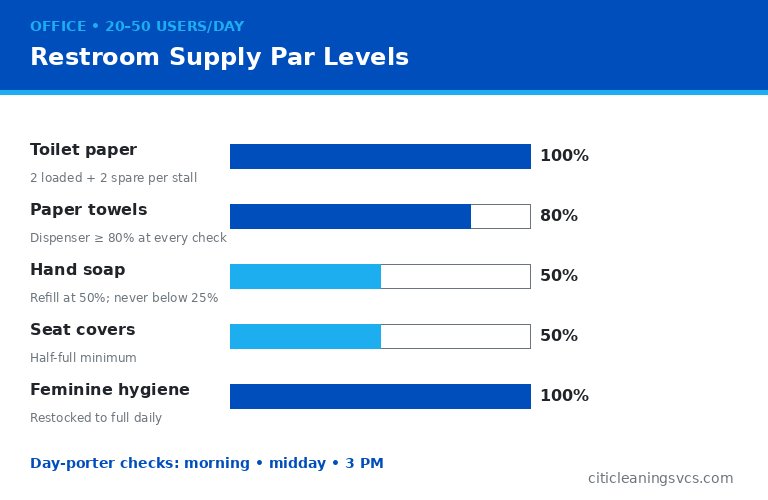
Empty dispensers generate roughly 40% of restroom complaints. Set par levels per fixture, define a time-of-day restock cadence, and the complaint rate drops hard.
A facility with 40+ restroom users per day runs a day-porter check three times — morning (open), midday (post-lunch), and 3 PM. Lower-traffic restrooms (under 20 users per day) need one mid-morning check. Our guide to day porter vs. night porter services walks through which model fits different facility types.
Build these par levels into the scope so there is no ambiguity about “stocked.” A dispenser at 15% capacity is not stocked.
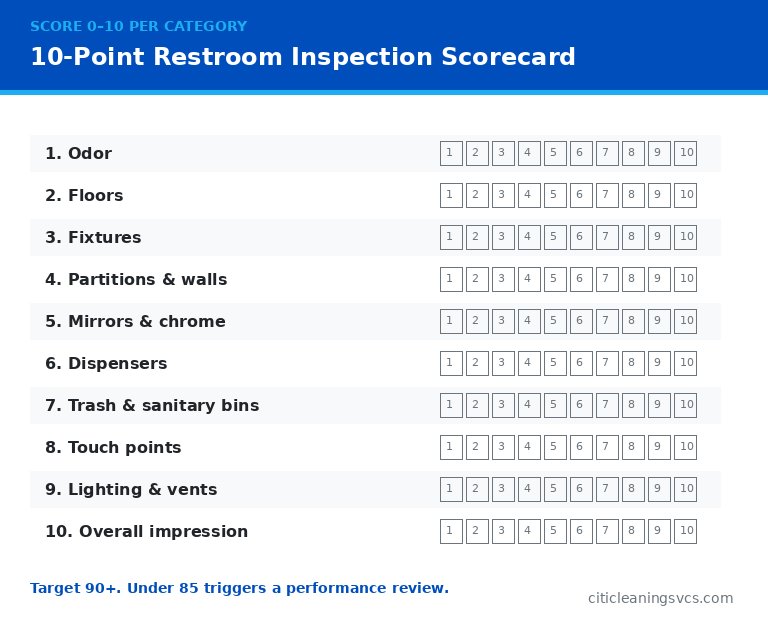
Subjective inspections (“looks fine”) don’t hold a vendor accountable. Score every walkthrough with the same 10 categories, zero to ten each. Total under 85 is a performance conversation. Over 90 earns the vendor the benefit of the doubt.
Review the trend monthly with the vendor. Scores backed by dates and initials are the only accountability tool that holds up in a disputed service review. Our broader framework for comparing commercial cleaning bids uses the same measurement discipline before you even sign.
A checklist is only as valuable as the accountability wrapped around it. Four moves turn this document into a working performance system.
This is the exact structure Citi uses with every commercial cleaning account we hold across Central Florida. Measured programs stay clean. Unmeasured programs regress.
Four mistakes we see when facility managers write their first checklist themselves.
Mistake 1: Combining cleaning and disinfection into one step. These are different tasks with different products and different dwell times. A checklist line that says “clean and disinfect toilet” without specifying dwell time is a line that will not actually disinfect anything.
Mistake 2: No cadence noted. “Clean mirrors” on a list without a daily/weekly/monthly tag means the porter decides when to do it. Decide for them. Our full guide to commercial tile and grout cleaning covers how cadence changes with soil type.
Mistake 3: Missing the touch-point line. General surfaces and touch points are different work. Call out touch points as their own step with their own disinfectant and dwell requirement.
Mistake 4: No signature requirement. Unsigned checklists are the same as no checklist. If the porter did not sign and date it, it did not happen.
Fix those four and your checklist moves from a document to a management system.
Yes. The daily, weekly, monthly, and quarterly tasks above combine into one printable checklist. Lay them out as a sheet with checkboxes, add a “porter initials” column and a “date” column, and hand it to the vendor. No proprietary tooling required.
Review the checklist itself every 90 days with your vendor. Review the signed, dated results every 30 days. Adjust tasks when a tenant pattern reveals a gap — new tenant mix, higher foot traffic, or seasonal usage shifts all justify adjusting cadence.
Daily tasks keep the restroom presentable to tenants. Weekly tasks reach soils that daily cleaning can’t fully address — grout buildup, drain biofilm, HVAC vent dust, dispenser interiors. Monthly and quarterly tasks reach soils weekly cleaning doesn’t address.
The core tasks are the same. Frequency changes with user volume. A warehouse restroom with 80+ shift workers per day may need two full cleanings a shift; an office restroom with 20 users may need one. Our take on warehouse cleaning services covers the operational differences.
Numbers remove ambiguity. “The restroom looks bad” is a conversation that goes nowhere; “the restroom scored 72 this week after averaging 91 the prior month” is a conversation with a specific root cause. Vendors who track their own numbers improve. Vendors who argue with the numbers are the problem.
The checklist defines “stocked to par.” Whether the vendor supplies the paper, soap, and liners (or the facility buys them separately) is a scope decision, but either way the par levels and restocking cadence belong in the checklist.
Harder, because the local franchisee’s priorities may not match the national brand’s standards. Our comparison of red flags your cleaning company is failing you covers the specific accountability gaps you’ll see with national chains versus an independent local vendor.
Yes. Citi runs the same checklist, same scoring system, same cadence on month-to-month arrangements as we do on long-term accounts. The vendor’s commitment to the standard is what matters, not the length of the contract.
A commercial restroom cleaning checklist is the fastest, lowest-cost performance upgrade a facility manager can make. The daily, weekly, monthly, and quarterly cadences all exist. The ADA line items exist. The inspection scoring exists. The one missing step in most restroom programs is documentation.
Here is the four-step action plan.
Citi Cleaning Services has been running this exact checklist structure for Central Florida facility managers since 2004 — family-owned, M/WBE-certified, 70+ trained cleaning professionals, 10+ year average client retention, OSHA-certified, Green-Seal-aligned, contract-free, 24/7. (407) 540-1850.
